
Can Louth's ambitious Active Travel programme actually be delivered?
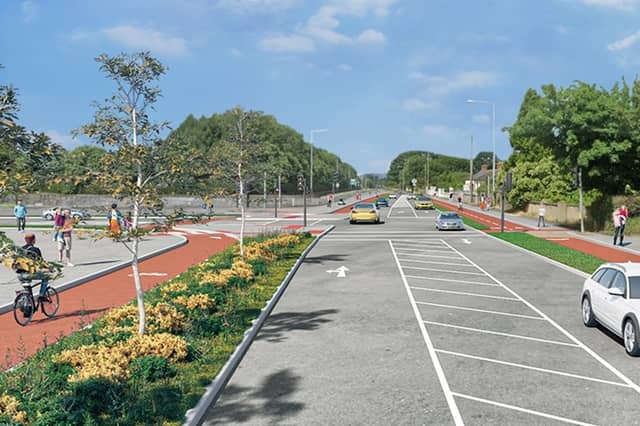

Louth County Council face challenges progressing plans to construction
Louth County Council’s Active Travel programme was designed to make the county safer, healthier and less car dependent.
In January, Minister for Transport, Darragh O’Brien announced a €360 million package for active travel and greenways.
Yet, in December last year, councillors were informed that the local authority’s Active Travel allocation from the National Transport Authority (NTA) would be decreased from €6 million to in the region of €4 million.
David Jones, Director of Major Capital Projects and Infrastructure Delivery with Louth County Council told members it would have to prioritise which projects get completed.
The programme notably includes major projects such as the Dundalk R132 Inner Relief Road and the Dublin Road from the Xerox Junction to Greengates.
However, internal documents obtained by the Dundalk Democrat through the Freedom of Information Act raise questions over whether the growing pipeline of projects in the county can realistically be delivered under the current funding model.
A meeting held between the local authority and the NTA on January 28th reportedly set out that funding from central government would be capped at €4 million for the next five years.
The documents show Louth County Council’s ambitious active travel portfolio includes 48 individual projects, with an estimated cost of approximately €130 million.
As a result, it is said that “14+ projects will need to be suspended, once they reach an appropriate milestone”.
The issue isn’t whether active travel is needed, but whether the current funding and delivery model can turn dozens of planned projects into tangible completions.
One project illustrates the scale of the challenge faced by Louth County Council.
The Dublin Road in Dundalk from the Xerox Junction to Greengates, while not immediately considered as one of the county’s largest infrastructure projects, documents released under FOI show that the project has grown into a multi-million euro project with an estimated cost of almost €14 million.
The three-kilometre project aims to increase pedestrian and cyclist trips by 20% while also reducing annual collision rates by 10% within five years. It extends beyond just improving cycling infrastructure, the project includes plans for junction changes, improved traffic management and drainage.
Concerns were raised by local councillors about the lack of funding allocated to the project with just €30,000 allocated for 2026. It follows a trend of dwindling funding across the two previous years. Louth Council re-ceived €160,000 in 2024, dropping to €135,000 in 2025.
Across three years, the project received just €325,000, a fraction of the estimated cost of close to €14 million.
Although the NTA confirmed it had allocated €600,000 in additional funding for the project in 2026.
The funding gap highlights the central problem facing the active travel programme in Louth.
If one project out of 48 requires more than three times the annual funding for the entire county, it raises the question about the viability of these projects and if money is being spent on ever-increasing design costs that may not begin construction for years.
Cost estimates from October 2024 show a 53% increase for Xerox to Greengates, going from just shy of €8 million to over €12 million excluding VAT (€13.93m including VAT).
Many active travel projects are designed to connect with other schemes. For example, Xerox to Greengates aims to link in with the R132 Inner Relief Road project, which itself saw its annual allocation cut from over €2.5 million in 2025 to just €800,000.
Louth County Council later con firmed that less than €60,000 of the 2025 allocation had been spent on the Inner Relief Road. Internal documents lay some of the blame at the door of the design team.
“Due to non-performance of DT [De-sign Team] throughout the year, the financial spend for 2025 is affected,” one document states.
David Jones, Director of Major Capital Projects and Infrastructure Delivery informed councillors in March that all of the unspent funding is forfeited at the end of the calendar year.
“[Funding is] allocated in January, and if you spend it over the course of the year, you spend it, if you don't, you don't. It doesn't roll into subsequent years," he said.
When asked if Louth County Council had too many projects to feasibly deliver, Green Party councillor Marianne Butler told the Dundalk Democrat that the problem lies with central government.
“Like many councillors, I am aware that delivery depends heavily on National Transport Authority funding and that projects will have to be phased over a number of years.
The issue is not that there are too many worthwhile projects, but that this government has lacked sufficient ambition in funding the infrastructure needed to give people real transport choices.
“It's important to recognise that having a substantial pipeline of Active Travel projects is a positive thing. These projects represent identified local needs and a long term vision for creating safer and healthier communities.
They are not simply more cycle lanes, they are also road safety, accessibility and public realm projects that modernise infrastructure which, in many cases, is no longer fit for purpose.
“For example, there is widespread frustration with the Avenue Road roundabout in Dundalk, and projects such as the R132 Inner Relief Road are about making our streets safer and more accessible for everyone, whether they are walking, cycling, using public transport or driving,” she said.
Independent councillor Ciarán Fisher, while in favour of the programme, highlighted practical problems with the scheme.

“The reality of these plans have yet to touch Dundalk in a drastic way.
“The particular bug-bear I have with Active Travel at the moment is that once an area is chosen as an area of interest for Active Travel, it pauses any and all investment in that area for things like; road improvements, bus shelters, pedestrian crossings or lights,” he said.
Cllr Fisher said Louth County Council is reluctant to carry out routine works in areas that have been earmarked for active travel.
His comments come in relation to a Senior Engineer in Louth County Council telling councillors the local authority was wary about installing new traffic lights on the Inner Relief Road to address safety concerns.
The engineer told a Dundalk Municipal District meeting earlier this year that it “won’t be a good look” if new improvements were “ripped out” due to active travel works.
Cllr Fisher said: “The logic behind this being that if they are going to spend millions on a patch, hopefully with large funding from central government, it makes sense to hold off spending limited council funding doing a job that could get funding from the government.
“There is also the danger that a short term intervention might have to be dug up, ripped down, replaced, when the new works are done, which is seen as a waste of money.
“One frustration in particular being, as of yet, Dundalk and Louth have not yet had an Active Travel plan delivered.
“The problem I have is that it also completely blocks necessary short term interventions that the public and councillors can see as needed. All because of the potential of a bigger plan coming down the line.
“There are some 20+ Active Travel plans for Dundalk. At best, one or two might be delivered a year. This means that if a location chosen for active travel plans, like say Mill Street, are crying out for a traffic calming measure, a crossing or other intervention: that could be kicked down the road for years.
“It's infuriating. A solution needs to be found. A happy medium that will allow for interventions that are needed now to be carried out, and then married into a bigger undertaking when, if they happen down the line.
“Applying the same standards and design used in active travel plans elsewhere, pedestrian crossings, patches of cycle ways, traffic calming measures can be installed and seamlessly blend into a bigger project at a later stage.
“Our council needs to lobby for funding to do this, and if it's done right, short term intervention could lessen the cost of the active travel completion cost, improve safety at problem areas quicker and get much more public and councillor buy-in,” he said.
Responding to queries from the Dundalk Democrat, David Jones, Director of Major Capital Projects and Infrastructure Delivery with Louth County Council said there are currently 13 Active Travel Schemes across Dundalk and Drogheda which are at “various stages in the project life cycle”.
Mr Jones said Louth does have an ambitious Active Travel Programme which he said is “reflective of the location of two significant urban settlements”, Dundalk and Drogheda.
He said Louth County Council’s plans aim to ensure the network is connected and not “piece-meal and disjointed”.
“It was always accepted by the Council that it would take some time to achieve a fully connected cycling infrastructure but equally we believed that it was important that we planned for the same and bring forward a suite of projects that will achieve that goal in the medium to long term,” he said.
Mr Jones added that there are “complexities faced when retrofitting into an existing urban footprint such as Drogheda and Dundalk”.
“As a result, careful design, consultation, and planning is required, which takes time,in order to ultimately achieve successful delivery and outcomes,” he said.
However,he confirmed that as of yet, no projects have reached the construction stage.
Louth County Council’s adopted budget and its three year Capital Programme for 2026 to 2028 shows the level of ambition within the local authority; this cannot be disputed.
The budget highlights two key projects that the local authority hopes to complete by the end of 2028. The Dundalk Pathfinder on the Inner Relief Road as well as the Drogheda Pathfinder at Rathmullen and Marley’s Lane. The project estimates sit at €14.3 and €11.3 million respectively.
However, the document makes clear that these projects are at the discretion of the NTA and its funding allocations.
It’s an important caveat, it shows that despite the ambitious plans, the pace at which Louth County Council can operate is at the mercy of government funding, risking long delays before shovels enter the ground.
David Jones said the Council’s delivery is dependent on funding from the NTA and also confirmed the Department of Transport has “acknowledged that the number of projects being progressed nationally now exceeds the level of funding made available annually to the NTA “.
Therefore,he said projects have to be prioritised to remain within the allocated budget,and confirmed the Council are prioritising the Xerox Junction and Marley’s Lane in Drogheda with the view to begin construction in the next 12 months.
There are real-world consequences for such delays. When an area, road or junction is earmarked as future active travel schemes, minor works are put on the back burner on the basis they will be complete as part of the overall scheme.
This very problem came to a head in relation to Sexton’s Junction in Dundalk. Labelled an “accident blackspot” by Dundalk councillors,it sits between Marlbog and Seafield Road.
.jpeg?trim=0,43,0,42&crop=&width=640&quality=65)
It had been planned that safety concerns at the junction were to be addressed as part of the wider Xerox to Greengates active travel programme. However,councillors were told it would be late 2027 before the works would be completed at the junction.
Specific provisions are made in the Capital Programme for Sexton’s Junction. However, the document suggests that the €1.2 million project will not be completed until 2029. As a result, frustrations have started to flare.
Fianna Fáil councillor Shane McGuinness launched a passionate plea for Louth County Council to carry out the works sooner rather than later at the June Dundalk MD meeting.
“I know we can sit here and say everything’s in place and everything’s going to happen but there’s nothing happening.
“There was a child hit last week at Sexton’s Junction, there was a man hit the week before at Sexton’s Junction.
There’s been up to 16 serious accidents at Sexton’sJunction since January and we haven’t done anything about it.
“People in that area are blaming us councillors and blaming the county council.
“We can try and dance around it all we want, we’re not doing enough. I was elected to represent the people and we’re not doing enough,” he said.
A spokesperson for the NTA confirmed it has committed to funding €800,000 in 2027 to deliver“the Active Travel elements of Sexton’s Junction” and said “the remaining elements of this 3.2 km Active Travel scheme shall follow on from the Junction upgrade”.
Sexton’s Junction is just one of a number of issues facing Louth County Council’s active travel programme.
There is no shortage of ambition, Louth County Council holds a portfolio of 48 individual projects. Many of these projects aim to address real local concerns around road safety and accessibility.
Although the FOI documents suggest that that same ambition has outgrown the current delivery and funding model. Despite nearly 50 projects and an estimated cost of €130 million, only a small number are specifically mentioned in the local authority’s three year Capital Programme.
It means many of these schemes are being designed, planned and put before local representatives for Part 8 planning approval before being suspended or paused.
Mr Jones said having a number of projects progressed to planning stage puts the local authority in a“strong position to avail of funding as and when it becomes available” and means it has a “suite of shovel ready projects”.
However, he acknowledged that there is a “risk” that if too much time passes post design then further work would be required for a project to meet new“standards and design guidelines”.
Mr Jones said he does believe that the current system is capable of delivery and there will be evidence of that in the short term. He said he expects certain projects to reach construction in the near future.
Although he said there are challenges to delivery,“most notably the extent of available funding going forward for the capital stage of the projects”and said the current scale of delivery is“taking longer than had previously been anticipated”.
In response to queries raised in this article, a spokesperson for the NTA acknowledged that there is a “significant pipeline of active travel schemes” in Louth,and confirmed that funding will remain at €4 million through to 2030.
They added that there is “little scope to increase this annual allocation”.
The NTA said significant construction inflation over the last three years has led to a “widening gap between project costs and the funding available from the Government to deliver them”.
“This has resulted in Louth County Council having to alter their initial project delivery timelines and prioritise certain projects to match the current allocated funding.
“This adjustment involves Louth making the decision to pause certain projects,so that committed contracts and priority schemes can go ahead in line with the capital funding profile that has been advised of for the period up to 2030,” the spokesperson said.
On the issue of smaller interim safety measures, the NTA said it works with local authorities to “identify any potential opportunities to introduce some smaller safety measures such as crossings and traffic calming measures”.
However,they said at times that will not be possible due to factors such as cost and available funding.
The response from the NTA and Louth County Council show that there is no shortage of planning and ambition. Louth has a substantial pipeline of schemes, many of which are progressing to planning with the view to commence construction.
But both acknowledge the central problem. The number of projects now exceeds available funding, with the county set to receive €4 million annually until 2030. As a result, Louth County Council are forced to prioritise which projects proceed.
While it’s important for Council officials and councillors to remain focused on future schemes, government funding and long-term strategy, there is a danger that local residents perceive an absence of action.
For those people living beside dangerous junctions and hoping for safer crossings or traffic calming measures,an Active Travel project in the pipeline does not equal tangible progress and can feel like their concerns are being kicked down the road.
Funded by the News Reporting Scheme