
Congolese community in Dundalk celebrate independence day

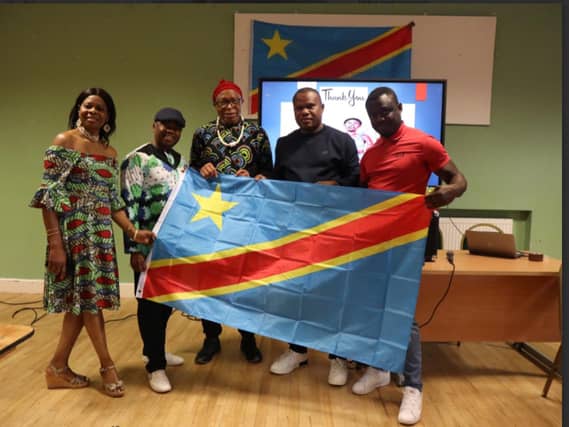

The Chairman Apo Ndendani presented a short history of the Congo
The Congolese Community in Dundalk celebrated their independence anniversary recently
The event was hosted by Congolese people living in Dundalk and Louth in collaboration with the Culture Connect organisation that is operating in the Louth region.
The event took place at Geraldine’s Hall in Haggardstown on Saturday 29th June.
Apo Ndendani aka Dan, the Chairman of the Congolese community, made a presentation on the Democratic Republic of Congo.
The audience consisted of a mixture of members of different African countries, Irish citizens and other nationalities, including Eastern Europeans.
The Chairman Apo Ndendani presented a short history of Congo from the Congo empire to the colonial past.
The history of independence was especially marked, including the role of Patrice Emery Lumumba, who is considered by many in the Congo as the father of independence, who was later killed by Belgian colonialists with the support of some natives.
The guests were captivated by his rise from a simple beginning to the first prime minister.
It was a great eye opener for many that Congo has for centuries been a source of industrial development starting from rubber which was the major raw material for tyres in the 19th century, to the present day were a lot of modern development has profited from immense raw materials including cobalt for electric cars and coltan for mobile phone, at the cost of many Congolese lives.
People also were surprised to learn that in 1945, the atomic weapons dropped on Hiroshima and Nagasaki were developed using uranium from a mine in the Congo.
Those present also suggested that this information should not only be repeated but extended to a greater public. Some of them promised to contribute to the planning of a bigger event in order to have an in-depth knowledge of the matter discussed.
The members of the Congolese community, as well as Africans and Irish people, recognised that Irish history has a connection to the Congo, where Irish lives were lost in the UN mission in Katanga in 1960.