
Jim's nine year quest brings Dundalk cemetery burial records online

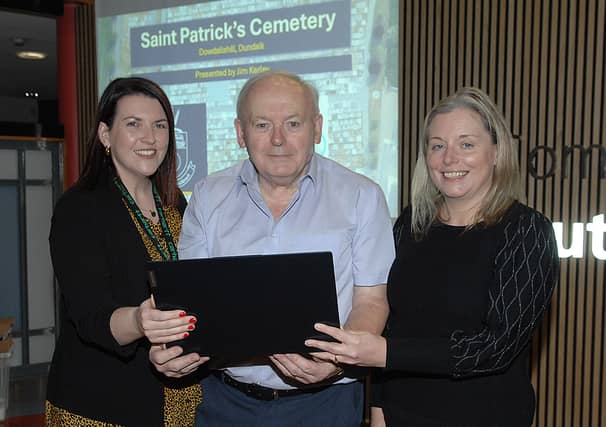

Launch of searchable database of burials for St Patrick’s Cemetery in Dowdallshill
After almost nine years of work, led by one man, which included searching through sources including birth records, marriage records, census forms, photographs, and gravedigger daily diaries, a massive project finally came to fruition last Thursday night, with the official launch at the County Hall in Dundalk of a free, searchable database of burials for St Patrick’s Cemetery in Dowdallshill, Dundalk.
Jim Kerley, a committee member of the Old Dundalk Society, was behind the mammoth project, and spoke to the Dundalk Democrat ahead of the launch.
A retired fireman in Dundalk Fire Station, Jim explained that he is also very interested in family trees and was often in St Patrick's Cemetery looking at gravestones and so on, but often found that headstones were worn away. Recognising the importance of retaining the information, he did some work and found that the burial records still existed,
“I went back to the [Old Dundalk Society ] committee and said, 'we need to do something about this to preserve the records and record them, and they said, that's a great idea, you go and do something about it!' And that was about eight years ago, close to nine.” The results of the project can now be found at the website, https://arcg.is/1bmPy41.
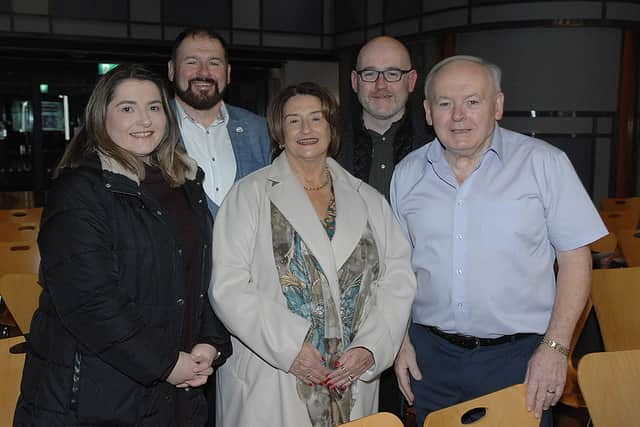
Above: Jim Kerley with his wife Jacinta, daughter Aoife, and sons Niall and Lorcan at the launch night
St Patrick's Cemetery at Dowdallshill is the burial place of around 23,000 former residents of Dundalk and surrounding areas. The graveyard, which opened on Good Friday in 1895, contains over 11,000 graves. The information available on the website in relation to those buried at the graveyard, is made all the more remarkable when the amount of work that went into compiling it is explained.
Jim explains a little bit about how to use the site and what information is available. “In my case, if you punch in the surname Kerley, it will show up 11 graves in the graveyard with dots. Click on any one of them, it will tell you who all is in the grave. It will give you all the information, the date they died, the date they were buried, whether they were married, single, where they lived, right across the board. Any information we have in the books.
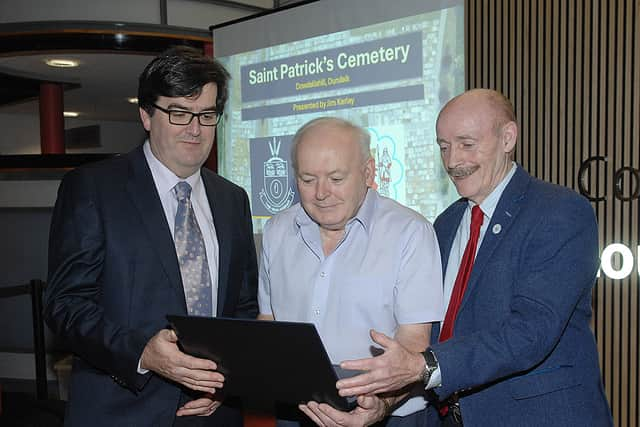
Above: Jim Kerley with Enda Finn DKIT and Micheal Gosling, President of the Old Dundalk Society browsing through the digital register
“When you're looking down the information, say you pick Kerley and you go into one of the big graves, it's showing James Kerley, but then it will tell you how many people are in the grave. So if it says, say ten in that grave but you can only see six Kerleys, that means there's four people of different surnames in it, such as the daughter or a sister, things like this.

Above: Willie Walsh Snr Executive Officer and David Jones Director of Services, Louth Co Council at the launch
Once it was recognised that the body of work needed to get the database compiled was so immense, Jim contacted Louth Volunteers, who would transcribe the the records. “So I would send two photographs and one page of the records to the volunteer and I would send them an excel sheet as well and they'd fill it in”, he explained.
“They would fill out whatever they could make out, if they weren't sure they highlighted it in one colour, if they couldn't make it out they left it blank and so on. They'd send that back to us and then we'd cross reference it with either the grave number, other people that was gone into it, we'd look at the obituaries in the Dundalk Democrat, you would cross reference it in any way possible.”
Through meticulous referencing and cross referencing, Jim and the team finally got the data compiled. “When we got the queries, at one stage I had 790, there were people who were outstanding, we know they died but their graves weren't matching. I'm now down to around 123 and of those we know we'll get more, there's one or two we won't.”
Getting the information into a database and onto a website was the next task. Jim's next port of call was to DkIT (Dundalk Institute of Technology), where he was introduced to Dr Brendan Ryder, Head of Department of Visual and Human-Centered Computing, and Dermot Logue and Enda Finn, of Department of Computing Science and Mathematics.
Seeing the potential for the project, Jim was given the go ahead to pitch the idea to students to develop the idea as their final year project. Fourth year students Kieron Peters, Vitaliy Vasyltsiv, AbdulFatai Saliu and David Asare signed up to develop the website, database and Android App. Jim was happy to share the news that the work on the project helped six people get their degree at DkIT.
The truly remarkable body of work carried out by Jim and those who assisted him can be seen and tried out at https://arcg.is/1bmPy41 where it is hosted by Louth County Council.
Unlike the students at DkIT, Jim says he never got a degree, but laughingly adds “I might get one of those complimentary ones now”. Leading such an astounding body of work and the unique knowledge he has picked up in the process, one can only imagine that if anyone deserves an honorary doctorate as a result of this, Jim certainly does.