
Louth Motors: Citroën ë-Berlingo-Deliveries are going to be electric
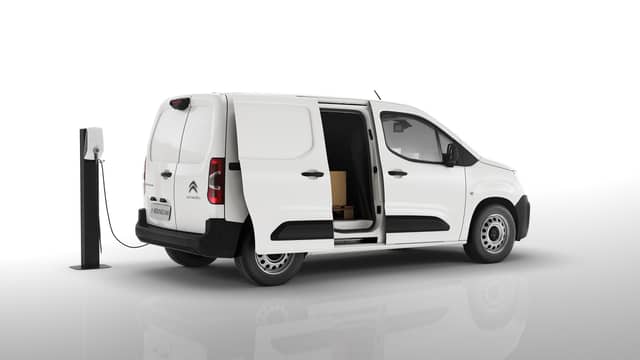

The pressure / incentive / encouragement on motorists to go electric isn’t confined to private motorists.
Following Covid19 and the explosion of home deliveries you must have noticed the number of electric vans being used by our favourite online “river” company.
Companies that transport goods need to be seen by their customers as being on-board with electricity or there is a perceived level of brand damage.
It’s all for the greater good but those same green/carbon aware customers who expect something to be delivered for free that sometimes only costs €5 can’t really be as aware of the whole-of-transport cost of the goods they order.
Especially if it has to be returned and that costs nothing – at least to the customer.
There are electric vans of all shapes and sizes now from the big Luton class to the “Transit” class and in this case the courier class.
If there is a delivery that needs to be made the commercial van sector has stepped up and delivered solutions for commercial customers.
The ë-Berlingo proposition here comes in three trim levels, all have a claimed range of 275kms from the 50kW battery and can carry up to 800kgs.
There are two wheelbase sizes but the range and load remains the same.
Range is always a worry for buyers but the way vans are used with multiple short route runs lend themselves perfectly to being electric.
In town there are no emissions and depending on your working arrangement you can recharge to 80% battery in just 30 mins – that’s lunchbreak territory.
Nearly all our post in urban settings is delivered via electric vans so you can see how viable they are when you consider the use a postvan gets.
Anyone who has not considered a commercial van for their application should seriously consider how applicable they are and I am sure in most cases they would suit perfectly.
My van had a single side door and two rear doors. The loading bay is very easy to access from the back with just a bit of an encroachment by the passenger seat and bulkhead into the load compartment that would have best been avoided for unhindered access.
Vans are nothing if not extremely versatile and the ability to extend the loading area by using what is effectively a big ski-hatch at the back of the front passenger’s seat is a clear demonstration of this.
I can see ladders, plastic pile and electrical conduit being transported securely this way that may eliminate the need for a roof rack with its additional wind drag / battery use issues.
Citroën are so proud of this that they brand registered it and called it Extenso.
I commenced my driving experience all those years ago in vans and I have never lost the love of driving one.
Apart from the practicalities they offer, the driving experience is tremendous.
We got the elevated and commanding view experience well before private motorists in their crossovers who adopted it to their hearts immediately – secret blown.
I love the flat sided shape of the vans with huge mirrors so that you always know where the vehicle is when manoeuvring it in all those tight and awkward spaces you need to go in a van.
Nowadays, the cabin is well kitted out with all the expected driving and comfort aids.
However, the car companies never miss an opportunity to earn a few more bob with the base model not coming with reversing sensors or a rear-view camera.
They know all buyers will specify these as they are crucial to van use yet you need to go to the next specification level to get them and indeed you need to go to the top spec to get front sensors.
All this in van that has Apple and Android as standard? And to get the rear sensors and camera it is “only” an extra €520 and it gets a trim level name. Bizarre.
What’s not bizarre is the driving experience. It is very car like and very comfortable.
Side panel resonance can be a concern in a van but in this case, I used it entirely empty, there was none of it.
Road noise levels are low and the ambiance for a van was very nice.
The electric driving experience is like a car but if you have drivers that like fast acceleration then the penalty will be additional charging stops and associated downtime.
Fleet managers will spot this immediately and I’m sure a word will be had.
But in an urban environment where speeds are low from traffic you learn very soon how to conserve the battery and it becomes the main focus when driving and it has to be said rewarding.
Prices start at €37,620 rising to €38,790 for the top spec model. The like for like price differential between it and the diesel model is €11,625.
Fleet managers and brand image consultants will be busy calculating the payback in terms of money and customer feedback carefully but, and it’s my prediction, that short, urban deliveries will all be by electric vehicles very soon.