
Second quarter sees new rents rise in Louth

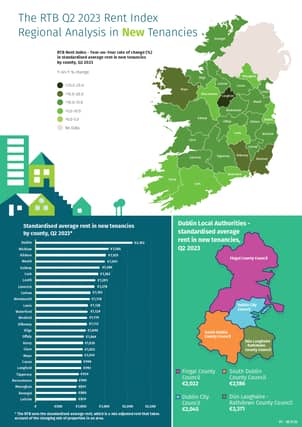

The average monthly rent in new tenancies in Louth has now risen to €1,295, year on year, according to the Residential Tenancies Board (RTB) which has today published the Q2 2023 Rent Index report for the period of April to June 2023.
The figure represents a 4.4% increase compared with the average monthly rent in new tenancies in Louth in quarter 1 of 2023.
It’s also a 14.4% increase on the figure for the 2nd quarter of 2022.
Broken down by area the report shows that the average monthly rent in new tenancies in Dundalk Carlingford was €1,228 and was €1,428 in the Dundalk South Area.
The figure for Drogheda Urban was €1,351.
The report also detailed the standardised average rent for existing renters in Louth which was €1,131 in quarter 2 of 2023, a decrease of 0,2% compared with figures from Q1, but an increase of 4.1% year on year.
Again broken down by area the report shows the average rents for existing tenancies which was €1,064 in Dundalk-Carlingford; €1,160 in Dundalk South; €1084 in Ardee; €1,253 in Drogheda Rural and €1,149 in Drogheda Urban.
The national standardised average rent in new tenancies was €1,574 in Q2 2023, which is an increase of 11.6% annually the largest since the report began in 2007.
This Index analysed 10,673 new tenancy registrations in Q2 2023.
Among the reports main finding was the fact that Louth was one of nineteen counties have standardised average rents in new tenancies above €1,000 per month in Q2 2023: along with Carlow, Clare, Cork, Dublin, Galway, Kerry, Kildare, Kilkenny, Laois, Limerick, Mayo, Meath, Offaly, Sligo, Waterford, Westmeath, Wexford and Wicklow.
It also found that in percentage terms, the smallest difference between new and existing tenancy rents in Q2 2023 was found in Louth where new tenancy rents were 14.5 per cent (or €164 per month) more than existing tenancy rents.
The purpose of the Rent Index is to measure rental price developments faced by those taking up new tenancies in the private rental sector.
Q2 2023 Rent Index Report includes, for the first-time, information on rent levels in existing tenancies, as well as new tenancies: Using newly collected data from annual tenancy renewals with the RTB.
insights are now available into the rents paid by sitting tenants.
Independently analysed by the Economic and Social Research Institute (ESRI), the RTB Rent Index report is based on the total number of private tenancies newly registered with the RTB each quarter. The Rent Index provides rental indicators based on actual rents paid for new tenancies in the private rental sector in Ireland.
The Rent Index report is based on (i) new tenancies in existing rental properties, (ii) new properties being let for the first time, and (iii) new tenancies in properties that have not been let in the previous two years. It is not designed to provide a measure of the rents being paid by existing tenants. The term “new tenancies” refers to a new rental agreement between a landlord and tenant.
Speaking on the publication of the report, Director of the RTB, Niall Byrne commented:
“The production of an index that can track rent developments in all rents across the private rental sector is a major step forward. Information is now available for sitting tenants which was not available in the previous Rent Index Reports.
“The RTB, in conjunction with the ESRI, is committed to publishing, and further developing, the new tenancy and existing tenancy rent indices. Over time, these indices will provide strong evidence and deeper insights into the private rental sector for the benefit of policymakers and the public.”