
8 simple tips to help children who are scared of medical appointments


Child psychologist Professor Sam Wass gives advice on how to beat kids’ fear of visiting the dentist, doctor and optician.
Many children are frightened of medical appointments, but this stems from a very basic concern we all share – fear of the unknown.
When parents take young children for their first doctor’s, dentist’s or optician’s appointment, what they may not have considered is that their child has absolutely no idea what’s in store for them, from what the waiting room looks like, to what they’ll be asked to do, what will be done to them and, crucially, whether it will hurt.
Recent research by Specsavers suggests more than a quarter of young children (26%) don’t like medical or health appointments, and child development expert Professor Sam Wass – the on-screen scientist in Channel 4’s The Secret Life of 4- and 5-Year-Olds – tells the Press Association: “It’s completely normal for children to feel nervous about healthcare appointments, especially when they’re doing something for the first time.

“Everybody’s frightened of the unknown, and don’t like not feeling in control. But the really big thing with children is that, for them, the unknown is much greater.”
He points out that even if adults haven’t been to an eye test before, for example, they can imagine what it’ll be like because they’ll have done similar things in the past. “So we can use that to imagine what the waiting room and the sensory experience is going to be like, what we’re going to be asked to do, and that type of thing,” he says.
“But children’s understanding is much less, so they’ll use their imaginations to fill it in, which doesn’t necessarily take them to where they want to go.”
In addition, it’s not the child’s decision to go to a medical appointment, which adds to their lack of control.
“It’s a much more unpredictable, uncontrollable experience for the child,” Wass stresses.
But there are things you can do to make medical appointments less scary for children, and here are Wass’s tips…
1. Rehearse before you go
As a young child will probably have no experience of whichever medical appointment they’re attending, Wass says it’s a good idea to rehearse the scenario first by playing optician/doctor/dentist, taking turns in the chair, etc.
“It’s about rehearsing it before you go,” explains Wass. “So partly what are they going to be asked to do, but also what’s the room going to feel like, what’s the sensory environment going to feel like, and even how the lights are going to be different.”
2. Give them choices
Not feeling in control can make both children and adults anxious, says Wass, so it’s a good idea to let children choose some of the things that will happen during the appointment, even if very minor.
“Although the child doesn’t have a choice about whether to go to the appointment or not, they do have a choice about the minor details,” says Wass. “So which chair they’re going to sit in, if there’s a toy they want to take with them, whether they want to hold your hand, and that type of stuff.
“That can really make it into something the child feels like they have a choice over, even though it’s [one] about the minor details rather than the major ones.”
3. Think about the waiting room
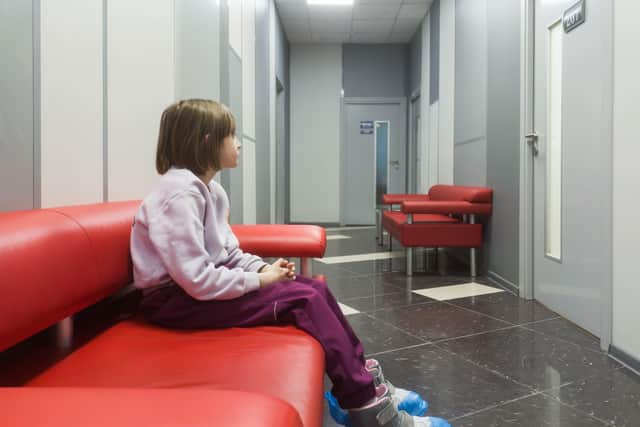
Even being in the waiting area can be hard for children, with the bright lights and strangers, and not knowing how long they’ll be there.
Wass says it can help to arrive close to the appointment time rather than early, and make sure your child knows what time it is, and how long they’ll have to wait.
“The waiting room is a particularly out-of-control period where, as an adult, you’re watching the clock and you know roughly what’s going to happen. But you need to communicate that to the child, let them know what’s happening,” Wass advises.

4. Use distraction
Studies have shown distraction is a good technique to use during children’s medical procedures, and Wass says it works best with a goal attached.
He suggests: “Give them a job before their anxiety starts rather than after, and make it specific enough to have an answer.
“Think about simple concrete tasks, building on stuff that’s interesting to the child but interactive – count how many animals they can spot, that type of thing.”
He says parents also need to be aware of what their child’s thinking about, so they’re ready to start distracting them when – or ideally, before – it’s needed.
5. Tell them what it will feel like, not just what will happen
Wass says many parents describe the sequence of events and stop there, but children want to know if it’ll hurt, will they feel scared, and how can they stay calm.
“They want to know what am I going to be asked to do, what’s the room and the sensory environment going to feel like? Tell them the chin rest is cool, the room goes dim etc – it prevents an unexpected sensation turning a manageable moment into a frightening one.”
6. Don’t reassure children too much
It’s natural for parents to tell anxious children not to worry and that things are going to be alright, but Wass warns that too much reassurance can backfire, as it makes children feel there really must be something to worry about.
He says research suggests too much reassurance can be counterproductive, and explains: “The child can interpret these signals from the adult who’s giving a lot of reassurance in the opposite way to that which is being intended, as a sign there’s something they need reassurance about.
“So don’t do a lot of reassurance like ‘It’s going to be fine’. Just focus more on describing what the experience will be like, and when you’re waiting, just be very calm and relaxed.”
7. Time the preparation to the child
More warning isn’t always better, says Wass. Very young children will probably forget if you tell them about an appointment a week before, so he says telling preschoolers the day before or on the morning of the appointment is usually fine, while older children should be given a bit more notice.

8. Use the appointment as a learning experience
Depending on the age of the child, Wass says telling them everyone goes to the dentist and doctor and has eye tests, and explaining what you know about eyes, teeth etc can interest children and help reduce anxiety.
He says: “Engage with them as rational, sensible beings, and let them know what’s happening, that the tests are very minor, and it’s very likely there won’t be a problem. There’s some really interesting and important learning to be done from this that will probably help long-term and will certainly help to reduce anxiety in the short-term.”
Specsavers has partnered with Professor Sam Wass to help alleviate children’s appointment anxieties and encourage more eye tests in young children through the new No Scaries in Sight initiative featuring a free, interactive online activity, fronted by friendly Optomonsters.