
Heidi Klum and Jaden Smith sit front row for Vivienne Westwood Paris show


Actress Natasha Lyonne walked the runway as Andreas Kronthaler filled his SS27 collection with corsets, leopard print and gender-bending looks.
Heidi Klum and Jaden Smith sat in the front row as Vivienne Westwood staged a characteristically chaotic show at Paris Fashion Week.
Smith arrived in a dark pinstripe double-breasted suit, while Klum wore a plunging white blazer with a floor-length cream skirt.
Before the first model appeared, however, it was the late Dame Vivienne Westwood’s voice that filled the venue.
“Couture is very important and… sorry can we just start this again,” she could be heard saying, her words manipulated and repeated over a soundtrack produced and performed by Stuart McKenzie.
Other snippets of the designer’s voice followed: “I really want to attack what is corrupting the youth”, “If it’s popular it’s not culture” and “You get ideas from developing ideas that already exist.”
It provided something close to a manifesto for the clothes that followed.
Kronthaler has spent much of his career taking the enormous catalogue of ideas he and Westwood developed together and pulling them apart, exaggerating them and putting them back together in increasingly unexpected ways.
From there, any conventional rules around gender, proportion or taste were quickly abandoned.
Men wore blouses, Mary Jane-style shoes, silk dresses and enormous balloon trousers, while corsets, miniskirts and tiny tops appeared alongside baggy tailoring.
Checks clashed freely, leopard print met florals and shiny fabrics sat alongside distressed knits, lace, feathers and silk.
Gingham, rather than florals, became one of the collection’s key spring prints.
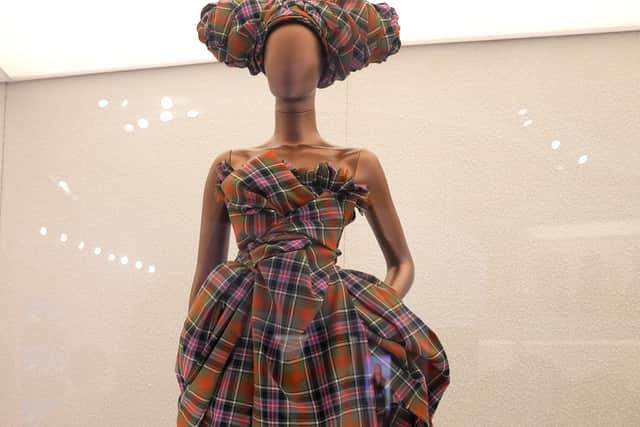
Westwood has long made a habit of treating familiar British fabrics with very little reverence.
Tartan, Harris Tweed and traditional tailoring became some of the designer’s most recognisable codes precisely because she distorted them.
That irreverence stretches back to the early 1970s, when Westwood and Malcolm McLaren opened their shop on the King’s Road in Chelsea.
Eventually renamed Sex, it became closely associated with the emerging punk movement, with Westwood turning tartan, leather, fetishwear, safety pins and provocative T-shirts into clothes that would help define the look of a generation.
But Westwood’s style extends far beyond punk.
Her 1981 Pirate collection began a shift towards historical dress, and over the following decades she became known for plundering corsetry, 18th-century gowns, bustles, British tailoring and aristocratic dress, then deliberately messing with their proportions.
By the late 80s she was regarded internationally as one of the world’s leading designers, and she won British Fashion Council Designer of the Year in both 1990 and 1991.
Those references were scattered throughout the SS27 collection.
The collection was bawdy, theatrical and erotic.
Sheer mesh exposed bodies underneath, shirts plunged almost to the waist and underwear was deliberately visible.
One male model wore little more than red-and-grey trousers, jewellery and a small hat bearing the word “Chaos”.
It was difficult to imagine a more concise description of the show.
On other models, chokers spelled out Venus, some wore vast headscarves and hats, and one appeared beneath what looked like an enormous lily pad.
There was even a lilo carried down the runway, while grapes appeared to tumble from a handbag.
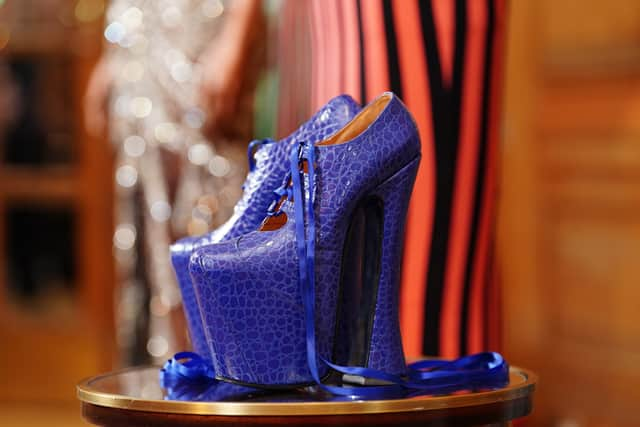
The accessories were equally exaggerated: enormous holdalls and slouchy bags competed with towering platforms, gladiator-style sandals and lace-up ballet shoes.
The latter offered one of the more wearable clues about where fashion is heading.
Ballet flats have dominated footwear for several seasons, but Westwood’s versions were laced around the ankle and paired indiscriminately with cropped men’s trousers, skirts and dresses.
Natasha Lyonne walked in a cropped patterned jacket and leopard-print miniskirt with her signature red curls piled around her face.
The American Pie star seemed to suit a collection populated less by anonymous models than a cast of characters.
That approach is deeply embedded in the house Kronthaler now leads.
The Austrian designer met Westwood in 1988 while she was teaching at the Vienna Academy of Applied Arts, and the pair married in 1993. He became not only her husband but her closest creative collaborator, helping develop some of the extreme silhouettes that defined her Nineties collections.
His position at the house did not begin with Westwood’s death in 2022.
In 2016, after more than 25 years of designing alongside her, Gold Label was renamed Andreas Kronthaler for Vivienne Westwood to publicly acknowledge the creative responsibility he had already assumed. Westwood herself said at the time that Kronthaler had taken on “ever more responsibility” and she wanted that reflected publicly.
Since her death, he has been left with the difficult task of continuing one of fashion’s most distinctive legacies without simply reproducing it.
The charity Body & Soul was particularly explicit about that inheritance.
Kronthaler said ahead of the show that its title came from his work with Body & Soul, a charity with which Westwood had first connected more than two decades ago.
A limited run of T-shirts has been created to raise money for the organisation.
And the use of Westwood’s recorded voice made her presence impossible to ignore.
Westwood’s famous corsetry also reappeared in several forms, including a white high-low gown whose sculpted bodice opened into great folds of fabric.
The silhouette has become increasingly familiar this fashion month, with designers repeatedly raising skirts at the front and allowing fabric to trail behind.
At Westwood, though, the historical reference felt less like another trend than home territory.
Corsets became central to Westwood’s work decades ago, particularly as she began combining the construction of historical dress with contemporary sexuality.
Her 90s collections pushed bustles, corsetry and hourglass proportions to deliberately exaggerated extremes, often in collaboration with Kronthaler.
The finale provided the collection’s grandest version of that idea.
Yasmin Wijnaldum emerged in a butter-yellow satin gown, its corseted bodice surrounded by enormous sculptural folds at the shoulders before spilling into an asymmetric full skirt and train, looking every inch the Westwood bride: romantic, historically inflected, exaggerated and just slightly unruly.
Kronthaler appeared alongside her for the finale, putting an arm around the model as the cast made its final circuit before walking out to take his bow.