
‘I have motor neurone disease and was told at 36 I have 10 years to live – I’m making the most of time with my family’


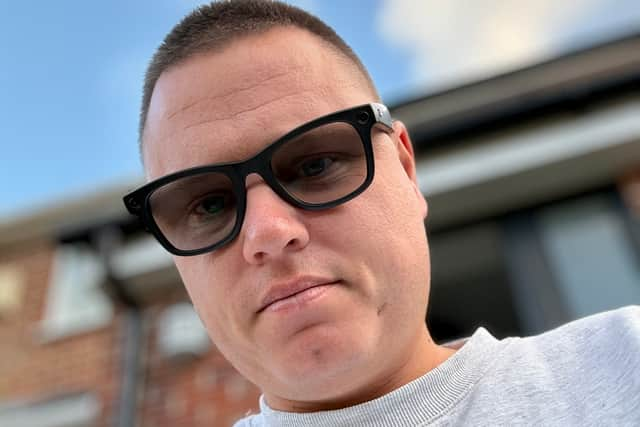
James Smith, now 41, described receiving his diagnosis as ‘awful’.
A father of three who was diagnosed with motor neurone disease aged 36 is halfway through his predicted life-span of 10 years post-diagnosis, but is determined to make the most of the time he has with his young family by travelling the world, making memories, and raising awareness of the realities of the condition on social media.
James Smith, 41, was diagnosed with motor neurone disease (MND) – a progressive, life-shortening and incurable condition which damages parts of the nervous system and causes muscle weakness, according to the NHS – after experiencing twitching in his muscles which progressed to weakness and losing control of his limbs.
The father, who lives in Bournemouth with his wife of 17 years, Carly, and their three children aged 10, eight and five, described receiving his diagnosis in June 2021 as “awful”, having to face the prospect that he would have just 10 years left to live as the disease progressed.
Since his diagnosis, James has lost all dexterity in his hands, his wrists have become “completely limp”, he is unable to feed or dress himself, and has had “a number of falls” which mean he is likely to become a full-time wheelchair user in the coming months. He has also had to contend with explaining the disease’s progression to his young children, as well as trying to make the most of the time he has left with his family.
Speaking of receiving his diagnosis in June 2021, James told PA Real Life: “I’m not going to beat around the bush: It was awful.
“My wife burst into tears. She was heavily pregnant with our little girl at the time. I’d just started the dream job that I’ve always wanted, and he’s telling me that I’ve got motor neurone disease.”
James was told that his life expectancy was around 10 years, “which is over double the average lifespan”, due to his age and the slow progression of his condition.
“I’m halfway through the journey now, of this 10 years, so I’m just going to make the most of it.”
James’s symptoms began in September 2019, when he noticed “an innocent twitch” in his left bicep and tricep after coming home from a run.
“I showed my wife, and we thought nothing of it,” he said.
“We thought it was maybe adrenaline. But as time went on, I noticed that when I was running, I could feel my left arm becoming weaker.
“I remember holding my arm up in front of me, and it would just drop.
“It prompted us to go: ‘That’s not right, let’s book a doctor’s appointment’, and the journey started from there.”
James had some blood tests before getting referred to a neurologist, and carried on with his regular life – going to work in his full-time sales job, continuing with his running, “trying to not think of the worst case scenario”.
“My nan unfortunately had motor neurone disease as well, so you’re thinking in the back of your mind: ‘Is it this?’, and you’re Googling everything,” he said.
In March 2020, James had his appointment with a neurologist where he had an MRI scan and an EMG test, which measures the electrical activity in the muscles to find nerve and muscle damage. This first set of results came back inconclusive, and James said he was advised that “only time will tell” and told to come back in three months for follow-up tests.
However, the following day, the UK Government announced the national lockdown in response to the Covid pandemic, and James ended up waiting six months to be seen again.

He was furloughed from his job, then made redundant, and he decided to begin to retrain as a barber – a job he said he had always wanted to do.
“One of the things I’ve noticed with MND is it makes you realise you need to do the things you want to do now, rather than wait for something like this to make you do it,” he said.
After qualifying as a barber, he began working full-time in a barbershop. He loved the work, but said that the dexterity required in the job made him notice other changes happening in his body.
First, his right arm began twitching as his left had been, and he noticed a deterioration in the dexterity of his hands.
In September 2020, he finally had his follow-up appointment and had a second EMG test. This time, it revealed denervation – loss or disruption of nerve supply – which he was told was a “tell-tale sign” of MND.
After being referred to a neurologist that specialised in MND – the very same doctor that had diagnosed his grandmother – James’s diagnosis was confirmed in June 2021.
He described the appointment as “awful”, particularly as his wife was heavily pregnant with their youngest child and he had just started his “dream job”, but said that as there was a long delay before his diagnosis was confirmed due to the consultant’s lengthy waiting list, he had begun to “come to terms with it”.
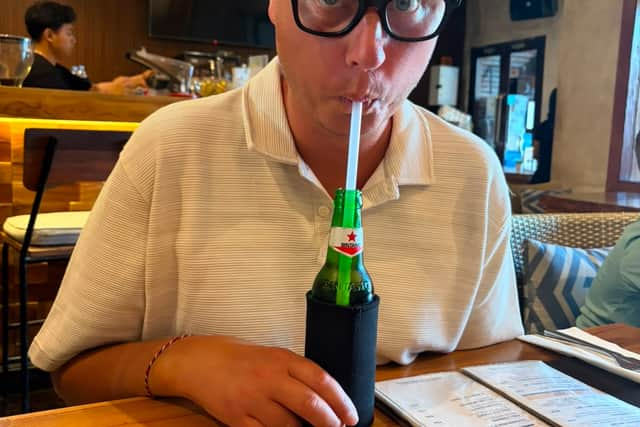
In the five years since that fateful appointment, James has had to adapt to a new way of life, with his physical capabilities declining – and while he misses being able to work, he said he is grateful to be at home with his children.
“The last year has probably been the toughest,” James said.
“I’m struggling to feed myself. I can’t hold cutlery, and now my neck’s got weaker, it’s affecting my swallowing and my chewing…
“(My wife) has to dress me now, she has to undress me, I’m at the point where I might need help showering.
“I had to give up my driving licence, I can’t drive anymore.
“My right leg is unfortunately going as well, which has prompted a number of falls that I’ve had in the last six months – some more scary than others – and I know that I’ll probably be in a wheelchair in the next month or two to help me keep safe.”
However, James said he has found “purpose” in sharing his experience on social media under the handle @adaptwithjames, raising awareness of the realities of living with MND.
Using Meta glasses – AI glasses with a built-in display, camera, and voice control functionality, which not only allow him to film and take photographs hands-free, but to make calls, send messages, and more – James shows the world the realities of living with MND, from his point of view.
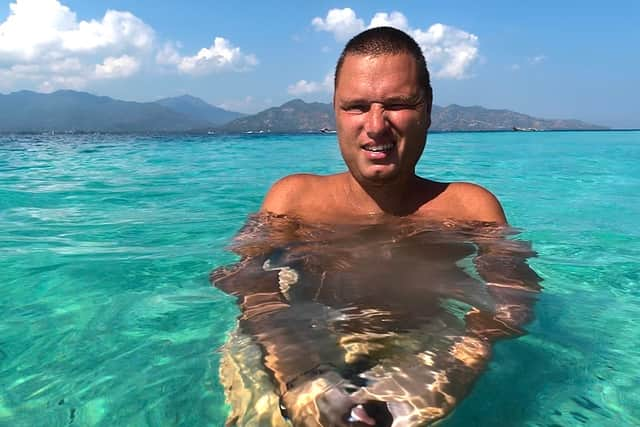
He said his videos “put people in my shoes”, adding: “Knowing what it’s like to not be able to pick up something you’ve dropped on the floor, or trying to do your shoelaces up, or even simply walking out my front door and trying to lock it”.
Despite some controversy surrounding Meta glasses, with concerns of covert filming, James is careful to get consent from those in his videos and blur the faces of strangers, and maintains that they are a very useful tool for people with disabilities like his.
The glasses cost upwards of £224, but James was able to get a pair thanks to a grant from the MND Association, which has awarded over £4 million in grants to people affected by MND in the past year.
“It gives people a new perspective on how motor neurone disease is affecting me, and in turn, I suppose, helps (others),” James added of his social media content.
“People might look at it and go: ‘Actually, yeah, let’s donate to the MND Association to help towards research and help towards treatment.”
The MND Association works with people affected by MND through guidance, practical and financial support, and funding research to seek new treatments and, ultimately, a cure. To find out more, visit: mndassociation.org.