
Volcano tourism is growing: What it’s like to hike and camp next to an active volcano in Guatemala

Lauren Taylor hikes the overnight Acatenango trek near the UNESCO city of Antigua.
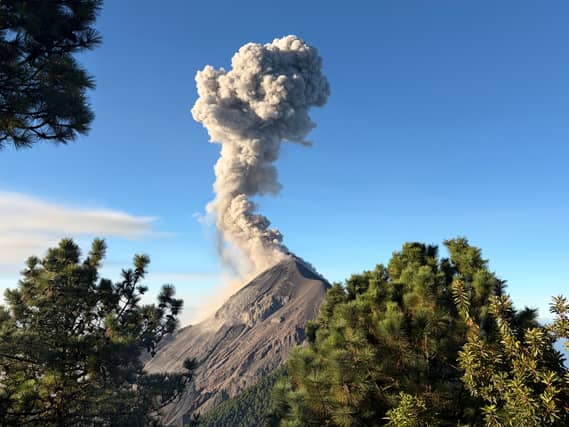
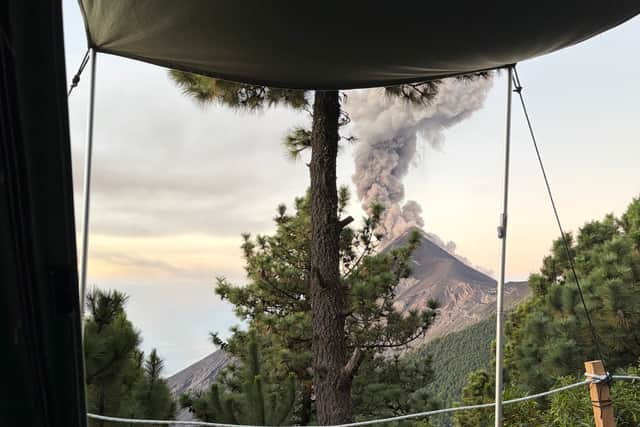
A faint “boom” sound emanates around my tent, as it has throughout the freezing cold night. The first signs of daylight are peaking through as I unzip the entrance to a perfectly framed view of Volcan de Fuego (meaning fire) mid-eruption.
One of the three continuously active volcanoes in Guatemala, and one of the most active in the Western Hemisphere, every 20 to 30 minutes grey plumes of ash dramatically rise into the sky.
And while fuming Fuego can be seen at a distance from the city of Antigua, I have hiked up neighbouring volcano Acatenango for this coveted view from one of the few base camps nestled into volcanic soil.
Not for the faint-hearted, with Acatenango’s peak at just under 4,000 metres above sea level, the steep climb zig-zags up through four distinct micro-climates and ecosystems that have adapted as the altitude dramatically increases.
Volcano tourism is part of the growing appeal for visitors to this Central American country, boarding Mexico’s south, with both Atlantic and Pacific coastlines. And it seems tourists are increasingly fascinated – the World Travel and Tourism Council estimated that international visitor spending was set to reach 21% higher than pre-pandemic levels this year.
And I can see why a moderate-difficult, overnight Acatenango trek is considered one of the best outdoor adventures in the entire region.
Beginning in the village of La Soledad mid-morning at around 2,400 metres altitude, the path starts in farmlands, before entering a semi-tropical cloud forest. Later, legs somewhat more wary, our guide Josias Back from Old Town Outfitters points out, “This is pine forest now”, while trainee guide Arelly props up the back.
Truthfully, I’m just focusing on putting one boot in front of the other. Altitude sickness at these dizzying heights is a genuine risk, and a few people descending are being helped down the mountain.
Winding paths through trees give way to open views, and it becomes clear just how high we are, as Josias points out the towns below built within circular craters and valleys formed by past eruptions.
I ask Josias, who has guided hikers up here for the past 10 years, how many times he’s walked to the top of Acatenango – “Maybe 1,000”, he estimates, “two or three times a week.” I suddenly feel a bit pathetic asking for breaks.
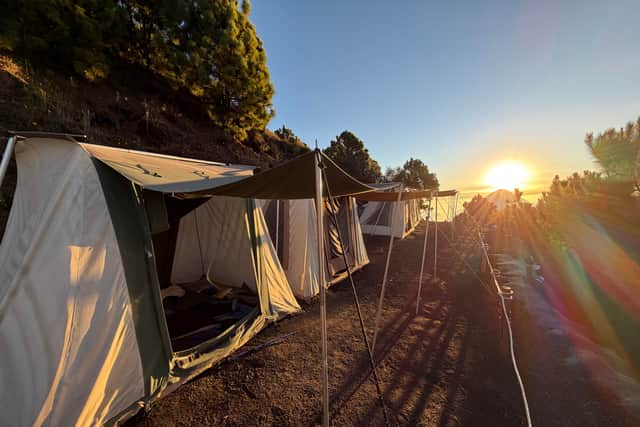
After finally reaching base camp – where a small collection of sturdy tents, a kitchen hut, a toilet hut and a fire pit await us – we rest before we brave the final 90-minute slog up to the peak.
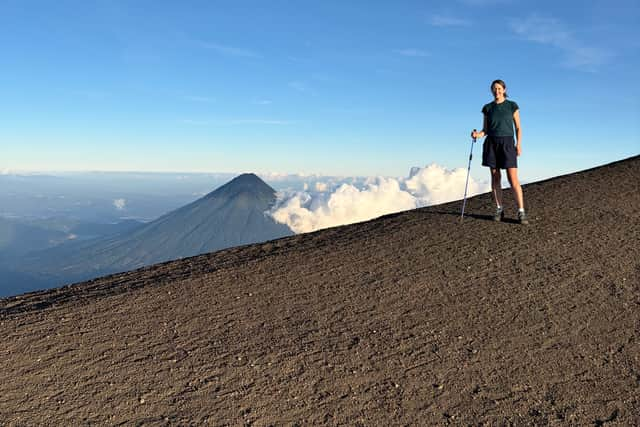
The greenery has become sparse, dark grey volcano sand is punctuated by smaller, hardy shrubs and yellow wildflowers. There’s little shelter from the now cold wind and the gravel scree underfoot gives way to give an extra challenge for tired legs.
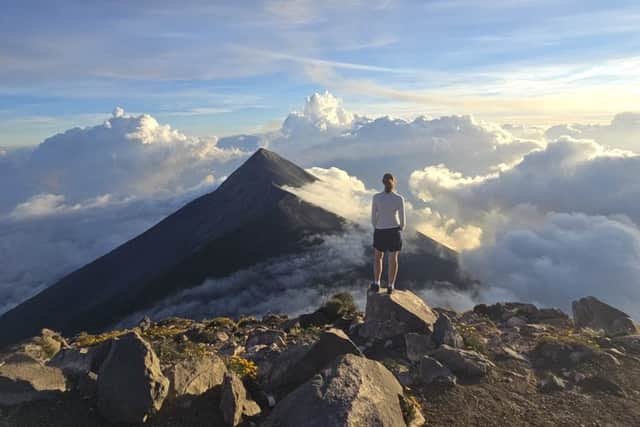
We make it to the top in time for sunset. Here, above the clouds, it’s only our small group and the sharp, dark angles of 3,763m-high Fuego breaking through the white, as the sky slowly shifted from muted oranges to pinks and the temperatures plummet.
When darkness hits on the way down, it’s headlamps on and the promise of Josias’ freshly whipped-up chilli con carne and tacos, which we devour huddled on plastic stools while sharing stories.
You’re never far from a volcano in Guatemala; there are 37 officially, more than 200 unofficially, depending on who you ask. Antigua – the capital until 1773 before the title had to be moved to Guatemala City due to devastating earthquake destruction – is flagged by three prominent volcanoes.
Seismic activity has very much shaped this nation. Even practically – “one of the main reasons that the citizens never built houses with more than three storeys was because of seismic activity,” says my guide Joel Lee.
It was something the Spanish underestimated during the conquest; “They didn’t realise it was a seismic city, they didn’t have good luck, their first city was destroyed.
“It was their karma,” he adds.
In fact, Antigua was rebuilt several times between the 16th and 18th century. What stands today is a compact historic centre just half a kilometre wide, made up of colourful building facades with iron-clad windows, and traditional courtyards, many of which are now coffee shops, small hotels and restaurants, including the picturesque Maxán, where executive chef Gabriela Matheu serves up a delicious sweet charred corn cooked over open coals (corn being an important stable in these parts), ceviche (for a nod to the country’s Pacific coast) and cacao mousse.
It would only take 15 minutes to walk the one length of the nine by nine blocks and yet nearly 40 churches are packed in. The facade and ruins of San Jose Cathedral still stand off the city’s main square, and the lemon yellow Iglesia de la Merced houses a spectacular courtyard, being set up for a candlelit wedding as we visit. While the well-preserved Convento de las Capuchinas, completed in 1736, is a fine example of Diego de Porres’ seismic baroque architecture, with deliberately thick, short earthquake-resistant pillars support wide, low arches and thick masonry walls.
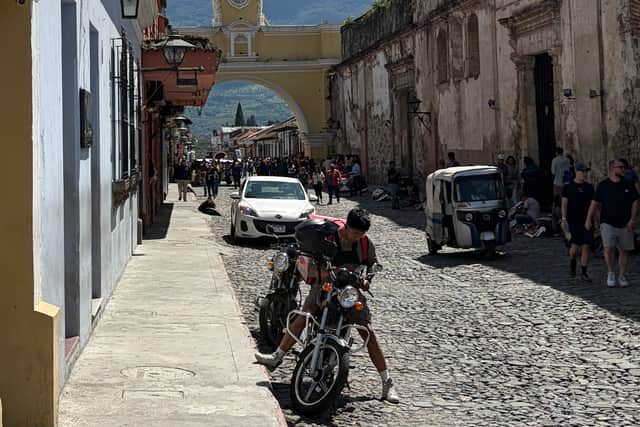
It’s important to “think about who were the ones who built the oldest churches,” says Joel. “The ideas came from the Spanish but everything was built because of the Mayas and African descendants.” Many indigenous people were forced into labour alongside the enslaved, but they left their subtle marks – Iglesia de la Merced church has some corn symbols rebelliously painted into the facade.
The 16th-century grid of cobbled streets, protected by its UNESCO World Heritage status since 1979, lead to small inlets hiding a maze of craft markets and intimate bars, like Cafe No Se and Whiskey Den.
Antigua Brewing Co. is a stylish spot to watch the famously vibrant sunsets of Antigua, with the three volcanoes in full view – a few doors down from my boutique hotel Mesón de María, with a pretty courtyard for breakfast and a glorious rooftop view for morning coffees.
There’s a relaxed traveller vibe, amongst the centuries-old history and authentic culture – an estimated 45% of Guatemala’s population are Maya and further north is home to some of the best preserved archaeological sites in the region.
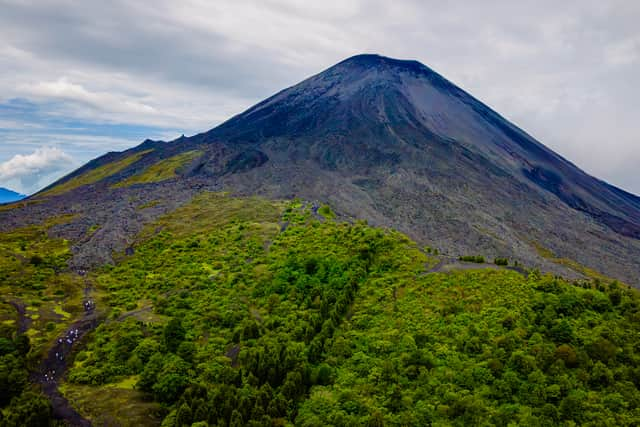
But the volcanoes are a looming reminder of nature’s power too. In August, two villages were evacuated when Fuego sent lava spewing into the air, and in 2018 nearly 200 people died due to its most deadly eruption since 1929.
Of the two other active volcanoes in Guatemala, Santiaguito is a four-hour drive from Antigua, near the city of Quetzaltenango in the Western Highlands, while Pacaya is a more accessible 1.5 hours away. A beginner-friendly half-day walk, we hike across dry lava fields and ashy soft ground, shaped by past eruptions – a dangerous eruption in 2010 caused three deaths and mass evacuation of nearby villages.
“There’s a positive side [to living nearby] – the fertile land – the negative side is you don’t know when an eruption will destroy your home,” says Joel, matter of factly.
A three-hour drive from Antigua is the huge 130 sq km Lake Atitlán, which shows an altogether different side of this remarkable country. The lake, of course, was formed by a huge volcanic eruption, and today is sounded by towering mountains at every angle, including three volcanoes. Guatemala’s deepest lake at 340 metres, Mayan communities were here before the lake was formed, archaeological ruins have recently been discovered under the water.
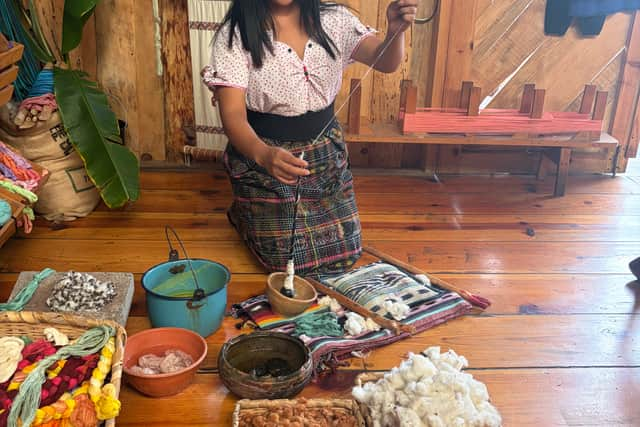
Our speed boat docks on the shore of San Juan La Laguna, where a traditional way of life has been preserved. Many locals wear traditional dress and we visit a Tz’utujil collective of 50 women, Flor Ixcaco, who make natural-dyed cotton by hand using ancient techniques and turn them into extraordinary crafts and clothes. Each piece sold comes with a little note with the name of the maker and how many days of work it took.
While chef Esmeralda Pojoy showcases generous local cuisine in her female-run restaurant for £10 for lunch – “The price is sentimental really,” she says, “It changes with the seasons” – and I devour a whole fried fish (from the lake) and an array of accompaniments heaped on my plate in the open kitchen.
One of the many villages clinging to the shores of Atitlan, San Juan is so colourful that the streets below our feet are literally painted with art, murals adorn walls, doors and stairs, and bright umbrellas hang in rows above.
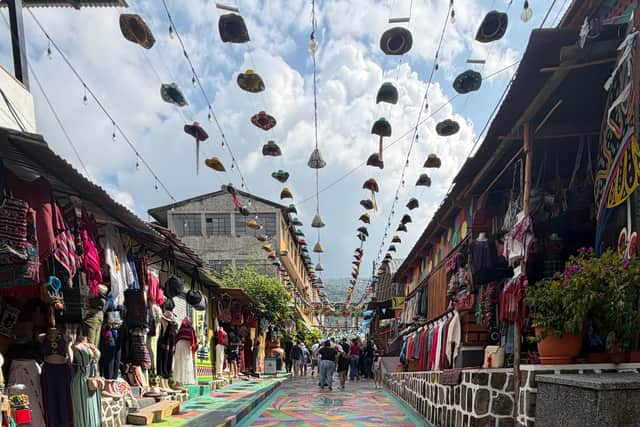
It isn’t designed for Instagram either, “Back in time, it was forbidden to paint,” Joel says, and so when they could, they did.
The culture of street art has been here long before tourism. A sentiment that runs throughout my visit here; at a time when many destinations are experiencing overtourism, Guatemala – a nation rooted in Maya culture on a land defined by volcanoes – holds an authentic flame.
How to book:
For more information on Guatemala, please go to visitguatemala.gt.