
IF WALLS COULD TALK: A monument to Thomas Spring Rice’s final column
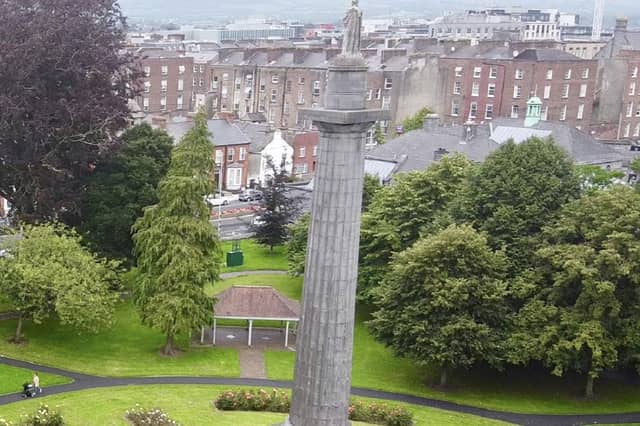

Columnist Dr Paul O’Brien discovers how public fundraising created an enduring landmark
Standing at the centre of Pery Square, the monument to Thomas Spring Rice is one of Limerick’s most recognisable landmarks. Erected in honour of a respected nineteenth-century politician and statesman, it remains a striking feature of Newtown Pery. Less well known is the remarkable public campaign that financed and erected the monument, a story that reveals much about civic life in nineteenth-century Limerick.
Erected during the lifetime of Thomas Spring Rice (1790-1866), later 1st Baron Monteagle of Brandon, the monument reflected the high regard in which he was held by many in Limerick. In a letter penned in London and published in newspapers in Ireland in December 1829, Spring Rice thanked the citizens of the city for their ‘warm and continued confidence’. While modern accounts frequently describe the monument as a Barrington family project, no primary evidence has yet emerged to substantiate that claim and Spring Rice’s own published letter contains no acknowledgement of the family. However, Daniel Barrington (1792-1842) acted as agent for the Pery estate and would have been directly involved in the plan. Permission had to be granted for the project. Nevertheless, Daniel Barrington (1792-1842) in his capacity as agent to the Pery estate, would have been closely involved in the scheme. As the monument was to be erected on estate-controlled ground, the project could not have proceeded without the necessary permission being granted.
The monument grew out of a carefully organised campaign that drew support from many of Limerick’s leading merchants, professionals and public figures. The story began when a group of prominent citizens proposed that a permanent monument be erected to Spring Rice, then one of Limerick’s best-known political figures. In a public declaration, they praised his long service as parliamentary representative, his advocacy for the city and his efforts to advance Limerick’s commercial interests. A public subscription appeal quickly followed. Notices published in the Limerick Chronicle reveal the breadth of support behind the venture. Merchants, bankers, manufacturers, landowners and professional men all appeared among the contributors. The surviving lists are particularly valuable because they identify not only those who donated but the exact sums they contributed.
The subscriptions also provide a fascinating snapshot of influential Limerick society during a period of economic and political change. Larger donations stood alongside more modest contributions. The campaign ultimately raised enough money to fund an ambitious monument rather than a modest memorial. News of the project reached Spring Rice himself, and his response was widely circulated. In a letter published in the press, he acknowledged the honour while insisting that any service he had rendered arose from his duty as the city’s representative. The exchange helped sustain public interest in the project long before construction began. An imposing column was chosen as the centrepiece of the memorial and a prominent site secured in Pery Square in Newtown Pery’s beautiful Georgian streetscape. The location ensured maximum visibility and provided an appropriate setting for a monument intended to reflect the city’s esteem for its parliamentary representative. Designed by Henry Aaron Baker (1753-1836), the monument comprises a Greek Doric column surmounted by a statue of Thomas Spring Rice sculpted by the distinguished Irish artist Thomas Kirk RHA (1781-1845).
By April 1831 the column had reached its full height and attention turned to the installation of the statue that would crown the monument. Contemporary reports treated the event as both an engineering feat and a public spectacle. The statue had been stored at Limerick House on Henry Street pending installation, the home of Lord Pery. On 20 April at an early hour, it was carefully wrapped in protective matting before being conveyed to the monument. Extensive scaffolding surrounded the column, and all preparations had been completed in advance. The marble figure would have to pass through successive levels of scaffolding before reaching its final position high above the square. The operation was directed by the contractor Mr. Hill Clements (1772-1858) of Thomas Street. Newspaper reporters were impressed by the organisation of the works and the discipline displayed by those involved. One account observed that everyone engaged in the undertaking, from the director of the great crane to the other workers on site, contributed to its success.
The lifting itself was both complex and demanding. Yet the work proceeded smoothly as the statue was raised through the maze of scaffolding. Crowds gathered throughout the day to watch the spectacle. As the marble figure climbed higher above the square, public interest intensified. One report described the sculpture as the image of ‘The Man of the People’, a phrase that captured the esteem in which Spring Rice was held by many of his supporters. Whether read as sincere admiration or political rhetoric, the description reflected the purpose of the monument itself. At two o’clock in the afternoon the operation reached its climax. The statue was successfully secured at the summit of the column, and a twenty-one-gun salute immediately announced the achievement. Many spectators removed their hats as a mark of respect and prolonged cheering followed the successful completion of the task.
With the statue finally in place, the project conceived several years earlier reached completion. The aspirations expressed in the original public appeal, the subscriptions gathered from citizens, the correspondence of Spring Rice and the labour of architects, craftsmen and workers had together produced one of Limerick’s most recognisable landmarks.
Dr Paul O’Brien is a lecturer at Mary Immaculate College