
If Walls Could Talk: Thomas Revington belonged to an ambitious group of pioneering entrepreneurs

THIS year marks 130 years since the death of Thomas Revington (b.1811), retail magnate and property developer who left an enduring mark on Limerick. Residential developments such as Revington Park and Revington Gardens still bear his name. His most impressive scheme was Eden Terrace, North Circular Road (NCR). Thomas Revington married Hester 'Hettie' Haines (1812-1880) on August 4, 1838 in Newbery Church, Cork. They went on to have six children, John, Homan, Ellen, and Mary who were born in Mallow, and Thomas and Georgina who were born in Limerick. Revington came from a family of noted entrepreneurs. His cousin, Joseph N. Revington established the extensive Ballymullen Tweed Mills in 1883 in Tralee, Co Kerry.
Thomas Revington began his career in Mallow, Co Cork where he operated an extensive drapery business spread across three buildings on the main street. After successfully trading for several years, he departed Mallow, settled in Limerick and established himself in retail. In 1844, 15 and 16 George’s Street were renovated under the direction of Dublin-based architect Charles Mittan. In March 1845, Charles Higginson opened a drapery establishment at the premises. His business did not survive for long and the following year, he formed a partnership with Thomas Revington. They opened ‘large, new commercial concerns’ at Higginson’s former premises on October 1, 1846. They sold items such as ‘silks and satins, furs, linens, blankets and hats, Paris boots and shoes, and Irish poplin’. Higginson dissolved his partnership with Revington in the early-1850s, moved to Clonmel and opened another shop; he was declared bankrupt in 1857. Thomas Revington then established the Limerick Warehouse Company of which he was the sole proprietor. In c.1873 he sold the business to John Daly & Co. of Cork (est.1779), Revington made £30,000 from the sale. It was next acquired by William Todd in 1899; the storied history of which has been well-documented. In turn, William Todd’s was bought by Brown Thomas but is still affectionately known to many as Todds.
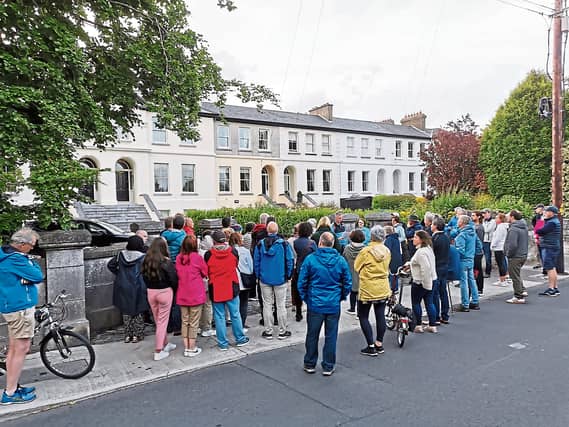
Revington’s keen business acumen coupled with his entrepreneurial spirit enabled him to expand his interests beyond retail and into property development. One of his first projects was Eden Terrace, built between 1861 and 1862. Nestled on a site set back from the road, Eden Terrace is a row of 12 elegant two storey over basement stucco-fronted houses, with recessed front porches, reached by a flight of limestone steps and distinguished by a central breakfront shared with the neighbouring house. In promotional material, Revington described the development as ‘a handsome terrace, about fifteen minutes’ walk from the city centre.’ Each one contained a ‘parlour, drawing room, three good bedrooms, servant’s room, two pantries, kitchen, scullery, and coal store. The roomy houses also featured the most up-to-date features such as water closets, running water and gas fittings.’ The houses offered ‘excellent stabling and coach houses.’ A neat garden at the front and the rear completed each one. The houses were brought to market on August 5, 1862. Over the years, many well-known Limerick people have lived at Eden Terrace including Lucy Caroline (née Gabbett), wife of William Smith O’Brien, Irish nationalist MP and a leader of the Young Ireland movement, in the late-1860s; Alderman Máire O’Donovan, the first female Mayor of Limerick (acting), in 1921; Capt. Eric Shaw, son of Sir Alexander Shaw of the famous bacon merchants, in the late 1920s, and in more recent times, former Mayor of Limerick Kathleen Leddin who made her family home at the terrace in 1972 and whose son, Brian Leddin served as a TD for Limerick City in the 33rd Dáil (2020 - 2024).
A prominent Limerick landmark associated with Thomas Revington is Ardhu House, built as his family home in 1860 at a cost of £4,500. It stood on about five acres of woodland and was reached by a gated avenue. Ardhu House and grounds are now owned by Revington’s modern day equivalent, Aidan Brooks. As well as owning property in Limerick, Thomas Revington held ‘700 acres in Co Galway in the 1870s as well as 317 and 82 acres respectively in counties Clare and Limerick’, according to the Landed Estates Database.
On April 24, 1862, Thomas’s daughter, Ellen Revington married Capt. Francis Napoleon Bingley Groves Benson at St Anne's, Dublin. Tragically, Francis died just four years later, leaving Ellen a young widow. In about 1873, Thomas sold Ardhu House to Robert de Ros Rose and moved with his wife to Dublin where they lived in the fashionable Merrion Square. In 1879, the society journal, Mayfair announced that his daughter, Mary was engaged to Somerset Arthur Butler, 5th Earl of Carrick, and that ‘Mr Revington gives his daughter £30,000.’ The article claimed Revington had ‘amassed an immense fortune, bought an estate for his son, and portioned off several daughters with large fortunes’, confirmation of his success in business. For reasons unknown, Mary’s marriage to Somerset did not go ahead.
On July 6, 1880 Thomas’s wife, Hettie died at Pembroke House, Upper Mount Street, Dublin. Following her death, Thomas and two of his daughters Georgina Revington and the widowed Mrs Ellen Wise Benson Groves moved to Bray, Co Wicklow. They resided in the large Palermo House, coincidentally built by another settler from Limerick, the Right Rev. William Gore, Lord Bishop of Limerick, in about 1785. Thomas Revington was a keen gardener who had a great interest in exotic plants and trees. The gardens at Palermo had been cultivated by previous owners and this may have been a reason that Thomas settled there.
In July 1887, the Irish Times reported that Revington was awarded a commendation for his ‘beautiful and exotic ferns’. A Giant Red that had been planted in the garden in the early nineteenth-century became a well-known landmark in the area. Thomas Revington died at Palermo House, Bray on May 28, 1895. He was interred in Mount Jerome Cemetery, Dublin. Curiously for such a successful businessman, he left effects valued at just £70. His daughters Ellen and Georgina died in 1920 and 1923 respectively and are buried in Christ Church Graveyard, Delgany. Thomas Revington and his daughters are commemorated on a plaque erected in St James’ Church, Crinken, Co. Dublin.
The staggering extent of Thomas Revington’s property interests became publicly known in 1933 when the trustees of the Revington Estates disposed of ‘ground rents and lands’ situated in and around the North Circular Road (NCR) and Ennis Road. The sale notice appeared in both Irish and British newspapers. The impressive and valuable portfolio included the ground rents for most of the large villas in the area including Shannon Lawn, Sunville, Kyleglass, Lota, Old Church, Derravoher, Tivoli, Ardbeg, Hawthorn, Shamrockville, Cliftonville, Thornville, Laurel Ville, Eden Terrace, Oreland, Craigfield, Bracken Brae, and Ardhu. In addition, the sale included the ‘land where Revington Park was being built and a large field across from Eden Terrace on which there are 26 newly built houses’. The Revingtons also owned Barrington’s Pier.
Thomas Revington belonged to an ambitious group of pioneering retail giants who established themselves over the course of the nineteenth century. Their ambition ushered in an era of opulent department stores that would not have looked out of place in large European cities. Revington and other city retailers introduced customers to a range of stylish goods and products viewed through enormous plate glass windows. They put Limerick on the map as the number one shopping destination in the Mid-West. Their commercial success provided much-needed employment, created large personal fortunes for themselves, and changed the retail landscape of the city forever.
Dr Paul O’Brien lectures at Mary Immaculate College.