
Mud matters in the battle for Hastings Farmhouse

Conservationists bring back building methods for special historical project in Shannon
THE BATTLE to rebuild Hastings’ Farmhouse in Shannon has been given a boost through a series of successful workshops by renowned heritage conservation engineer, Chris Southgate.
The Tullyvarraga farmhouse, home to the Hastings family from the 1840s to the late 1960s, was made famous during the War of Independence when it hosted Brigadier General Cuthbert Lucas who had been captured by the IRA. The Hasting’s house was vandalised in the 1970s shortly after the death of John Hastings and its thatched roof set on fire.
The walls, made from mud dug out of a nearby hill, which were exposed to the elements, deteriorated badly and were almost completely lost to mosses, weeds and ivy.
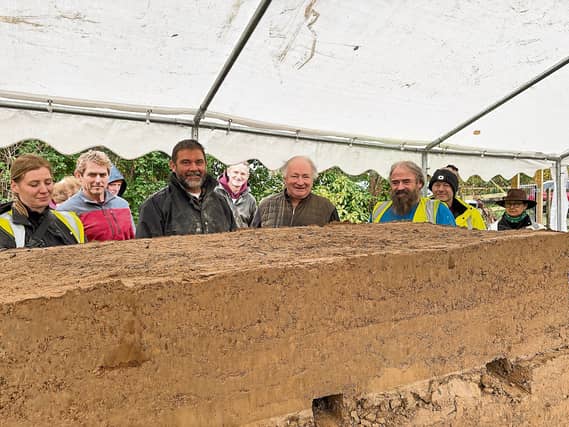
Mud Matters, the theme of the workshops run by Chris Southgate and his associates, traditional craft mason Eoin Madigan, and lime-rendering specialist Damien Condon, have shown that the test sections of mud are perfect for the planned restoration.
“We’re very lucky here to have very fine material and aggregate to compact very easily. You can just pick it up in your hand and you can see that it’s going to work. So, we’re able to dig it out of the ground fairly dry and compact it, and that means we can take the shutters down immediately. If it was in concrete, you’d have to wait three days. So, it’s a very practical way of building,” the conservation specialist explained.
“This mud material decays though with moisture, and in order to have a good structure, we have to have a roof on it, all the sills correctly done and details and plastering of lime-washing on the outside finished, for the mud to stay dry enough,” Chris added.
Craft Mason Eoin Madigan demonstrated how to select the most suitable clay and took the group of keenly interested participants through the principles and the practice of constructing walls with mud using very basic tools, while Damien Condon burnt the lime out of limestone rocks and added dyes from iron-rich stone, gravel and carbon to make a display of coloured washes.
“You wouldn’t have to go near the shops to build a house in the old days,” Damien said, and Eoin pointed out that all the neighbours were involved in the hands-on labour when the old farmhouse was constructed.
The battle to restore Hastings Farmhouse got underway in 2012, when Dúchas na Sionna began a conservation project to protect the remains of the house and a group of local volunteers cut away the greenery and mortared the walls to protect the ruins.
“We knew it was here and we knew the connection with the War of Independence story and we felt it was part of Shannon’s heritage, and unless somebody took responsibility to do something it was just going to continue to deteriorate and disappear altogether,” explained Dúchas na Sionna Secretary, Olive Carey.
The heritage group now plans to fully restore the farmhouse, situated as it is on the proposed Shannon to Bunratty/Sixmilebridge/Limerick greenway, as a heritage centre, exhibition space and community meeting venue with a training centre element.
Dúchas chairman, John O’Brien, is hopeful that planning permission and the finance to continue will be in place by the end of February next and that work will be well underway before the summer.
“It depends too on the number of people available. It’s really labour intensive and maybe there might be some community involvement at that point,” John said.
Chris Southgate is delighted with the technical progress they’ve already made on the farmhouse restoration through the weekend workshops, which were enabled through funding by The Heritage Council under the Community Heritage Grant
“We’ve proven the process of rebuilding in structurally viable material, now we’re trying to perfect the work method to make it as viable and as practical as possible from a financial point to view.
“We can innovate by using mechanical loaders and will be able to do long stretches of wall at a time,” said Chris, adding that he found it inspirational to build something of value to the community and to show just how easy it was to build environmentally with mud and lime.
“Mud is challenging to build with and is also inspiring. At the end of the day Mud Matters because it basically gives us a connection to the earth and it’s a natural way of building for the future,” he added.