
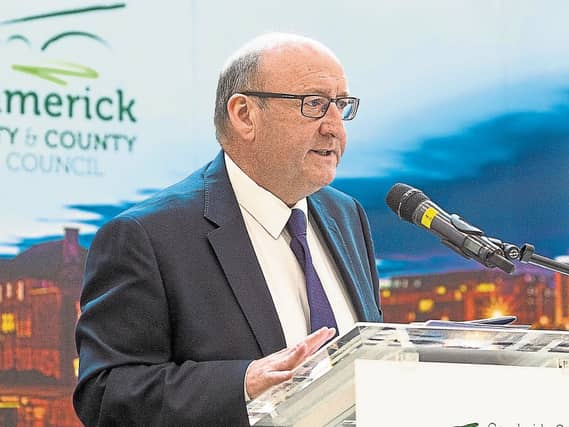
Q&A with Limerick's council chief Pat Daly


AINE [email protected]
THE chief executive of Limerick City and County Council says he hopes his legacy will be “leaving Limerick in a better place than when I began and build on the superb work that has already been done under the Economic and Spatial plan”.
In a wide-ranging two-part interview featuring 20 questions and answers published this week and next week, Dr Pat Daly discusses a Limerick city and county post Covid-19 and what his ambitions are for the region.
A native of Greystones on the Ennis Road, where his mother Rose still lives, Mr Daly was a student of Ardscoil Rís, “a great school”, he says.
An industrial engineer by profession, he holds a Master’s Degree in management from Sheffield University and a PhD in business management from University College Cork.
He began his career as an industrial engineer with Interbalco, a Swiss / American company in Shannon but most of his career was in Shannon Development (25 years).
He has worked with Limerick City and County Council for the last seven years.
Mr Daly held the positions of head of innovation, the director of economic development and planning, and deputy chief executive before being appointed the chief executive of the local authority in August 2019.
He will continue in the role “until we come to a conclusion of the directly elected mayor process”.
Mr Daly resides in Annacotty with his wife Mary.
“Mary and I enjoy a mix of running, walking, golfing - the outdoor life! We like nothing more than walking the Plassey Riverbank by UL or visiting the nearby beaches!”
What do you think are the biggest problems facing Limerick as we start to emerge from the lockdown?
Getting the economy reopened and back up running as close to normal as possible to sustain the jobs that were created pre the Covid crisis and make Limerick the most liveable and attractive place to live, invest, visit and work in.
The departure of Debenhams and the closure of businesses during the lockdown has taken a huge toll on the city centre, the effects of which will be felt for a long time to come. What is being done to combat the fallout from the pandemic?
We were acutely conscious of the change happening in retail pre-Covid and we had appointed a senior executive to support the city’s retail base who is now working closely with store owners. We’re essentially re-imagining how Limerick is going to work. We’re going to have much more destination shopping and more independent offerings, we’re still working on large investment plans.
I’m delighted to see that Aldi are interested in locating in Roches Street and there are a lot of good enquiries in the pipeline that we’re hoping to convert over the coming years. We’re confident that we can replace stores like Debenhams as we’re actively seeking new investment in Limerick including key retailers but also availing of other opportunities.
The Council is also working closely with central Government and Enterprise Ireland to put supports in place for businesses. We are playing a large role in the Business Re-Start grant scheme and we had a very successful Shop Limerick marketing campaign to support local retailers which is still on-going.
It’s exciting to see the new Kirkland Development's plan underway at Bishop’s Quay and the Rugby Experience giving good hope and encouragement to the city centre. Work will also begin on the Opera site later this year. There’s also been a lot of progress taking place to redevelop old building stock in Limerick over the last 12 months through projects like the Living City initiative with many new projects started.
Minister of State John Paul Phelan has insisted it is the Government’s intention to meet the “full balance” of lost commercial rates following the Government’s decision in early May to allow for a three months waiver of commercial rates for businesses which had been forced to close due to Covid-19. How much in rates did the council lose out on as a result of the waiver? And have you been given a commitment of when it will be reimbursed by the Government?
We are implementing the three-month deferral of rates which has a cash flow impact to the local authority of around €5 million. We are in discussions with Government around the details of this three-month national waiver scheme for implementation.
What other areas of the council’s income has been affected by the pandemic?
Other lost income (car parking, planning fees, etc) we estimate could be around €2 million on a full year basis.
There will be difficult times ahead and hard decisions will have to be made over the next weeks and months in relation to the allocation of funds for various projects in view of the economic impact of the virus. How do you envisage this playing out?
I agree things will be difficult but we’ve had a good history of resilience in Limerick. We are good at project management and of co-funding of projects, most of the ones we’ve announced we have secured funding for, such as the Opera site and Mungret. The Council is lobbying intensely with Government to keep the capital programme on track and to invest in committed projects like Foynes to Limerick and Coonagh to Knockalisheen road schemes, various social housing projects and the Cork to Limerick motorway. As you yourselves reported in the Leader, we have submitted applications to Government in excess of €200m for existing capital projects in the city under the Urban Regeneration Development Fund.
Many small businesses have struggled since the coronavirus lockdown began, some haven’t reopened, others may eventually find it difficult to remain open and will shut their doors, what can be done to assist these businesses?
I’m hugely sympathetic to the difficulties that the business community is facing at this time and we have a strong suite of supports in place to help. The Council is administrating the Business Re-Start Grant and Rates alleviation schemes, and through the Local Enterprise Office there are also a huge number of supports and loans available to businesses. These include everything from the Trading Online voucher scheme that helps those wishing to explore e-commerce options with a wide range of mentoring supports available and also marketing support through the Shop Limerick campaign.
The first election for a directly elected mayor is expected to take place in 2021. How much will your role change when you have to work with the person elected?
The new directly elected mayor will have distinct powers that transition from the chief executive to the directly elected mayor but the chief executive will have enhanced roles in other areas so I see it as very much of a partnership process. The mayor will have a huge role in policy while the chief executive role will still cover operational issues so it will be a change, but life is about change. We have a very good history of good collaboration and partnership in Limerick of breaking the mould and we’re working together with the Department of Housing, Planning and Local Government and the Implementation Advisory Group chaired by Tim O Connor positively to make it happen.
The council has announced plans for the temporary pedestrianisation of some city centre streets to get the city back on track by giving cafes, retailers and restaurants more room to bring their businesses out onto the streets. Some businesses have expressed grave concerns that the plan to ban cars from some streets will have a negative effect on people coming into the city. Has the Council got this wrong?
No, we’re delighted with the public interest in these proposals. To move forward in the city, we must try new ways of operating and also listen to all of those who have so far commented or made submissions on the proposals. As the city recovers, we are keen to introduce more pedestrian friendly areas. In the short term, this means introducing some temporary street closures and widening footpaths to create extra space outside cafes and restaurants for tables and we will also create a network of click and collect spaces for short term pull-ups. We also want to make the city more bike and pedestrian friendly and lower the speed limit in the city centre. These are still draft plans at this stage but they do encompass ideas that come from a number of different stakeholders and have been discussed previously at various policy committees and by interested groups. We’ve been in consultation with a huge amount of people and I’m confident we’ll come up with a solution that is best for Limerick. We’re not in the business of closing streets for the sake of it, we are working with the traders and we’re delighted that it’s allowed people to think about their city and we hope this becomes a constant dialogue. We are listening to people and we will not do anything that damages the city centre fabric or the businesses in it.
Work is expected to start on the €300m Project Opera in the city centre in September. Will the plan be affected by the pandemic? Will this space be a game changer for Limerick city?
We all know the transformational impact that the Opera Site is going to have on Limerick and I’m aware that the site has had its challenges over the years. But the latest news that the demolition and enabling works contract is going live couldn’t be better timing as it comes in the midst of a really challenging period for us all and when we need to see such positive signs of recovery. The Opera Site is a huge programme, the demolition and enabling works will be as big as anything undertaken in the city centre. We are looking at a 3.7 acre site in the heart of the city that is significant in scale and in sensitivity. There’s substantial demolition and clearing works to be done to prepare it for a LEED standard build, which is the world’s leading green-building project and performance management system. But it’s also much more than a demolition phase of the project, there’s a very substantial conservational aspect to this. When Limerick Twenty Thirty, was established the Opera Site was the biggest project on the horizon and the most talked about. It’s taken two years to get it to this stage but now the physical work begins and that’s a huge moment for the wider programme, for Limerick and the region. Look at how the Garden International site got turned around into a multi-award winning project within two years of the establishment of Limerick Twenty Thirty. The same will now happen with the Opera Site and it’s going to be a game-changer for Limerick. Two vacant properties are also to get a major bounce from the Opera Site development, Barrow House, which formerly housed Instore, on Michael Street and all three units at the 10,000 sq ft The Carlton on Henry Street - former home to an Elverys store - are to have new life breathed into them by works to facilitate the relocation of the Limerick City Library and HAP, respectively, into these properties. This is a real positive for the buildings and the areas around them.
Are there any new developments on the Marks & Spencer project following the announcement last year that they are to come to Limerick?
The Council meets regularly with the promoters of the Marks and Spencer project and we are hopeful that they will proceed with planning for a new development shortly. Nothing in life is ever certain, particularly in these times, but we are hopeful that future developments like Opera, the UL City Centre campus, Cleeves Riverside Development and other developments will create the critical mass of activity in the city centre that will make retailers like M&S and others locate here.
Are there any plans for the Cleeves site in the city centre?
A lot of the concentration now is on the Opera Site and it’s great to see full-steam ahead on that with a commencement of work there in the autumn. But we are equally excited about the potential of the Cleeves site. Limerick Twenty Thirty is currently in the procurement process for a team that will identify the opportunities for the site and move onto master-planning it. It is a huge opportunity for the city and region as we are talking about 10 acres in the heart of Limerick. It will also be a whole new dynamic for the city centre as it will bring commercial activity onto the northern bank of the Shannon. The site is zoned 'City Centre Area' in the City Development Plan which means it’s suitable for a number of uses including commercial, residential and educational. So, I’m really looking forward to seeing progress on this and the strategic vision for the site being finalised.”
Next week the chief executive discusses staycations, Shannon Airport, county towns and the M20.