
SPOTLIGHT: Sri Lankan artist finds a creative home in Limerick
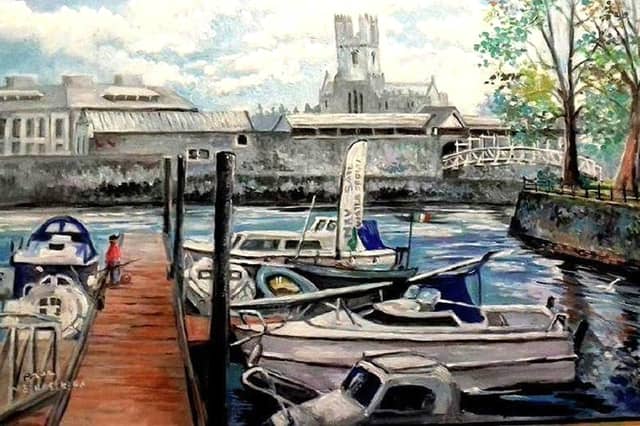

Sri Lankan artist making waves on the Limerick scene
Today, Weerasekera is known across local arts circles for work that is richly textured and filled with light and colour. But his story is also about belonging, reinvention and the relationship between a city and an artist who found inspiration in its streets, people and atmosphere.
For many in Limerick, his work has become instantly recognisable. There are echoes of Sri Lanka throughout his paintings — tropical colours — yet there is also something unmistakably rooted in the west of Ireland.
Leaving Sri Lanka behind
Weerasekera grew up in Sri Lanka during a period of immense social and political change. When he moved to Ireland, the transition was profound. Like many immigrants arriving in a new country, he faced not only the practical challenges of building a life but also the psychological weight of displacement. Familiar sounds, colours and rhythms disappeared overnight. Dublin was his first home in Ireland. The capital offered opportunity and anonymity in equal measure. It was where he adapted to Irish life, learned its social codes and slowly rebuilt a sense of stability. Yet the pace of Dublin never entirely suited him. He needed reflection, community and space. Limerick would eventually provide all three.
Discovering Limerick
When Paul settled in Limerick, the city was very different from the energetic cultural hub it is becoming today. Limerick’s Georgian elegance sat alongside industrial architecture and working-class neighbourhoods.
Over time, Limerick stopped feeling like a temporary destination and became home. That transformation can be traced through his artwork. The work became more rooted in place. Limerick entered the paintings not through literal landmarks alone but through atmosphere.
The Shannon, the changing skies and the particular quality of western light offered him a new visual vocabulary. He began looking closely at streets and buildings that local people might pass without noticing, discovering character in familiar corners of the city and county. That ability to make the ordinary newly visible became an important feature of his developing work in Limerick.
Painting memory
For immigrants, there is often pressure to choose between preserving the past and embracing the present. Paul rejects that binary entirely. His work suggests identity is not fixed but constantly evolving. In many ways, he paints what it feels like to belong to more than one place at once.
A growing cultural city
Weerasekera’s rise as an artist has coincided with Limerick’s growing confidence as a cultural city. Limerick has steadily built a reputation for creativity and innovation. Artists like Paul have contributed significantly to that transformation.
His exhibitions have become familiar fixtures within local galleries and community arts spaces. Weerasekera has never approached his role as an artist through elitism. He values accessibility and conversation. Community engagement matters deeply to him and he has consistently supported local cultural initiatives. That openness has earned him admiration well beyond traditional arts audiences. In Limerick, where creativity often grows through collaboration rather than hierarchy, his approach fits naturally.
Immigration and modern Ireland
Part of what makes Paul’s story compelling today is how closely it reflects the changing face of Ireland itself. When he first arrived, Ireland was still relatively homogenous. Immigration existed but multiculturalism was far less visible than it is now.
Over the years, cities like Limerick have transformed into far more diverse communities. Artists from different backgrounds are no longer peripheral voices. They are central to Ireland’s evolving cultural identity. Weerasekera belongs to a generation of immigrant artists who quietly expanded what Irish art could look like. Without abandoning his Sri Lankan heritage, he helped shape a more inclusive understanding of contemporary Irish creativity. His work resists simplistic labels. It is not merely Sri Lankan art displayed in Ireland. Nor is it art that suppresses its origins to fit into Irish cultural expectations.
Instead, it exists confidently between worlds. That confidence carries particular importance for younger immigrant artists now building careers in Ireland. Weerasekera’s journey demonstrates that authenticity matters more in the process of assimilation.
Art as reflection
I have been to his home where every room is packed with framed paintings on the walls and floors. As I spent time listening to Paul I noticed his thoughtful nature. He speaks carefully about creativity, often describing painting less as self-expression and more as reflection. For him, art is a conversation between past and present, memory and place. His paintings are bright and beautiful.
A quiet legacy in Limerick
Unlike artists who cultivate celebrity or controversy, Weerasekera has built his reputation steadily and quietly. There is humility in the way he approaches both art and community. Yet his contribution to Limerick’s cultural life is substantial. He represents something increasingly important within the city — the idea that creativity thrives through diversity and exchange. Limerick’s artistic identity today is richer precisely because it includes works like his.
As the city continues to evolve culturally, figures such as Weerasekera remind people that art does not emerge in isolation. It grows through movement, encounter and human connection. His paintings tell stories about Limerick itself, a city capable of welcoming difference and allowing it to flourish creatively. That relationship between artist and place remains at the heart of his work.
Paul paints mostly street scenes and landscapes but also some portraits. I was very surprised last year when he presented me with an unsolicited/un-commissioned portrait of myself! His generosity is a reflection of his character. He has donated significantly to Milford Hospice and a charity for feral cats.
Paul has had over 35 solo exhibitions in Limerick and a few in Dublin. He has annual exhibitions (October/November) in the Dovecot restaurant (Adare) and Adare Heritage Centre. Adare scenes/buildings appear frequently in his art.
Between past and present
Years after leaving Sri Lanka, Paul Weerasekera still carries traces of home within him. Yet Limerick has become inseparable from his identity, both personally and artistically.
The city gave him more than residence. It gave him belonging. In return, he has offered Limerick a body of work filled with colour and light. They remind viewers that identity is layered, constantly changing and shaped by every place we pass through.
In a world increasingly defined by movement and migration, Weerasekera’s art feels more relevant than ever. And in Limerick, where the Shannon continues its journey through the city, his story has quietly become part of the landscape itself.