
Then & Now: Priest who founded Muintir na Tíre was a man of the people - Tom Aherne
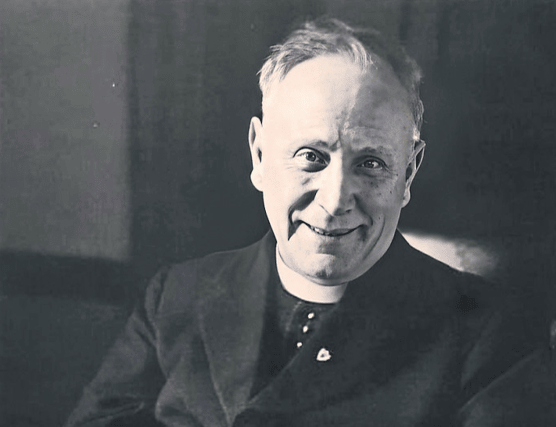


THIS WEEK we concentrate on the life and times of a great leader who improved the lot for people in rural communities which are now under threat with services being decimated at present.
Canon John Hayes was born into difficult circumstances in Ballyvoreen, Murroe, on November 11, 1887, during the land war. Five years earlier his parents, were evicted from their 49-acre tenant farm at Moher. They were evicted along with several other tenant farmers by Lord Clancurry in 1882. Soldiers and police surrounded the house, and his mother with a child in her arms, was driven from her home. The household furniture was thrown out on to the road and the roof was pulled down. The parents and young family were cast out into the unknown.
When John was born, the family were living in a temporary wooden hut, erected by the Land League. It was on a site, given by a kind farmer a mile away. He spent his first seven years, in the three-roomed hut, before the family returned to the farm. The living conditions were poor, and five children died there. It had only a stove to provide heat, and to cook for the large family. They cut turf and gathered sticks, to feed the stove, and they had no open fireplace. John suffered from rickets, leading to a stunted appearance.
The kindness shown by their neighbours, who rallied around helped them to survive, without their land for twelve years. In defeat they returned on the landlord’s terms, to their house in ruins, and their land in wilderness. The experience of the suffering and hardship left a deep impression on the young lad, and the neighbourly solidarity was to inspire him in later life.
John attended Murroe NS and later Crescent College, Limerick, travelling by cart and jennet, before entering St Patrick’s College, Thurles, as a seminarian. He received a scholarship to the Irish College in Paris, where he was ordained in 1913. He was known as the ‘’Poet Hayes’’ for his skilful and humorous compositions.
His time in France prompted a lifelong interest in European and international affairs. After a few short parish stints in Meath, and Wexford he was posted to the Liverpool docklands from 1915 to 1924. He helped to take care of the young and the poor around the city slums. Here he encountered the harsh plight of Irish emigrants, both southern Catholics, and northern Protestants. The appalling living and working conditions, fuelled a fire inside, and motivated him to do what he could to keep his own people at home, on the land or in some industry in rural Ireland.
On returning home in 1925 he served as curate in Ballybricken, and later in 1927 in Castleiney in County Tipperary. It was here he set up a branch of the Pioneers, and established an organisation, to improve the lot of local communities. Inspired by Flemish and French movements, he formed a farm producers’ group. Realising that this would cause friction, with other sections of society he decided to set up Muintir na Tire in 1937 as an inclusive, parish community movement in Tipperary Town, his then base.
It was a time of serious division in every townland and parish in Ireland. There were sharp divisions of social class, inequalities of status, class distinction, and outright snobbery. Canon Hayes wanted all these divisions to be set aside and be replaced by community spirit. The new organisation was received with enthusiasm, as well as opposition. He was a man with a vision and promoted its benefits, and in time Muintir na Tire flourished.
He was filled with optimism at a time when hope seemed to have gone out of fashion. He attempted to set up rural industries: The Angora rabbit scheme, tobacco growing, rhubarb growing - he tried everything. There were some failures, and many successes, and people began to have faith in themselves.
Lectures and Rural Weeks were organised and meetings, were held in icy cold schoolhouses, by candlelight. Delegates were sent to Dublin, to demand better water schemes, and telephone kiosks, for remote rural parishes. Community halls were built, and damp schools upgraded. During the war thousands of jobs were created providing turf and other necessities.
He was appointed Parish Priest, in Bansha, Co Tipperary in 1946, and progressed to Canon in 1954. He surrounded himself with a strong leadership team in Muintir. The organisation provided community information centres, (now known as citizen information centres) and community halls, group water schemes, Credit Unions, and community training, and it also encouraged rural communities to accept Rural Electrification.
Tom Fitzgerald served as his right-hand man for 10 years up to his death. He travelled the country with him as his driver, and personal assistant. The former chief administrator of Muintir na Tire, said: ‘’I first came to know him as a very kind priest, when I was an altar server. Then in 1946 he gave me a job at the new Muintir office in the town. He was a truly charismatic figure who attracted huge national and international attention. I remember traffic being held up for hours one night at Kildare, on the main road to Dublin, as a torchlight procession led him into town’’ he said.
A tremendous orator (Tom said Hayes developed his skills at a Hyde Park-type speakers’ corner in Liverpool) he spread the Muintir philosophy of self-help and community action ‘’much like Jesus proclaimed his message. Against a background of economic depression and lingering Civil War divisions, he brought people and communities together. He got people to set aside differences and think of practical ways to work for the common good.’’ Tom said.
‘”He was a warm magnetic man of the people, and he certainly lived out the advice given to him by a monk, when he was considering monastic life originally - ‘’it’s out there with the people you belong not in here.’’ He was an admirer of the work of Michael Davitt, and Padraig Pearse. The old Chinese proverb: It is better to light a candle, than to curse the dark was a favourite saying of the Canon. He died in February 1957 in a Tipperary nursing home, following a minor operation, and is buried in Bansha.
The country is certainly in need of Muintir na Tire at present, whose founding ethos, could be summarised as neighbourliness, self-help and self-reliance. One might use different terms today such as partnership, enterprise, and sustainability but the basic principles of 85 years ago still stand.
Last Friday was the anniversary of his birth, and now 65 years after his passing, rural Ireland was never in more need of a person with his leadership vision and determination. Dom Mark Tierney summed up Canon Hayes, as follows: ‘’ Muintir na Tire, is his monument, not carved in stone, but in the hearts and minds of the people of Ireland.’’