
Wild About Wildlife: Limerick training weekend out in nature

I was recently at a training weekend and while it was a lovely weekend away from the family most of the time was spent indoors. While the view through the glass took in green fields and hedgerows, there was strangely no way to open a window. I felt a bit claustrophobic and took any opportunity to clear my head by exploring the surrounding environment.
The best time was first thing in the morning and even away from home I am generally an early riser. I quickly sipped into my comfortable tracksuit and walking shoes and passed through the deserted grounds of the hotel. There had been a wedding reception on the previous night and there was no one else stirring. I was feeling very excited as there is nothing better than exploring a new environment.
As I approached the roundabout i was surprised that the road so busy at his early hour. I had to very gingerly cross the road
The hedgerow bordering the field was full of blackberries. They looked delicious but I am always cautious around picking in an unfamiliar location and beside a very busy road. Comfrey had also flowered in the field and this is an excellent flower for bumblebees. The leaves were once crushed and used to set broken bones and this gives the plant its alternative name of bone setter.
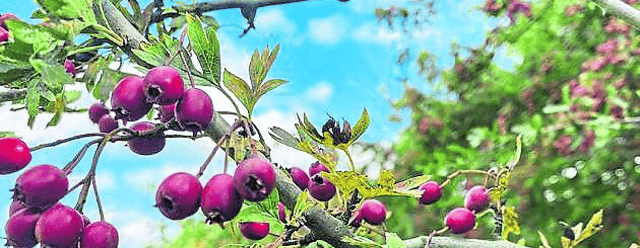
The hedge had an interesting mixture of tree and shrubs. Hawthorn was one of the main species and these were covered in red berries. These are delicious to eat and are very good for your heart. A tall ash tree had been left to grow and this will provide a spring singing perch for birds.
The next part of the hedge consisted mainly of elm. This is a natural indication that this is a very ancient hedge. It could even be the remains of a woodland that was cleared with only a narrow line of trees left standing.
Growing throughout the hedge there was honeysuckle interspersed with elderberry, rose hip and bramble. The flowers of the honeysuckle release their scent at dusk and attract night flying insects like moths.
The smaller flowers were equally as interesting. Broad leaved plantain was a close neighbour of a few garden escapes. I found the small pink flowers of oxlip and also a cranesbill with bluish flowers.
From the branches of a sycamore a robin was singing. I recently read that birds living in the urban environment with all of its associated background noise are evolving to sing at a higher pitch than their more rural cousins. When we are doing bat surveys and using the bat detectors it is interesting to see how much background noise is picked up that is beyond our normal hearing range. Birds like robins also early in the morning and late at night when the city environment is quieter.
The bright red berries of lord and ladies were growing at the base of the hedgerow. Despite their appealing look they are very poisonous.
The next field was full of beets and these were for fodder for animals. A few large trees had been cut down but had been left to naturally decay.
This had become a fabulous natural bug hotel and will house countless mini beasts and perhaps even hibernating frogs.
The alarm calls of a blackbird reminded me that it was time to turn back. There was just time to take in a beautiful garden full of black eyed Susan flowers and a large lime tree. Even the familiar wildlife becomes more interesting when explored in a new location.
For More
[email protected] or 089 4230502.