
An iconic moment for Tipperary hurling captured by John D Kelly

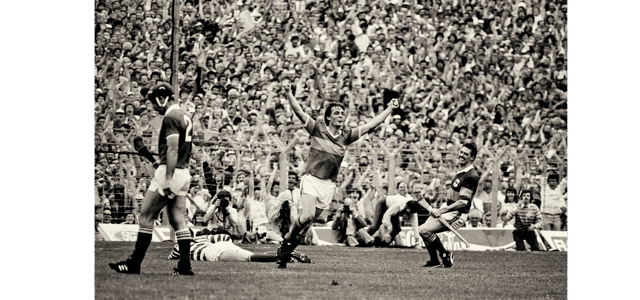

Visual Emotion - Clonmel Junction Arts Festival
Sport, but in particular Tipp hurling became a major part of John D Kelly’s life.
Whether the assignments on his work roster were an All-Ireland Final in Croke Park or Junior B hurling fixtures at grounds all over the county John approached them all with the same energy and treated them all with the same level of importance.
The sideline presence of John became a familiar sight on all GAA occasions, big and small.
Every weekend was taken up with covering GAA activities and he was fortunate enough to arrive in the game at a time when Tipperary hurling was undergoing a renaissance.
One of his best-known pictures captured an iconic moment in Tipperary hurling, one that symbolised the beginning of a new era after the long famine.
John was on hand to capture the sight of Nicky English turning in delight after scoring one of the most famous goals for Tipperary in Semple Stadium in 1987.
That iconic moment proved to be a major turning point for Tipperary hurling.
That legendary kicked goal earned Tipperary a Munster final replay and a pilgrimage of a trip to Killarney for the hordes of Tipp hurling supporters gripped by the sensation of a hurling reawakening.
“I will never forget the moment. English had just kicked the goal for Tipperary to get the replay. I had gone from taking pictures at junior soccer games where there were only a handful of supporters to taking pictures at hugely important matches taking place at the great stadiums in the country in front of 56,000 people. Tipp had been nowhere in hurling for years. Everybody got caught up in the moment,” said John.
The Clonmel photographer will never forget the thought process that went through his head in the seconds leading up to the English goal.
“There was only one frame of that English picture that was taken on a Nikon FM2. I was out at the 21-yard line. The ball was pucked out and I glanced down at the camera and saw that I only had one shot left on the 36 roll of film. At that stage of the game, I did not have the time to change the roll. It was instinct and there was an element of good luck that I did not use up that picture when the ball landed in front of the Cork goal or when Nicky kicked the ball to the net. I was fortunate to have one shot left for the celebration and it was that moment that meant so much to so many people and still does today,” said John.
“A sports picture is not just about the action, it is about the action, the emotion, and the moment all combined,” said John.
John very rarely felt as overjoyed as the following Thursday morning he was driving down to Anne Street from his home and saw a picture of Nicky English on the front page of The Nationalist, his picture, in the newsstand outside Tommy Maher’s shop.
“For me, that feeling was very special. It was my picture on the front page, I just could not believe it. Its appearance on the front page showed just how important that moment was to people at the time,” said John.
Reflecting on that period John feels privileged to have been The Nationalist GAA photographer at the time of the exciting revival.
Photographer Willie Boland had retired and John availed of the opportunity.
“It was 1986. I had never played hurling or Gaelic football. I remember driving to Kerry to my first match with the late Sean O’Driscoll. It was an U/21 football match and we had to stop to get directions on the way. ‘Follow the tar road’ was the instruction I received from a local. It was all new to me. I blended in and the GAA became a huge part of my life, I loved the atmosphere and the excitement of it all,” said John.
John was aware he was in a privileged position, he was as close as you could be to the hurling drama unfolding in the electric atmosphere of the times, the knockout Munster championship and everything to play for.
“It was do or die all of the time and you could really feel that when you were out on the pitch on the sideline with the camera. That all-or-nothing stake had a massive impact, you could not explain that to people now. The tension was unbelievable with over 50,000 people caught up in the action. The bigger the event the more heightened emotions were out on the field,” said John.
“It was an incredible feeling to be sitting on the sideline, the intensity of it all was in your face, it was amazing,” said John.
“I was lucky to be there, it was very special. These hurlers were real heroes to everybody in the county. I remember coming home from those matches and my uncle Toby, a real hurling man, just could not believe that I was out there on the pitch with those players,” said John.