
BIG READ: Tipperary woman's career change and 'swapping salon chairs for milking machines'
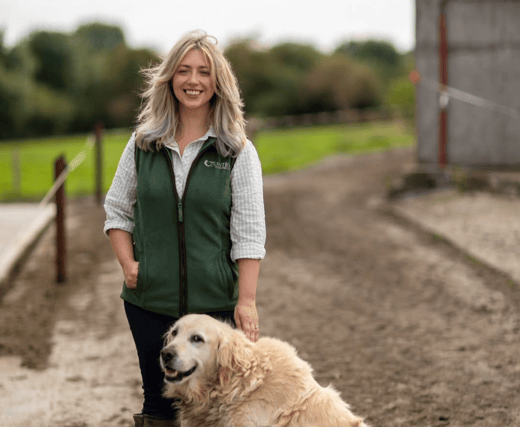

Katie Gleeson is an online content creator who documents family life on a dairy farm in rural Tipperary via her Instagram account @katieinthecountry.
Last week, I was profiled in a national newspaper about my career change from hairdressing to dairy farming.
It was a story about swapping salon chairs for milking machines.
I expected some reaction, but I hadn’t anticipated the flood of responses when the piece was picked up on 2FM Drive.
Listeners rang in to share their own career changes, from office jobs to carpentry, from teaching to tech.
It seems I’m far from alone in making a mid-life pivot.
Career changes are more common than we might think.
Studies suggest that the average person will switch careers three to five times in their lifetime.
In Ireland, many of these transitions happen in our 30s and 40s, when people reassess their work-life balance, financial stability, or simply decide to chase a long-held passion.
Some changes are voluntary, people seeking fulfillment, better conditions, or a fresh challenge. Others are forced by external factors, such as redundancy, industry decline, or economic shifts.
Farming, in particular, has seen its fair share of career pivots, often driven by policy and economic realities rather than personal choice. As I move into farming, its a sector at a crossroads.
With environmental policies tightening, fluctuating prices, and increasing costs, some lifelong farmers are stepping out of the sector entirely.
They’re diversifying into contracting, forestry, or agritourism.
Some are leaving agriculture altogether, taking jobs in advisory roles, education, or even tech, where their problem-solving skills and work ethic are highly valued.
This is not unique to farming.
Trade policies, government decisions, and market shifts have long dictated the fortunes of entire sectors.
A second Trump presidency, for example, had Irish dairy exporters watching nervously.
With 92% of our dairy produce exported, mainly to the UK and EU, but also some of it heading to the US, any changes in tariffs could have knock-on effects for farmers here.
Just as Brexit forced many to rethink supply chains and trade routes, potential US policy shifts could do the same.
So what does all of this mean?
For one, it highlights resilience and adaptability of people.
Whether chosen or forced, changing career requires a leap of faith, a willingness to learn new skills, and an ability to navigate uncertainty.
The days of staying in the same job for life are dwindling.
Instead, flexibility is becoming the most valuable trait in any industry.
If the reaction to my own story taught me anything, it’s that there is no ‘right’ career path, only the one that fits at a given time.
The teacher who left for the tech world, the office worker who became a baker, the farmer who pivoted to tourism: they all took a risk, just as I did.
And while it’s not always easy, it is often rewarding.
So if you’re standing at a crossroads, wondering whether to make a change, know that you’re not alone.
Whether by choice or necessity, career shifts are part of life.
And sometimes, the scariest leap turns out to be the best decision you’ll ever make.