
Combined sewage system in Thurles is impacting water quality say LAWPRO

Ireland will be fined for its failure to protect its water quality.
That is according to Director of Services for LAWPRO Anthony Coleman at this week’s sitting of the Thurles-Templemore Municipal District.
He said while Ireland still has until 2027 to meet its target, he does not think that we will.
It would be better, he said, to put the money into infrastructure now than fines later.
Mr Coleman was responding to councillor Jim Ryan on infrastructure problems in Thurles.
Following a presentation from representatives of LAWPRO on Tipperary’s water quality, Cllr Ryan said he was glad to have proof of the problem.
He said while the report was ‘shocking and disappointing,’ it wasn’t surprising.
Cllr Ryan said he and others have been raising the issues of the combined sewage system in Thurles for years. He said in times of high rainfall, raw sewage flows into the river Suir, causing pollution.
“You don’t need to be a scientist to see that the water (river) doesn’t move anymore,” said Cllr Ryan.
He said this has been raised with Irish Water. And he said it was ‘hypocritical’ to blame farmers when raw sewage is being allowed to flow into the river.
“I don’t think Irish Water is taking this seriously,” said Cllr Ryan.
Mr Coleman said that while ‘nobody can stand over that,’ it was the responsibility of the council to lobby Irish Water.
Last year, Irish Water told the Tipperary Star that the planned upgrade is in the design phase and due for completion in 2029.
This week, we contacted Irish Water for an update on the project. Their spokesperson said:
“Uisce Éireann is progressing plans to upgrade the waste water network in Thurles. The project is currently at the concept design stage.
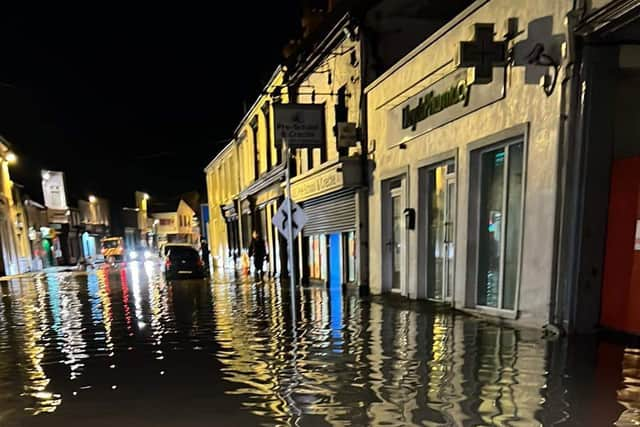
Flooding on Friar Street ,Thurles last year. During a night of heavy rainfall, the combined system got overwhelmed and flooded the street. Picture: Cllr Jim Ryan.
PRESENTATION
LAWPRO stands for Local Authority Water Programme.
Regional Coordinator for the LAWPRO south east and south west regions Fran Igoe said the aim of the presentation was to put in a local context some of the EPA reports members may have seen in the media.
In his presentation, he told the council that Tipperary had the worst water quality in the south east.
Water quality in Tipperary reduced to a 33% satisfaction rate. That is down from 61% 12 years ago.
River health has significantly deteriorated, particularly around Templemore and Thurles.
The presentation outlined several contributing factors, including agriculture, extractive industries and drainage systems, and septic tanks.
He said such ‘dramatic changes’ over a short period of time have knock-on effects to tourism, fishing, biodiversity and human health. Mr Igoe said LAWPRO is not an enforcement agency.
But it does work with industries to reduce their impact on water quality across the country.
This work includes supporting farmers upgrading septic tanks, providing seed money for community groups carrying out projects or raising awareness during special events like heritage week.
He said from an urban design point of view better, drainage systems in urban areas can reduce run-off of wastewater.
He said combined drainage systems that mix rain and wastewater can become easily overwhelmed in bad weather.
And based on their data, Thurles is suffering for its drainage system.
“That would indicate to us an issue with the combined system,” said Mr Igoe.
But he also said that there was no one factor but a mixture of issued that will get worse with climate change.
He said the key was to work together to plan ahead and find opportunities for improvement.
“A collaborative effort is needed to turn this around,” said Mr Igoe.
COLLABORATION
Responding to the presentation, Cllr Seamus Hanafin said he found it disappointing to see Tipperary have such a high level of deterioration.
But he wondered if water quality was getting worse everywhere and what might be the main cause.
Cllr Peggy Ryan said she did not think there was any point blaming any one group. Rather it was better to focus on solutions.
She did want to know when it came to restoration of areas, where the funding would come from.
Thurles Cathaoirleach Sean Ryan said there used to be smaller drainage committees, and he was sorry to see them go, as there was a need to bring stakeholders together.
Mr Coleman responded saying the main contributing factor is agriculture, and farmers acknowledge that.
However, the role of LAWPRO is to support farmers to do work on their land and limit their impact.
“We need farmers to step up and do the work on the ground,” said Mr Coleman.
Mr Igoe urged councillors to be ‘smart’ with their active travel and urban projects and to work with other industries and organisations.
He said it was up to all industries to do the work.
“What is required is for all agencies to work together,” said Mr Igoe.