
'Eighty-nine years ago I started school here and 17 years later I returned to teach'

Kilsheelan/Kilcash Notes
‘Eighty-nine years ago I started school here and seventeen years later I returned to teach’.
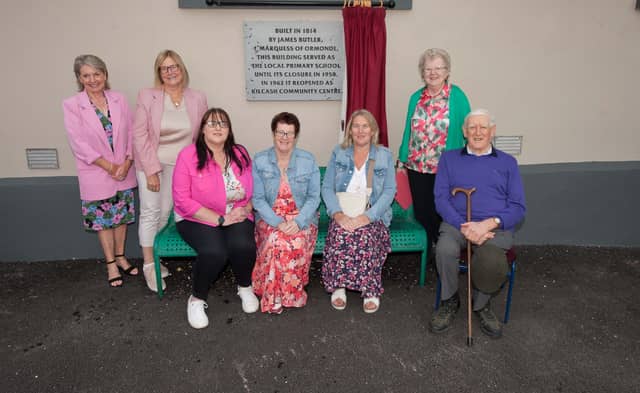
With these words Anna O’Neill Hutchinson proceeded to draw back the curtain on a newly erected plaque on the newly painted wall of Kilcash Community Centre, formerly the national school for the local area.
Locally, to those of a certain age, the building is still referred to as ‘the old school’ though it hasn’t served as such since 1958 and the opening of the ‘new’ school.
The plaque gives basic information about the origin and continued life of the building. And, indeed, it has an interesting history.
It was built in 1814 by James Butler, 1st Marquess of Ormonde as a primary school for the locality at a cost in the region of £1,500.
In its early years it operated under the Kildare Place Society. In 1831 Government provision for national school education began and in 1832 the parish applied to join the new system.
As ecumenical applications were encouraged there was a mix of Catholic and Protestant applicants.
Along with Fr. James Halley and his curate Fr. John O’Donnell, the Catholic lay applicants were: Richard Asper, William O’Carroll, Thomas O’Donnell, John Reilly, William and Roger Hannigan and William and Matthew Hyland.
An Asper, a Hyland and William Hannigan also appear on the Kilsheelan application in 1856. The Protestant applicants along with Rev Langer Carey were: John Barnes, John Barnes Jnr., James Kelly and L. Hoskins Tierney. The last two were also applicants for Kilsheelan school in 1856.
Schooldays were long – the school was open six days a week and in summer the school days ran from 8 am to 5 pm. In winter the days were somewhat shorter, running from 9 am to 3 pm.
In 1835 Kilcash Boys’ school had 86 pupils who were instructed in bookkeeping, geography and the ‘hree R’s’. In the same year the Girls’ school had 76 pupils enrolled.
Their subjects were reading, writing, arithmetic and needlework.
The children paid a penny a week which was supplemented by a payment of £10 annually from the National Board.
Some random pupil and teacher numbers – 1843: 120M and 101F with a male and a female teacher. 1849: 62M and 28F with one male teacher. As the intervening years were those of the Great Famine this may well have a bearing on the numbers.
At this time and leading into the 20th century, one family in particular had a long teaching association with Kilcash School. Thomas Manning began teaching in 1847 and members of the Manning family continued to teach until 1951 with the retirement of Kitty Manning.
At this point Anna O’Neill Hutchinson returns to the story of the school. Having received her primary education in the ‘girls’ room’, Anna went on through secondary school and teacher training college to return as primary school teacher Miss O’Neill. Anna taught in the old school until transferring to the modern new school in 1958.
She continued to teach in Kilcash NS until her retirement in 1990.
Beir beo go deo, Anna.