
Tipperary need big improvement for tricky assignment against Waterford

Tipp looking for first championship win at Walsh Park in 30 years
It may be just the first round of the championship but already things are looking ominous for Tipperary. The hoped-for step-up from league form didn’t happen. We hung on to limit the damage to just four points but it was a minor comfort on a day of major discomfort.
Walsh Park this Sunday now looks even more threatening.
Sometimes the warm-up routine of a team can offer little hints of the day’s mood. Tipperary’s preamble on Sunday looked laboured, with lots of dropped balls and second-bite control attempts. It wasn’t crisp and there was no energy vibe coming from the group.
Unfortunately, the throw-in didn’t signal much change. This was a plodding, sluggish performance, one that bodes badly for the remainder of the series.
Fortunately, Cork didn’t dazzle in the first half either. It was a strange half, very broken with little flow or intensity. Darragh Fitzgibbon stormed into the match with four points in ten minutes – and then disappeared. Bryan O’Mara takes some credit for the shift.
Wayward free-taking by Tim O’Mahony helped keep Cork in check and Tipperary worked a decent string of points. Two apiece from Jake Morris and Oisin O’Donoghue were noteworthy; Jason Forde found his radar on the frees after an opening miss.
Ultimately, the first half was neutral, the teams locked at 0-13 apiece at half-time. There was a sense at the break that this game still had to happen. It was as if the build-up had shackled the players and the game had still to open up.
When the match did eventually explode in the second period it was Cork who found the gears and we were left hopelessly in their slipstream. A red wave gathered momentum and worryingly we had no response. As the man said, Goodnight Irene! The lead eventually stretched to nine points before Alan Tynan’s brilliantly-struck goal, plus a few late points, earned some respectability for the home side.
Modern punditry is dominated by stats; for some they are the be-all and end-all of every game. For me they merely give mathematical evidence to support your impression of the game. They rarely reveal anything of surprise.
And so, it will be no shock to read that Tipperary didn’t score from play in the second half until 64 minutes. Or that Cork outscored us by 0-11 to 0-1 between the 44th and 59th minutes. That’s when the game was won and lost; that’s when Tipperary wilted.
Other stats of relevance: Cork’s starting half forwards of Fitzgibbon, Barrett and Walsh shared 12 points evenly between them; Tipperary’s starting half line of Morris, Ormond and O'Donoghue managed just 0-4. Cork’s starting six forwards hit a combined total of 0-20 from play; Tipperary’s front six signed off on 0-5.
In every metric that has been produced Cork were streets ahead of us in this game. For example, Tipperary won just 65% of Rys Shelly’s puckouts, whereas Cork won 85% of Patrick Collins’s restarts. That’s a particularly damning statistic. If you can’t profit from your restarts then what hope in broken play?
Ironically, one of Rhys Shelly’s main claims to the number one jersey, ahead of his rivals, is his precision puckouts. So, was this a goalkeeping failure? Not really. He may have misplaced some but mostly he had nothing to aim at because we were failing so badly outfield. How often did we see him delaying the puckout as if waiting for something to happen, some movement - and usually waiting in vain.
It serves to illustrate the collective nature of a team sport like hurling. What happens in one line affects what happens elsewhere. The entire Tipperary full forward line on Sunday was replaced but the supply of ball into them at times was woeful.
Interestingly, Cork appeared to deliberately deploy centre back, Rob Downey, to man-mark Stefan Tobin. It looked like a calculated attempt to discourage a talented youngster on his debut. It’s a tactic that Brian Cody’s Kilkenny regularly employed. We remember it particularly when Shefflin played that role against Paudie Maher and later Cathal Barrett as they were making their marks at senior level.
The Swans' lad need not be discouraged. He worked hard, won a free and should have had a few others. He’ll get plenty more opportunities, hopefully on winning sides.
Ironically, when Downey returned to the half line in the second half, he had a major influence on the game, especially in establishing air superiority. Andrew Ormond is a fine player in many ways but the high ball is not his speciality. Raining high ball in the Cork half backs is foolish.
That Cork half back dominance in the second half was a major stumbling block for Tipperary. Conversely, it was a great launch pad for Cork to supply an attack where newcomers, William Buckley and Barry Walsh, thrived. They represent a major positive for Cork in this campaign.
A final reference to the statistics: Cork had 15 wides and Tipperary had just five. Cork had 44 shots on goal, Tipperary had 30. Just in terms of volume alone, those figures indicate the major gulf between the teams.
It’s a real worry for Tipperary now ahead of the trip to Waterford. Could any Tipperary players be happy with their performance? Very few. The subs did make some impact, with Sam O’Farrell and Darragh Stakelum getting on the scoresheet, while Darragh McCarthy was faultless on the four frees he hit. That was despite the boo boys from Cork who again demeaned themselves.
Oisín O’Donoghue was arguably the one Tipperary player who contributed best to the team effort. He scored 0-2, was involved in several assists and was fouled for a number of other scores. Besides, his physical ability to hold up the ball in attack is a major asset. His development this year is impressive.
The upshot now is that we head off to Waterford on Sunday in downbeat mood ahead of a tricky assignment. We’ll be favourites but we’ll need a major step-up in form for a game that is a must-win. Defeat here will almost certainly doom our prospects, so there’s no hiding place. I expect a sharp reaction to the Cork defeat.
Waterford may have lost their opening bout to Clare last Sunday but their 4-21 score won’t have gone unnoticed. The goals kept them in the contest at different junctures but having that capacity makes them a real threat. Stephen Bennett’s form and Austin Gleeson’s return are definite plusses. Two years ago, we drew at Walsh Park; our last win there, believe it or not, was in 1996.
Elsewhere, our minor hurlers followed up their opening-round win over Clare with an equally impressive success over Cork last Friday evening at the Stadium. It was a very different game to the previous round but an equally delightful outcome.
There was just a point in it at half-time, with Tipperary leading 1-6 to 0-8. Chris Dunne dispatched the goal from a penalty after Zack O’Keeffe was fouled. Cork came strongly in the second half before Tipperary put in a rousing finish. Conall Morrisson fed KJ Dunne for a crucial second goal and a flurry of points rounded it all off. The end margin was seven, belying the earlier tightness.
It was far from the shootout spectacle of the opening round, which in a sense makes it all the more admirable. This time they had to win differently and found a way. After leaking 3-19 to Clare the first day, the defence, led by James Finn, was much more miserly this time, conceding just 0-16.
That defensive security plus the forward flair of the Dunnes, Morrisson and company was too much for Cork. Ciaran Gantley’s 0-2 coming off the bench was also noteworthy.
Heading the group now on four points, they seem assured of All-Ireland action. What remains is to make the Munster decider as one of the top two. Away games to Limerick and Waterford will test the team’s roadworthiness.
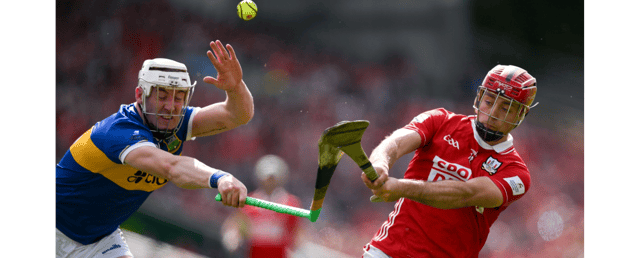
Tipperary's Eoghan Connolly breaks his hurley as he attempts to block a shot by Cork's William Buckley of Cork during last week's match in Thurles. Picture: Sportsfile