
The time when the Berlin Wall came tumbling down

MEMORIES OF THE IRON CURTAIN
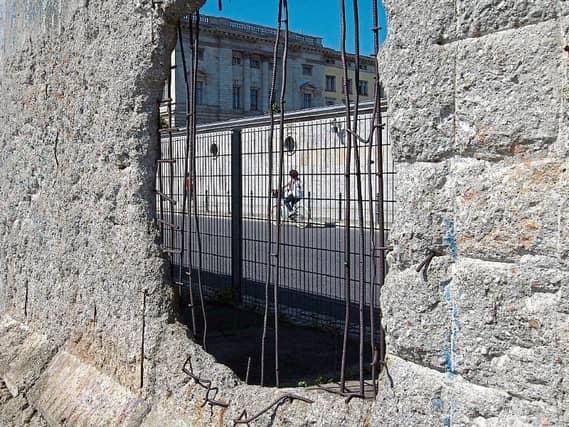
The wall, which Winston Churchill described as the Iron Curtain, came tumbling down 30 years ago, an event which was recently celebrated in Berlin. It didn’t just tumble, it was joyfully, gleefully hacked apart by the ordinary people who had been kept separated by it for decades. Small chunks of the masonry, which symbolised that separation, are still treasured by many people. These became the symbols of the birth of a new democratic era in Europe.
I became aware of the realities of the wall on my first visit to Bavaria, when I awoke to the loud noise of mechanical vehicles. On looking out the window I saw several large tanks driven by the United States soldiers stationed at the nearby US barracks. I was told that the tanks were being driven to the local railway station for loading on to special trains which transported them down to the borders of Czechoslavakia, then in the so-called Eastern Europe.
And there, on the borders of the then Western Europe they engaged in military exercises. Very often the army of Eastern Europe would hold similar exercises at the other side of a narrow mined no-man’s area which marked the highly-defended border. It was a show of strength between democratic West and dictatorial Communist East. What you can do I can do better.
The actualities of that divided Europe for ordinary people I discovered several years later, following the destruction of the wall and the reunification of Germany. This was in a small village just a half-kilometre on the western side of the border. A wooden signpost mapped the way through a track in beautiful woodland which led to another track which marked the border. Once a strictly no-go area, it led to a hilltop summit from which there was a view of the neighbouring village, with its church and adjoining cemetery.
Located a few yards on from what was once the western side, I found an inscribed modest memorial in limestone, which stated that from this small area people could look down on the cemetery and “attend” the funerals of their relatives and friends from whom they had been separated by a track in a wood, by the toxic politics of the time and by the inflexible officialdom which could not facilitate the natural mourning of the bereaved.
I had already experienced one small element, and indeed stupidity, of that inflexibility. This time came in 1984 for a visit to a family member then living in Czechoslovakia. For this it was necessary to obtain a Visa, but Ireland did not have any Embassy in Dublin and all applications had to be made through the London Embassy. This was long before the time when information became available via the computer, so first it was necessary to confirm address in London.
A letter requesting a Visa brought a bulky response: two pages in the application forms and several pages of instructions. Send current passport it said, give precise details of dates of arrival and departure; means of travel (plane or train); reasons for travel; in the case of a private visit, the names and addresses of people with whom one intended to stay. Enclose bank draft. Here, the instructions did not make any reference to the fee payable by citizens of Ireland, but did indicate that required of British citizens, which was 20 shillings per applicant, so I sent a draft for 40 shillings to cover applications of husband and self. Allow six weeks for processing, the instructions said, so I booked airline tickets three months ahead. Just to be on the safe side, I said. The lot was sent by registered post.
Six weeks passed and no response. I telephoned the Embassy and was curtly told that Mr. So-and-So who dealt with such matters was “in conference.” Two months passed, and I now began to worry about our passports, precious documents, which, as I saw it, were now in the hands of a foreign and not very accommodationg Embassy.
Two more weeks and a phone call to the Embassy. Mr So-and-So was still “in conference.” A few days later, however, a letter arrived returning bank draft for 40 shillings and requested instead a draft for 25 shillings, since the fee per person for Irish citizens was 12 shillings and 6 pence. Just four days before proposed departure, passports and visas finally arrived, with instructions that we should check-in to the nearest police station within three days of our arrival.
Following a flight to a German airport and a train journey, we crossed the grey forbidding border; armed soldiers, accompanied by dogs; barbed wire; detailed examination of luggage, personal inspection; change of currency, two hours delay and we were on our way.
Our host met us at the railway station of a once gracious city. We walked to his apartment, located on the second floor of the large house which he once owned, but which had now been appropriated by the State (no compensation) and converted into three apartments. Some distance from the front door he asked us to remain silent (and certainly not speak in English) as we passed the consierage’s office and climbed the stairs.
Next day we walked in bright sunshine through a charming but now neglected square to the police station. Our host, a man of many languages, was chatty and joking until we reached the station where our documents were handed over and we were directed to a second floor waiting room, where he lapsed into complete silence, and so did we. An hour later, having regained our documents, we came out once more into the sunshine, and he returned to his affable chatty self once more.
Walking through the square again, I recalled that someone once wrote that democracy was probably the most cumbersome, slow-moving, inefficient form of governance that exists - until one considered the alternative.
And I promised myself that I would never ever again miss the opportunity to cast my vote in any future local or national elections - the bulwarks of our Irish democracy.