
Tipperary man believes great-grandfather was present at the founding of the GAA

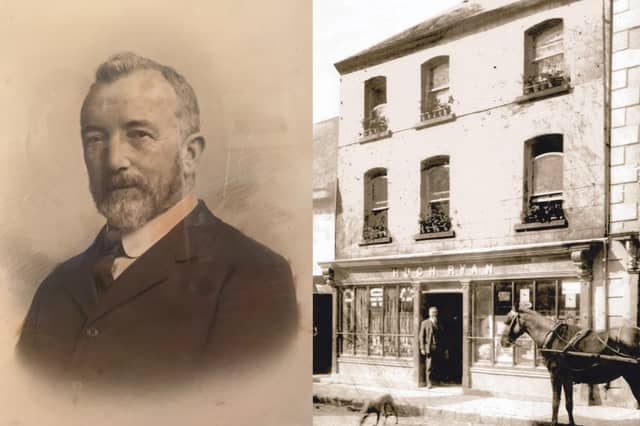

Hugh Ryan of Thurles believes his great-grandfather, also Hugh Ryan, was one of those present at the founding meeting of the GAA on November 1, 1884
Tipperary’s Hugh Ryan is compiling a case for the fact that his great-grandfather, Hugh Ryan, attended the founding meeting of the GAA on November 1, 1884.
Hugh began piecing evidence together some years ago, following the passing of his father, who had long believed his grandfather to have been one of those present at the meeting.
As previously discussed in the Tipperary Star, edition dated November 19, 2026, it had long been believed that seven people attended the meeting in Hayes’ Hotel.
Tipperary’s Tadgh Dwyer however reached out to this paper with evidence to support his claim that many more had in fact also attended the meeting.
Upon reading this piece, Hugh Ryan also reached out to the Tipperary Star, showcasing evidence that his great-grandfather may have also been present at this meeting, providing us with his own written piece containing some of the information he has been able to find so far during his studies.
His piece reads as follows: “Was Hugh Ryan of West Gate, Thurles, among those present when the Gaelic Athletic Association was founded at Hayes’ Hotel on 1 November 1884? A newspaper report published two days later, read alongside family testimony and evidence of his prominent role in the early Association, makes a strong case that he was.
“Accounts differ on how many people attended the meeting. Thirteen are named in some histories, while Cork GAA’s published history allows for as many as fourteen. At the heart of Hugh Ryan’s case is an important distinction in the Cork Examiner report published on 3 November 1884 just two days after the foundation Meeting.
“The report lists “Mr O’Ryan (Thurles)”, followed by Mr Wyse Power and then “Mr Ryan, solicitor, Callan”. John McKay, who attended the meeting and is credited with writing the report, thus recorded two separate entries, with another attendee between them. Only the Callan man was identified as a solicitor.
“Michael Cusack, co-founder of the GAA, described Joseph P. Ryan as a solicitor of both Callan and Thurles. This has led to an interpretation that the newspaper’s two entries refer to the same person.
“That interpretation presents a difficulty: it requires an eyewitness to have listed one man twice, under different descriptions, with another attendee between the entries. The more straightforward reading is that McKay was recording two men.
“The question is whether the Thurles man was Hugh Ryan.
“His family has long maintained in published accounts that he attended the founding meeting. His great-grandson, also Hugh Ryan, recalls being told this by his father from childhood. The family explanation was that Hugh appeared in the report as “O’Ryan” because of his membership of the Irish Republican Brotherhood.
“Published historical work identifies Hugh as an IRB member. The suggested connection between that membership and the newspaper’s use of “O’Ryan” remains family testimony, but the variation in the name should not, by itself, rule him out.
“Other names in reports of the foundation have required interpretation. The Tipperary Leader’s “E. Dwyer”, for example, has been read by historians as T. K. Dwyer. There is a reasonable argument for applying similar latitude to the “O’Ryan” entry.
“The family’s identification also fits Hugh’s standing in the Association’s earliest years. He is reported to have attended its second meeting at the Victoria Hotel in Cork, as a Tipperary delegate. His subsequent activities place him firmly among those who helped establish the GAA in Thurles.
“In 1886, Hugh chaired the organising committee for the Monster Hurling Tournament, which drew an estimated 15,000 people to the town. The following year, Michael Cusack credited his “Herculean work” with the Association’s success in the area. During the split in the GAA, Maurice Davin named Hugh first in a letter proposing a provisional committee.
“Special Branch reports describe Hugh’s West Gate public house as a meeting place for the early Association. One claimed that no important decision in the GAA was taken without his approval. Such reports must be understood as the observations of police watching the organisation, but they nevertheless provide evidence of the influence attributed to him.
“In The Hurlers, historian Paul Rouse places Hugh at the head of the Thurles and Meelick teams as they assembled in Birr for the first All-Ireland hurling final in 1888.
“The assessment published after his death was equally striking. In its 1919 obituary, The Nationalist described Hugh as “mainly the founder” of the GAA in Thurles and said that he took “a most active and prominent part in its inauguration in the district”.
“Those words concern the Association’s establishment locally; they do not explicitly place him at Hayes’ Hotel. His later prominence likewise cannot establish his attendance on its own. But both give weight and context to a family tradition that identifies him with a separately recorded Thurles attendee in the contemporary report.
“The case therefore rests on several connected strands: an eyewitness account that appears to distinguish two men; a longstanding family identification of the Thurles man as Hugh; and a documented record of leadership in the early GAA.
“This does, however, provide substantial grounds for recognising Hugh Ryan as a probable attendee at the founding meeting, rather than treating the two newspaper entries as an established duplication.
“The Cork Examiner report and The Nationalist obituary survive, and the family can also provide Davin’s letter and the Special Branch reports. The family would welcome a fresh examination of the evidence for identifying “Mr O’Ryan (Thurles)” as Hugh Ryan of West Gate.”
If you have any more information regarding this evolving story, contact us at [email protected].