
Tipperary's Killoskehane Castle opens its doors for a pre-Christmas gallery
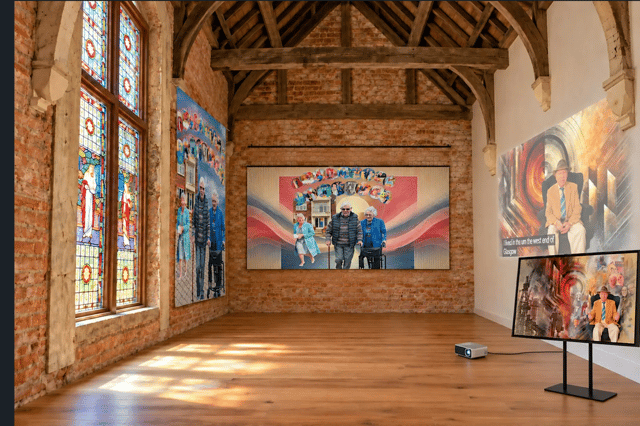

Killoskehane Castle in Borrisoleigh, north Tipperary, opens its doors later in November for a special art exhibition celebrating ageing, with AI helping to prompt memory of things of which no pictures exist
For two days this November, the privately owned Killoskehane Castle outside Borrisoleigh will open its doors as a gallery. Owners Alex and Kolin have dressed Killoskehane Castle for Christmas and handed its rooms over to the life stories of older people, from travel memories in the lounge to a farming life near Cork in the kitchen.
This free exhibition is on the doorstep in north Tipperary, and makes a ready-made pre-Christmas family outing: walk the rooms, then rearrange old photographs on the dining-room platters into your own family's story.
The Long Becoming, a digital collage artist Dr E Alana James, fills the castle with life-story portraits of people in their 70s, 80s and 90s, built from interviews, family photographs and historical imagery.
The Long Becoming treats late life not as decline but as accumulation: a long becoming. Each portrait starts with a recorded conversation and ends as a layered collage in which a face sits among the places, objects and moments that shaped it, with abstract colour fields carrying the "feeling tone" a photograph can't.
The work asks what a portrait is when it is co-authored: the sitter remembers, the artist researches and proposes, and the sitter decides what is recognisably theirs. The result sits somewhere between portraiture, oral history and collective memory.
James uses AI image generation as a research and drafting tool, not a substitute for memory.
Where no photograph exists, such as a childhood street, a dance hall, or a first emigration, she generates candidate images and brings them back to the sitter, who accepts, rejects or corrects them. Only what the sitter recognises enters the collage. These generated images are openly presented as interpretations, not archival evidence, and are captioned as such. That transparency is part of the work's argument: memory is itself a reconstruction, and the portrait makes that process visible rather than hiding it.
The show is particularly relevant now as Ireland, like much of the world, is ageing: the UN projects that by 2050 roughly one in six people worldwide will be over 65.
At the same time, the generation now in its 80s and 90s holds first-hand memory of an Ireland: rural, Catholic, emigrant, pre-digital, that is disappearing.
Public debate about AI and images has mostly been about fakery. The Long Becoming offers a counter-model: generative tools used slowly, consensually and with the subject in control, to recover what was never photographed.
The exhibition is open on Friday November 27th and Saturday November 28th. Although free,booking is recommended. More can be found on Eventbrite.