
Walkers take part in special commemorative walk in Tipperary
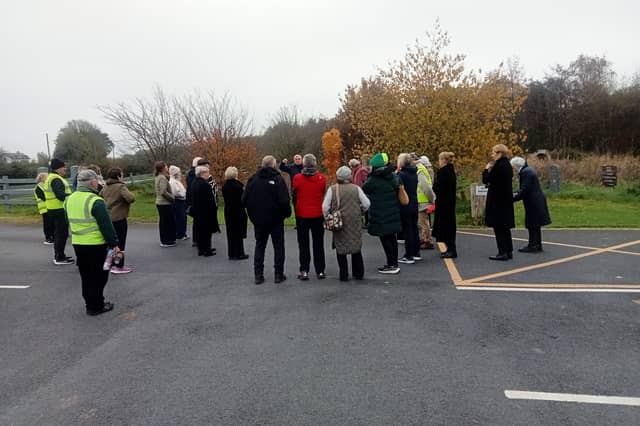

The commemorative walk from Holycross Abbey to Cabragh Wetlands took place on Sunday November 8
On a dull but dry day a group of walkers left Holycross Abbey heading for Cabragh Wetlands.
The walk took place to commemorate an invitation which was extended to the Cistercian Monks of Holycross Abbey 700 years previously by Lord Fertiana the local landlord.
It all took place because the monks were in urgent need of fuel, specifically turf.
They needed this to sustain an immense catering operation.
Pilgrims arriving at this sacred place were granted two nights bed, breakfast and evening meal entirely free of charge before vacating the room on the third morning for the next person in line.
Fulfilling this hospitality was a massive, full-time undertaking, as it entailed feeding the Abbey-staff, the monks, the lay brothers, and the workers.
The monks lived by strict but simple rules, for example rising at 2:10am, praying every three hours and fasting until 2:30pm.
The kitchen inventory was equally disciplined, restricted to just three pots of hot water; one for beans, one for vegetables, and one for washing up, and three ladles, one for serving beans, one for serving vegetables and one specifically for placing turf on the fires.
Heating was confined to the calefactory - a small room near the kitchen containing the only fireplace in the building at which the Monks could warm themselves after their early morning prayers.
By rule this fire could only be lit on November 1 and had to be extinguished on Easter Sunday regardless of the weather outside.
Turf was the essential fuel-source of the era and while an ample supply existed in a bog on the outskirts of Thurles, accessing it presented a challenge.
The most direct route, through Fertiana, required crossing private land.
In the 1300s Fertiana was its own extensive parish encompassing Galbertstown, Cabragh and Turtalla as well as the area we now know as Fertiana.
To facilitate Holycross Abbey, Lord Stapleton, the landowner, in the year 1326, exactly 700 years ago, granted the monks verbal permission to pass through his property.
This verbal agreement stood for decades until early 1360s when Lionel, the son of King Edward III, introduced the Statutes of Kilkenny which placed stringent restrictions on contact between Anglo Norman settlers and the native Irish.
To safeguard the arrangement, the Stapleton family formalised their promise in writing as a deed, which read “We hereby give permission to the Abbot and convent of the blessed Virgin Mary of Holy Cross and their successors, to go and return through the lands of Fertiana with their horses their carts and their cars to carry turf from the abbot’s bog.”
The exact location of the Abbot’s bog remains somewhat unclear, though it is believed to have been situated in the area of Lisnagonoge which extended to the townland of the Commons. Therefore, the bog was possibly somewhere between Cabragh Castle and Thurles Golf Club.
700 years after that historic right-of-way was first granted, Cabragh Wetlands invited people to honour that legacy by travelling from Holycross Abbey to the Cabragh Wetlands.
People were invited to walk the route, or to drive. People wishing to walk were asked to assemble in the cloister after Mass where stewards were on standby to lead the group.
Participants were welcomed to Cabragh Wetlands by historian Jimmy Duggan, who spoke of the rich cultural heritage of the area.
This was followed by light refreshments and beautiful music and chat.
Sincere thanks to Father Celsus for including this commemoration in the Sunday Mass.
A special thank you to Cecilia, Una, the choir and musicians for providing such beautiful music for our liturgy today and later at Cabragh Wetlands.
A special thanks also to Michael Long of Cabragh Wetlands.