
FEATURE: Bright sparks from Kildare schools take part in BT Young Scientist and Technology Exhibition 2023

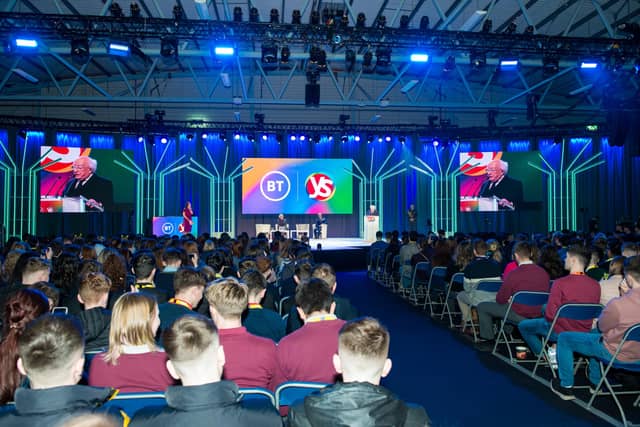

Kildare Live journalist Ciarán Mather spoke to a number of the brilliant students at the RDS in Dublin
After two years in strict Covid-19 restrictions, the BT Young Scientist and Technology Exhibition (BTYSTE) is finally back in full-force; and all without the need for a NASA centrifuge.
Eight schools from County Kildare took part in this year’s highly-anticipated science competition: Maynooth Post Primary School, Celbridge Community School, Confey Community College (Leixlip), Coláiste Lorcáin (Castledermot), and St Paul’s Secondary School (Monasterevin).
In addition, there were projects from Newbridge College, Coláiste Naomh Mhuire (Naas) and Gaelcholáiste Mhaigh Nuad (Maynooth).
The Leinster Leader attended the illustrious ceremony and sat down with a few of the different participants to discuss their projects, their motivations, and their goals for the future.
NAAS
Speaking about their project, Sinead Byrne and Ellie Coffey, two Transition Year (TY) students from Coláiste Naomh Mhuire, said that they wished to aid people in developing more eco-friendly habits; a very relevant topic in this day and age.
Titled 'Green habits: An app that helps users create eco-friendly habits', the pair devised an app that offers useful tips that may seem small, but make a big difference.
So far, it has been trialled with 200 students, with very positive results.
Such tips provided include drying clothes outside, and cutting down on meat.
Explaining why they chose to set up the app, Sinead said that the duo are both involved in their green school committee, and are 'very passionate about protecting the environment.
Ellie added that she intends to study climatology when she goes to college.
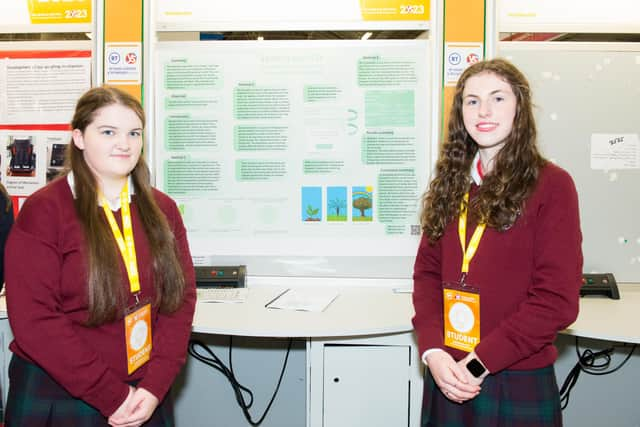
Sinead Byrne and Ellie Coffey
Two other students from the school, Róisín Dunne and Arianna Petley, were inspired by the legendary Leonardo Da Vinci, with their project, 'Leonardo Da Vinci’s Inventions: Comparing Yesterday With Today.'
The ambitious project involved the duo examining his blueprints for a variety of modern-day inventions, such as parachutes, and how they held up to their modern counterparts.
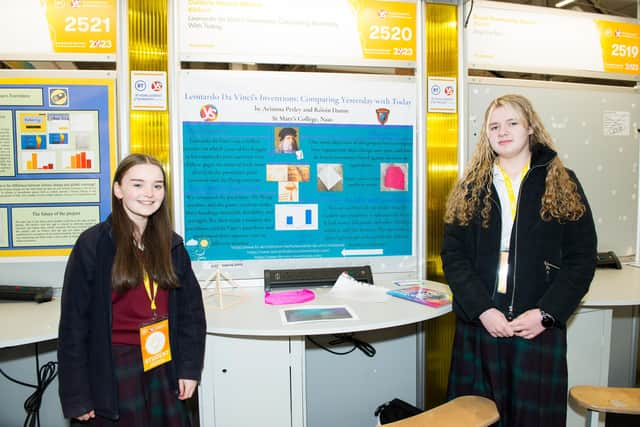
Róisín Dunne and Arianna Petley
Róisín, who was also guided by Ms Hennessy, added: "I have always been drawn to him; he was a man of many talents, and had a very brilliant and inspiring mind."
Needless to say, Róisin said she wishes to pursue engineering in the future.
NEWBRIDGE
Another student, Tara Mulhall of Newbridge College, focused her project on 'forecasting an individual’s political leaning based on their social media profile.'
The fifth year student, who was guided by teacher Dermot Walsh, said that she was inspired by her wish to combine art, politics, psychology and technology, in addition to her research on the 2018 Cambridge Analytica data scandal.
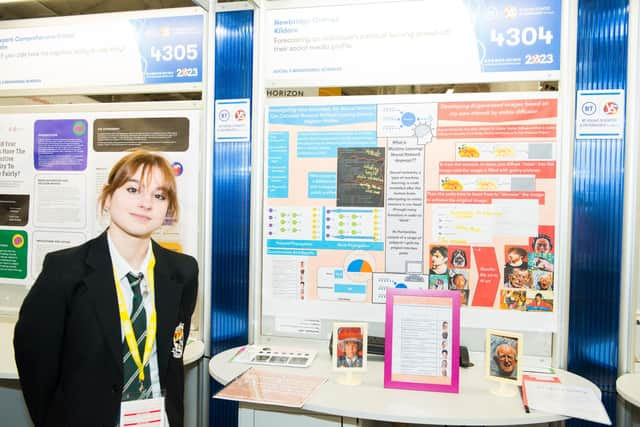
Tara told the Leader: "I wanted to show that by using machine learning, that it can be a tool for science, art and people."
She added that she 'scraped' the publicly-available data of a number of Instagram profiles in order to discover their political leanings.
From this, her programme learns from the data and can accurately predict people’s political leanings.
In addition, she used an Artificial-Intelligence art generator as part of her experiment to generate images based on the input submitted from the person into the programme.
When asked about her career, she said: "I think I would go down a more science route, because I can always do my artwork in the background, but I do feel like I look at things from an artist’s point of view, which in a weird way kind of helps me."
Tara later achieved first place in the Senior Individual category for her project.
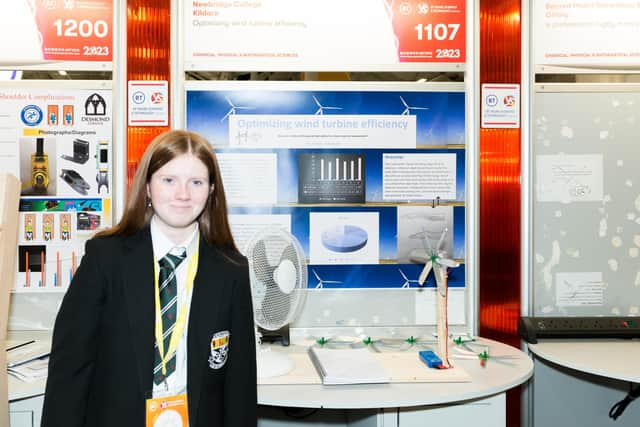
Emily Johnson
Meanwhile, first-year student Emily Johnson, also from Newbridge College, chose to focus her insightful project on 'optimising wind turbine efficiency.'
Emily told the Leader that she has always enjoyed reading about science, and cites Albert Einstein as an inspiration for her.
As part of her project, Emily, who was supervised by teacher Anne-Marie Davis, investigated the variations of blades for wind farms, and which ones produce the most electricity.
She explained that she measures the voltage, current and amps, which in turn allowed her to calculate the number of watts produced.
Emily also said that she is passionate about fighting global warming and women in STEM.
On the latter point, she said: "I would like to see more women in science.
"It’s limited for women at the minute, but hopefully it won’t be (this way) in the future."
Emily won first prize in the Junior Individual category for her project.
MAYNOOTH
Níamh Másún, a second-year student from Gaelcholáiste Mhaigh Nuad, aimed to please with her project 'Combinational games: what happens when the rules change?' (translated from Irish).
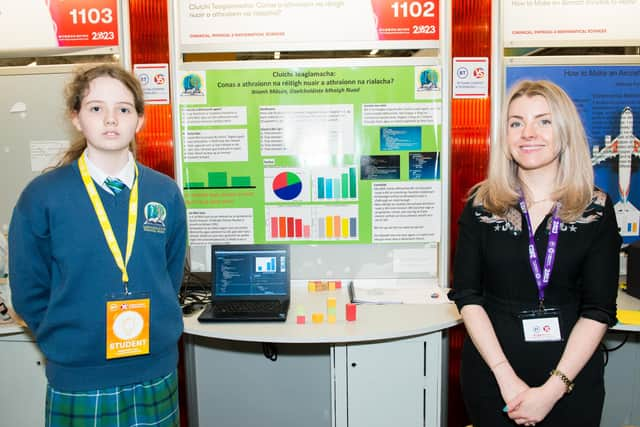
Níamh Másún with teacher Maria Ní Ghóillidhe
She praised her teacher, Maria Ní Ghóillidhe, for her help, and Níamh said was with her 'every step of the way.'
Níamh also used coding as part of her project: "I found it easy to get into, which is good because I didn’t do any coding before I started this project, but I am interested in learning more about coding."
Two TY students from another Maynooth-based school, the Maynooth Post-Primary School, also honourably endeavoured to raise awareness about blood transfusions through their project, 'An investigation into the practicality of proliferating blood transfusions and to discern why there has been a decline of donations in Ireland in recent years.'
Niamh Barry and Anna O’ Flaherty, who were supervised by teacher Catherine Roche, wished to emphasise the importance of blood transfusions, while Anna was especially inspired as she had a loved-one who underwent a very important transfusion procedure.
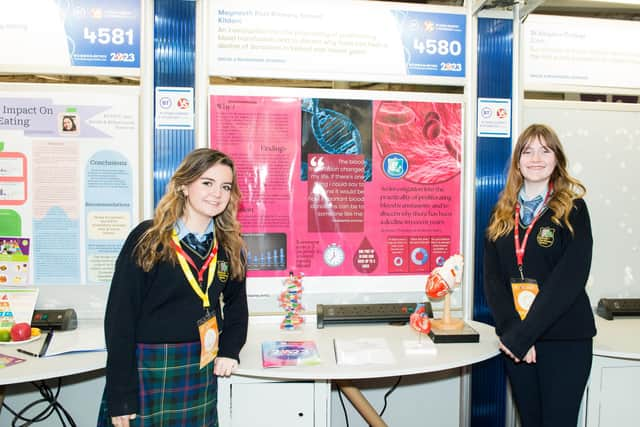
Anna O’ Flaherty and Niamh Barry
Commenting on their project, Anna said to the Leader: "We found that there is a lot of apathy around blood donation, so we decided that this project would be the best way to survey and educate people about giving blood, and maybe we can save a few lives through it too."
The pair also said that they welcomed the field of science and technology being more accepting of women, and pointed to there being less misogyny in the field compared to the science-sphere of the past.
Both of them won a Display Award for their project.
CASTLEDERMOT
Alex Gaffney and Oisín Hanberry, two TY students at Coláiste Lorcáin, also posed a very simple but nevertheless intriguing question: 'Do slogans on bins boost recycling?'
Alex said that he was 'curious to see the difference' between a bin with a slogan and a bin with no slogan or a generic slogan.
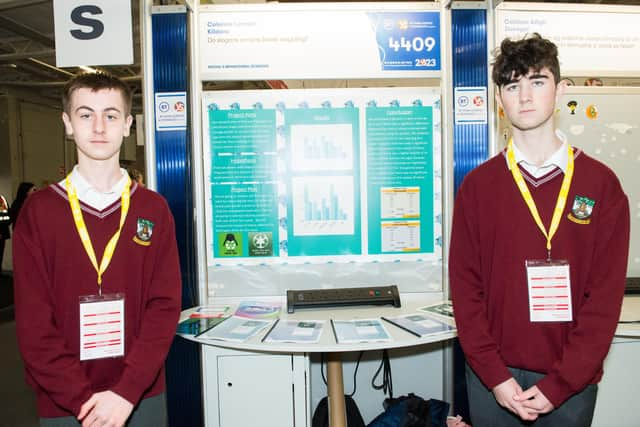
Oisín Hanberry and Alex Gaffney
"I myself would be more likely to recycle if I see, like, a funny slogan, and I will remember it," he added.
The pair both agreed that while he did not previously have a big interest in environmental issues, but over the course of setting up their experiment, they have since become more interested in environmental protection.
They also said that they both would be considering pursuing a career involving environmental protection in the future.
Alex and Oisín were aided by teacher Amy Sullivan.
CELBRIDGE
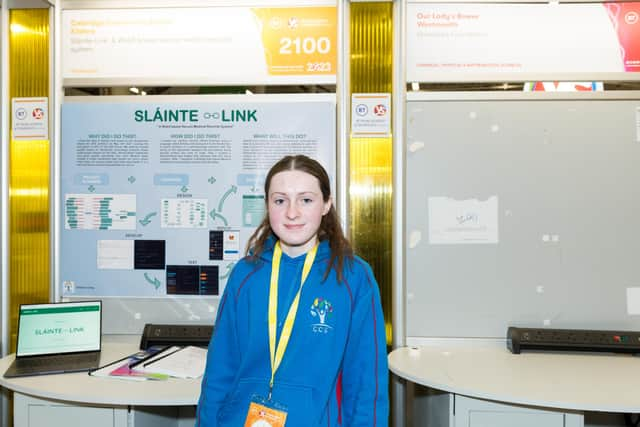
First-year Addison Carey has always had an interest in computer science, and as such, she decided to pursue it with her experiment 'Sláinte-link: A Web-3 based secure medical records system.'
Her immaculately-crafted system involved the use of blockchain, which refers to a digital system in which a record of transactions is kept.
Addison Carey
She added that, in the future, the system could be used to store medical stand data, and gave an example of MRI scans being saved as non-fungible tokens, otherwise known as NFTs, which are unique unique products that cannot be copied, substituted, or subdivided, and are recorded in a block chain.
Addison’s experiment was supervised by teacher Zita-Ann Murphy.
Her project was Highly Commended by the judges.
LEIXLIP
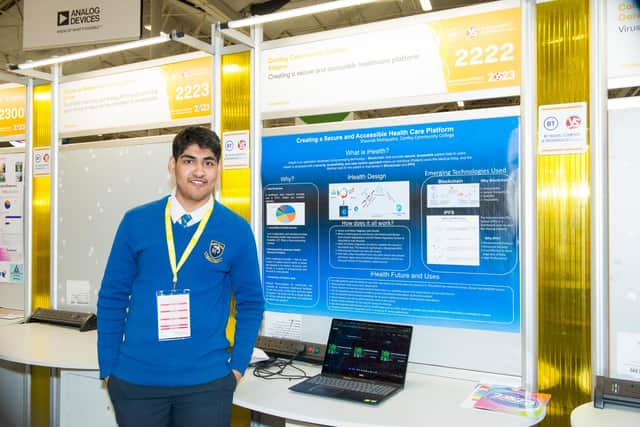
Third-year Confey Community College student Shaunak Mohapatra, also created a unique database with his impressive project titled 'Creating a secure and accessible healthcare platform.'
Shaunak Mohapatra
As such, Shaunak developed his own database via a blockchain as a means of streamlining access to medical data, while maintaining safety for its users.
He said he used the programme Solidity make the database, and also made use of smart contracts stored on the blockchain.
Shaunak also said that he believes that programming is 'revolutionary' and wants to pursue it when he’s older.
Teacher Sean Murtagh supervised Shaunak with his project.
Shaunak later received two awards for is project: the first Award he received was - 2nd in Technology in Intermediate Category while the second Award he received was Special Industry Award from We are Ireland Online (the National Registry for Ireland Web domain).
MONASTEREVIN
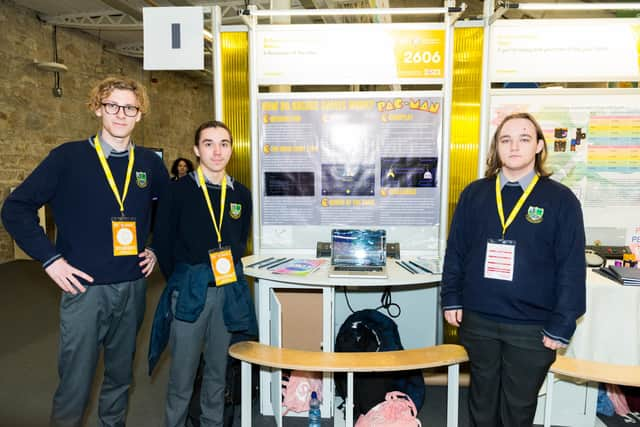
Last but certainly not least, three fifth-year students from St Paul’s Secondary School created a very faithful and entertaining recreation of the game Pac-Man.
Friends Luca Gheorgiu, Lucas Casey-Ryan and Dorian Pazur previously took part in their school’s TY young scientist competition, and won the first-place prize.
After the competition, the trio decided to expand on our idea, under the supervision of teacher Emily Woods.
Lucas Casey-Ryan, Luca Gheorgiu and Dorian Pazur
Lucas added: "The gaming industry is huge now, and the fact that we created this game in a few weeks demonstrates how far gaming tech has come."
Both Lucas and Luca said that while they are considering other careers after secondary school, both of them did not rule out pursuing a career in video-game design.
OTHER PARTICIPANTS
Other schools and their projects involved in the competition included:
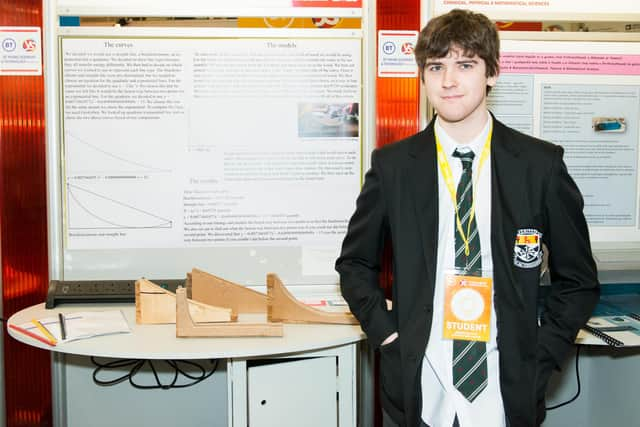
Louis Hayden
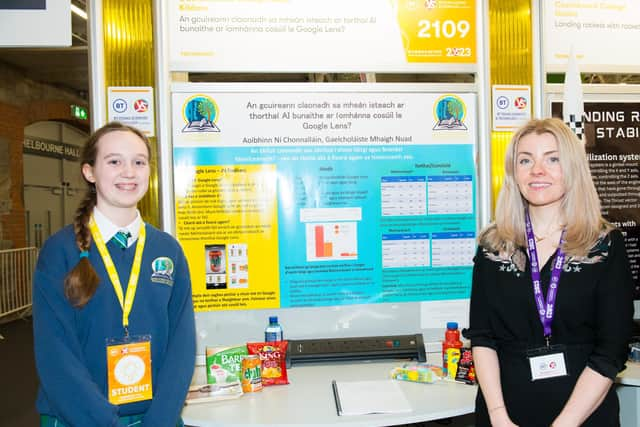
Aoibhinn Ní Chonnalláin with her teacher Maria Ní Ghóillidhe
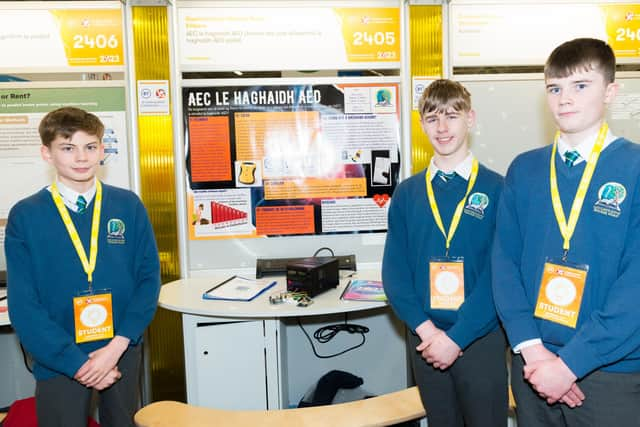
Ethan Sykes, Cathal Quinn and Odhrán Melia
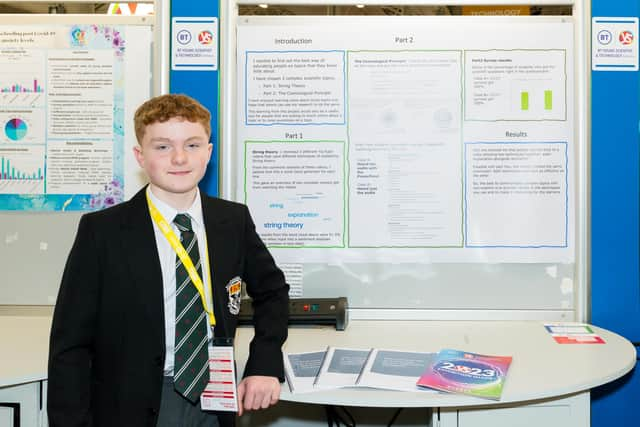
Rian Hearne
- Amelia Read of Coláiste Naomh Mhuire, Naas. Project: 'Hypo vs Hyper – An investigation into the awareness of the public into the differences between Hypoglycaemia and Hyperglycaemia.' Teacher: Nadine Hennessy.