
Kildare residents express anger over data centres at Dublin protest

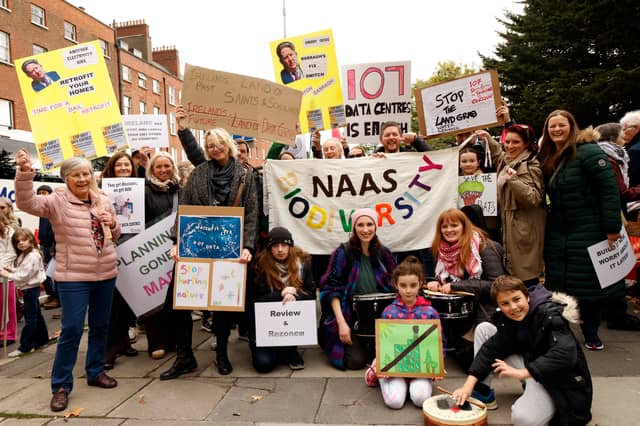

There was criticism of Kildare councillors who opposed a review of a data centre zoning decision
Naas residents were among thousands of people who took part in a national demonstration in Dublin city centre.
A protest march took place between the Garden of Remembrance and Dáil Éireann and the event was organised by Friends of the Earth and many communities from across Ireland, affected by data centres, were represented.
The Naas group created their own banner for the protest and the overall and the participation in the advent was organised by the
The banner that led the national march was created by the people of Naas, painting and sewing after work in the week before with the effort headed up by the Kildare Data Centre Awareness Campaign.
“We sacrificed our Saturday and got on buses gathered outside Our Lady and St David’s Church on the Sallins Road and turned up to what was a very vocal march surprisingly cheered on by by-standers and tourists.
“The atmosphere was great and the amount of media coverage was unexpected, from all the traditional Irish press to The Guardian and Agence France-Presse,” said Lesley Cowper of the KDCAC.
“That banner, bearing the slogan "No More Data Centres", means simply that we’re not against data centres, we're just against more of them. Ireland has the largest number of data centres in the whole of the EU counting 107 with our actual requirement being in the range of 2 to 3 to provide smart phone and Internet usage.”
Ms Cowper said the protest highlighted opposition to data centres by people living in Drogheda, Ennis, and Kilmeaden, for example.
She noted that Labour Party leader Ivana Bacik was present and called for a moratorium on data centres.
Ms Cowper also criticised the councillors who did not support a motion by Independent Ireland councillor Bill Clear for a review of the decision to zone land at Jigginstown for a data centre - which is likely to be provided by Microsoft.
“We were not asking for a de facto rezoning. We were asking them to just consider a review.”
She said the councillors voted in favour of “data centre only zoning and did so without adequate knowledge or information about the detrimental effects data centres could have on the very constituents they were elected to represent.”
Ms Cowper said residents groups were not fully informed and “as far as we’re concerned this all happened without meaningful consultation.”
Despite this, “more than 2,000 emails were sent by the people of Naas requesting a review. This was an unprecedented campaign, yet where was democracy when those voices went unheard? Where was democracy when those concerns were ignored?”
She added: “I personally wrote 40 emails to Kildare county councillors and only a handful responded and I am grateful to them.”
She said concern about the issue of data centres led to the Republican Party losing recent elections in the US.
“Concerns around energy use, infrastructure and local impacts are no longer niche issues. That epiphany may be all very well for Americans, but it does not necessarily bode well for Ireland or Naas. If the construction of AI and data centre infrastructure in America slows down, the pressure to accelerate developments and buildouts to capitalise on investment in places like Naas and across Ireland could intensify.”
She added: “We are going to need backbone from our political representatives. We need them to stand up for our best interests, to properly inform themselves and to ask tougher questions. We also need the Environmental Protection Agency to up its game and adequately scrutinise reports and assessments” relating to the planning application for the Herbata data centre new Newhall, Naas.
Ms Cowper criticised the Fianna Fáil and Fine Gael for supporting the data centre zoning.