
KILDARE TV COLUMN: Michael Collins film certain to divide opinion

Kevin Dowling
An Irish friend said to me: ‘Please remember one thing, there’s no Irish problem, only an English problem.’”
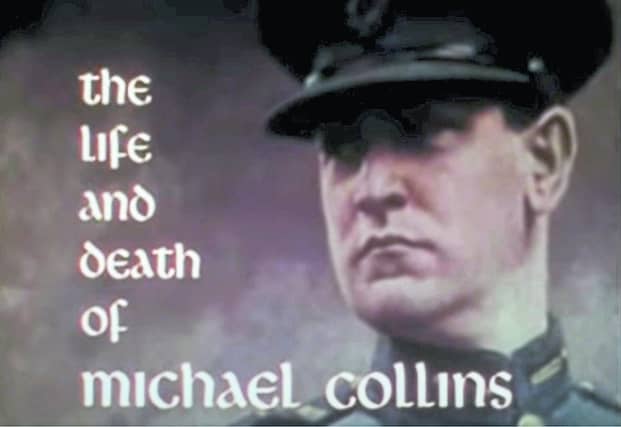
These are the provocative words that open Kenneth Griffith’s 1973 documentary, Hang Up Your Brightest Colours.
This film recounts the life and times of Michael Collins, who was obviously one of Griffith’s heroes. Collins, we learn, was born in 1890, the same year that Parnell was destroyed by ‘bigoted moralists’. Griffith does little to hide his views and politics throughout.
For Griffith, Collins’ immutable path towards armed rebellion was forged by his knowledge of the ‘murderous conquest of the Elizabethans’ and the ‘murderous progress of the English Cromwellians’.
We learn about Collins’ early school life and how he emigrated to London after passing the British Civil Service exams. Griffith visits Collins’ homestead, which was built by his father and later destroyed by the notorious Essex Regiment during the War of Independence.
For Griffith, the dreaded Auxiliaries ‘were comparable to Nazi SS troops’. The idea to send the ‘Auxies’ here was the brainchild of Winston Churchill, we are told. If Griffith were alive today, he would most likely be comparing this group of mercenary ex-officers to Putin’s Wagner Group.
This film was obviously a labour of love for Griffith. It was commissioned by the British broadcaster ATV. Griffith had free reign over the subject matter, and it shows. When the network saw the finished product they refused to broadcast it.
Decrying this act of censorship, he took ATV to court, and received an out of court settlement. With the proceeds he bought his London home, which he aptly named Michael Collins House.
This film’s production date, 1973, is equidistant between our own time and the era of Collins. The ruins, buildings and streetscapes are not a facsimile copy of what was around in 1922, but they do not belong to our era either. It’s a beautiful historical document in its own right.
Watching Griffith weave his way through Dublin’s old style double-decker buses and cars, one is struck by how much has changed since the film was made.
He visited several of the Dublin and Cork sites that were central to Collins’ life. In varying stages of elegant decay, many look unchanged since the 1920s. With the current ‘hotel rash’ blighting our capital, most of these sites are no doubt lost forever. Modernised, as they say.
Towards the end of the film, Griffith is filmed performing ‘in character’ as drinks are handed out to a crowd outside Cork’s Four Alls pub. His ululating Welsh accent rings out in the foreground, like Dylan Thomas reciting Under Milk Wood.
In the background there’s an eerie presence, peacefully enjoying a pint of stout. This is Michael O’Brien, Collins’ first cousin. At the time of filming, O’Brien was 82, the same age that Collins would have been, had he survived. The eyes, nose, grin and bearing are all unmistakable. It’s like seeing a stranger who reminds you of a long departed relative.
Griffith closes with another quotation, this time from GB Shaw, in a letter he wrote to Collin’s sister after Collins had been assassinated: ‘Don’t let them make you miserable about it … I rejoice in Michael’s memory … So tear up your mourning and hang up your brightest colours in his honour.’ Stirring stuff indeed.
This documentary is obviously a polemic. Despite its age, it is certain to divide opinion. Leaving aside Civil War politics, and the rights and wrongs of the British Empire, there’s a lot going for it.
You can watch Hang Up Your Brightest Colours for free on YouTube.