
KILDARE WILDLIFE COLUMN: Could Sphagnum moss help restore boglands

Nuala Madigan from the Bog of Allen Nature Centre
Sphagnum moss is also known as the ‘bog builder’. Over thousands of years this moss has grown upwards, storing over ten times its own weight in water forming the raised bogs that we know today.
Due to drainage of peatlands, surveys have identified that less that 1% of Sphagnum mosses are actively building Ireland’s boglands today.
One peatland, that has been affected by drainage is a site part owned by the Irish Peatland Conservation Council in Co Meath. To date restoration work on the site has included managing the water table through the creation of bunds across the peatland to support the peatland to store water.
With this work completed in 2021 the Irish Peatland Conservation Council identified that the percentage cover of Sphagnum moss was low on the high bog. For the peatland to return to peat forming conditions the water table management alone was not sufficient.
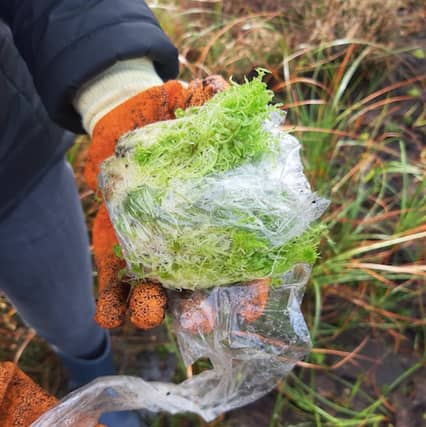
Looking at options to encourage the growth of Sphagnum mosses, the Irish Peatland Conservation Council looked to a Canadians Sphagnum moss transfer technique. This method of restoration involves harvesting Sphagnum moss from a donor site on the peatland, and transferring it to an area of bare peat. While this method is proven to be successful due to the low cover of Sphagnum moss, on this particular reserve it made this option impossible. The Irish Peatland Conservation Council looked for another option and identified BeadaMoss. Based in the UK this company grows Sphagnum to be transferred onto peatlands. One concern with this method was the introduction of non-native Sphagnum moss, however the company had an Irish mix Sphagnum moss available.
With support from Bord na Móna, last week the Irish Peatland Conservation Council transferred 400 Sphagnum moss clumps on the reserve in Meath in two trial areas.
Over the coming years we will be monitoring the growth of these Sphagnum moss clumps to determine if under the correct conditions this restoration method may be used on other sites in the future.
If you come across a wildlife species that you would like help identifying contact me at [email protected].