
KILDARE WILDLIFE COLUMN: Heliotropes dancing in the sunlight

Nuala Madigan from the Bog of Allen Nature Centre
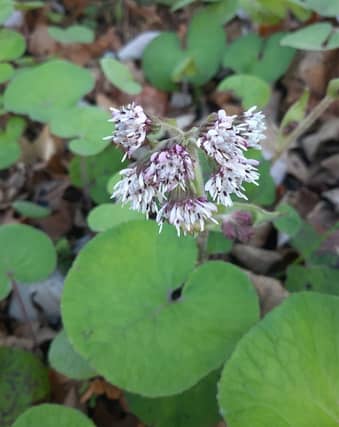
Last week while visiting a school I noticed a flower which was in full bloom and identified it, with the support of the website www.wildflowersofireland.net, as winter heliotrope (Plúr na gréine as Gaeilge).
This plant is not native to Ireland. According to the National Biodiversity Data Centre winter heliotrope is native to Eastern Africa and was first brought to Ireland as an ornamental plant to provide ground cover and while it is not known exactly when it was first introduced, it is believed to be before 1866.
Today winter heliotrope can be found growing in hedgerows, roadsides, river banks and woodland and is considered to have a low risk of impact to native biodiversity. The flowers are pale pink and are held on spikes growing approximately 25cm in height.
The leaves are kidney shaped and bright green on the surface. The surface of the leaf is also hairless, while the underside is hairy. Interestingly, according to both the mentioned biodiversity websites earlier in this piece there is actually no female plant of winter heliotrope in Ireland, Britain or Europe.
Therefore, this plant can only reproduce vegetatively meaning a new plant can grow from a fragment or cutting of a parent plant. As its name suggests winter heliotrope is a plant that demonstartes heliotropism. Heliotropism is the directional movement of plants to sunlight, so don’t be surprised if winter heliotrope growing in your garden is facing one direction in the morning and another in the afternoon!
If winter heliotrope is growing in your garden and has started to move out of the area you originally planted it in there is no need to reach for chemicals. If you regularly prune this plant it will naturally weaken. You can also control it by covering the plant in a layer of damp cardboard weighed down with 15-20cm of mulch such as bark chip or leaf mould.
This will eliminate light an essential ingredient for this plant to photosynthesis and grow. Watch for winter heliotrope in your community this week.
If you come across a wildlife species that you would like help identifying contact me at [email protected].