
KILDARE WILDLIFE COLUMN: Rare Bank Voles live in shallow burrows

Nuala Madigan from the Bog of Allen Nature Centre
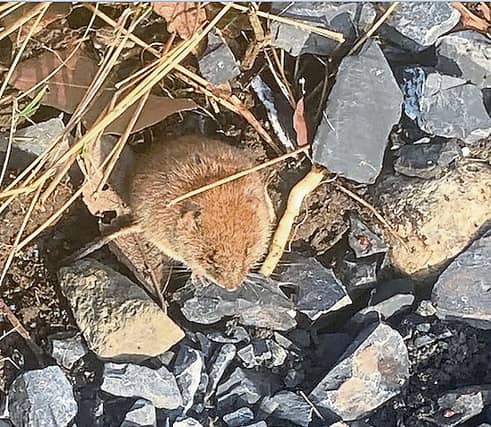
Recently Milltownpass Tidy Towns sent me an image of a little mammal they pictured along a woodland trail at the edge of their local bog.
They were looking for help identifying this mammal, as while it looked like a mouse, the tail seemed shorter, and it was covered in hair.
They had pictured a Bank Vole (Vól bruaigh as Gaeilge). Personally I have never come across one of these in the wild so it was lovely to receive the image and take the time to learn a little about this mammal which is actually not native to Ireland.
It is believed to have been introduced sometime in the 1920’s first getting to Ireland as a stowaway within imported goods.
The Bank Vole’s body is approximately 15cm in length. It is covered in brown fur with the underside is grey in colour.
The front legs have four toes while their back legs have five toes. They have small eyes and ears and their nose is blunt.
Their diet is a mix of berries, insects, snails and fungi making them omnivores. They live in shallow burrows beneath the surface, typical in habitats with a good undergrowth such as woodlands or hedgerows, because when exposed Bank Voles make tasty meals for birds of prey including owls and kestrels.
Bank Voles line their nests with feathers and mosses. The young known as pups are born blind and hairless.
The will feed from their mother for the first two weeks and during this time the female can become pregnant again as Bank Voles can breed all year round, as they do not hibernate as long as there is sufficient food for them to feed.
You can therefore come across a Bank Vole at all times of the year.
After the young are weaned from the female they will leave the nest in search of an area to establish their own territory.
In Ireland the Bank Vole lives for 18 months.
If you spot a local wildlife species and would like to learn more, take a picture and you can send your wildlife encounter image to me at [email protected].