
KILDARE WILDLIFE WATCH: Hen Harrier woos mates with sky dance

Nuala Madigan from the Bog of Allen Nature Centre
In early February the National Parks and Wildlife Service published the results of the breeding survey of the hen harrier (Cromán na gCearc as Gaeilge) that was completed in 2022.
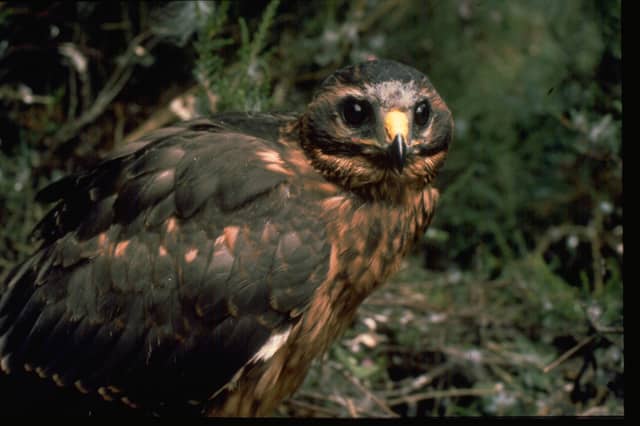
The survey introduces the hen harrier as a territorial bird of prey, which is known for its spectacular aerial courtship display, the ‘sky-dance’. It is said that the hen harrier got its name because it was known in the past to feed on free ranging foul. The females are larger than the males, and similar to other harrier species, male and female have different coloured feathers.
The male is mainly grey above and white below, while the females and juveniles are brown above with white upper tail coverts. Their habitat can be described as open, typically upland heath and bogland, with areas of low-intensity farmed grassland also favoured.
The hen harrier feeds mainly on small birds and mammals, which are often caught by surprise as the hen harrier uses surrounding woodland and forestry to wait and watch before taking their prey.
Due to its preferred habitat type, the hen harrier is a ground nesting bird, building a nest of sticks lined with grasses and mosses on a heather hummock.
An interesting study completed in the Orkney islands showed how this bird practices polygyny with males mating with several females during the breeding season.
The female will lay four to eight white eggs, which she incubates for 31-32 days. Once the young chicks hatch, the male supports the female with feeding the chicks.
The male rarely stays with the young and if they do it will generally be only for a few minutes.
You may be familiar with another bogland bird, the curlew which sadly has experienced a 98% decline in population since the 1980’s.
Surveys of the curlew have identified approximately 120 breeding pairs remaining today in Ireland.
Unfortunately this hen harrier survey reports that the national hen harrier population has declined by one third since 2015, to an estimated maximum of 106 breeding pairs (85 confirmed, 21 possible). The report also identified that the hen harrier breeding range has contracted by 27% for the same period. A review of data for those sites covered in each of the past five national surveys (i.e. 1998/2000 to 2022) indicates a 59% long-term decline for those sites. The magnitude of declines observed for the subset of sites surveyed across all five national surveys would likely prompt the Red-listing of hen harrier on the Birds of Conservation Concern of Ireland.
The hen harrier is another example of why Ireland is in a biodiversity emergency and why the conservation of a representative sample of habitats is so important for biodiversity
nationwide.