
Kildare's Wildlife Watch: The house martins are returning from Africa

With the Irish Peatland Conservation Council
During the summer months, Ireland welcomes many migratory species that visit and breed on our shores. Over the next few months, you can expect to see Painted Lady butterflies and the swallow bird, both of which are making the long journey from Africa at this time.
This week, the Irish Peatland Conservation Council at the Bog of Allen Nature Centre have welcomed back the first migratory species, the house martin (gabhlán binne as gaeilge).
Their nests, built from mud, can take up to three weeks to build and are located in the eaves of houses or buildings. They sleep in their nests at night, and as you can imagine, after their long journey they don’t like having to build a new nest so regularly return to the same one each year.
At this time, we believe the house martins are busy feeding on insects, which they catch in flight, as they build up their energy after their long journey to Ireland in recent weeks.
House Martins are similar in size to swallows but they can be distinguished from swallows as house martins have a shallow forked tail compared to the swallow which has a long, forked tailed.
The house martin’s feathers are blue/black on the upper parts and white on the under parts.
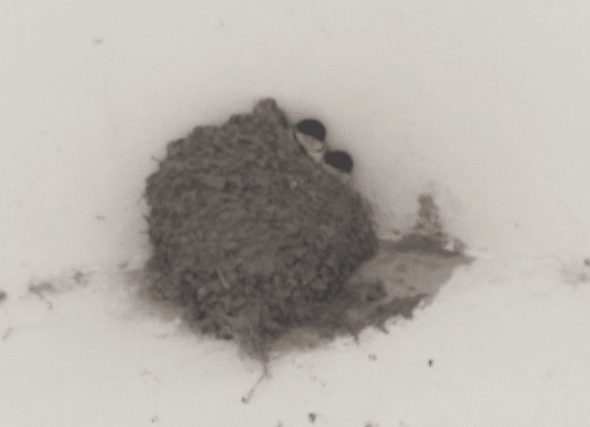
These birds can have between two and three broods of chicks each year. We were surprised last year when the house martins seemed to be still rearing a brood of chicks in late August, as they usually begin their long return journey to Africa in September. The image of house martin chicks in a nest was taken back in 2017 at the Bog of Allen Nature Centre.
Please note, you should never disturb nesting birds, their chicks or indeed any wildlife. I am aware the image is not of a high quality, however, to avoid disturbing the chicks at the time I used maximum zoom on my camera!
Don’t forget, if you come across a wildlife species that you would like help identifying, I would be happy to help. Contact me at [email protected].