
Kildare's Wildlife Watch: The Scots Pine that replaced our native tree

With the Irish Peatland Conservation Council
I am sure you have all heard of the term evergreen. It is used to describe trees that do not lose their foliage in winter. Trees can also be referred to as coniferous — that is, they produce cones.
One example of an evergreen coniferous tree is Scots Pine (péine albanach as Gaeilge). This native tree is considered to be one of the oldest trees in Ireland, dating back to the last Ice Age 10,000 years ago.
Science has allowed us to understand our past and, through pollen samples analysed from peatlands, we can trace those plants that lived in Ireland long before computers or modern record keeping.
However, we also believe the native Scots Pine also became extinct in Ireland around 4,000 years ago.
This was due to climate change, when Ireland got the temperate climate we are all familiar with today.
We know this because beneath our bogs we find trunks and stumps of 4,000 year old pine trees buried in the bog.
According to the Tree Council of Ireland (www.treecouncil.ie) the Scots Pine I identified is probably an ancestor of those trees imported from Scotland 150 years ago.
A Scots Pine tree can grow to 35 metres in height and it is said they can live for 700 years!
The leaves are needle like. The fruit of Scots Pine are brown cones that form once the flowers have been pollinated.
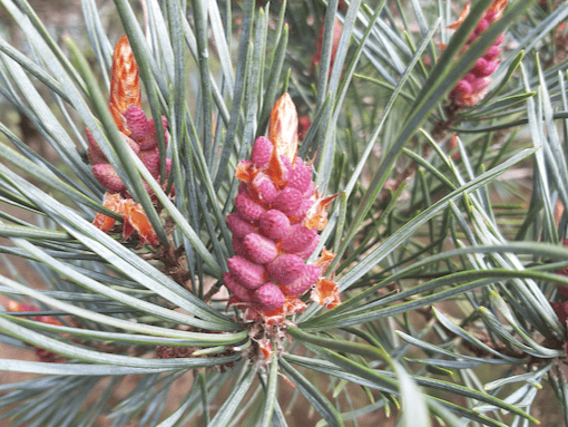
I suppose I never thought about what the flowers of Scots Pine looked like until coming across them this week.
The image provided I believe to be a male flower of Scots Pine as the female flower is more spherical in shape.
Both male and female flowers can be found on the same tree and as it takes more than one season for the cones to mature on any one Scots Pine tree, if you find Scots Pine in your community this week expect to find male and female flowers aswell as cones.
Don’t forget if you come across a wildlife species that you would like help identifying, I would be happy to help. Contact me at [email protected].