
KILDARE WILDLIFE WATCH: Underwater predator related to water scorpion

Nuala Madigan from the Bog of Allen Nature Centre
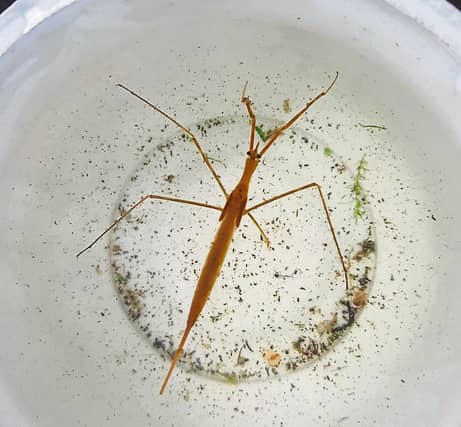
While preparing for a Heritage Week event, I was collecting a sample of freshwater invertebrates from the constructed pond in the wildlife gardens of the Bog of Allen Nature Centre, and to my surprise from one of the sample nets I identified a water-stick insect (uisce-bata feithidí as Gaeilge).
I have worked at the Bog of Allen Nature Centre for the past seventeen years and have dipped hundreds of times in this pond and have never recorded a water-stick insect before. To learn more I visited the website of the National Biodiversity Data Centre and learned that only sixteen records of this species have been recorded in Ireland to date, and this sample identified at the Bog of Allen Nature Centre would be the first recorded for County Kildare.
Reading a bulletin of the Irish Biogeographical Society Number 44(2020) I found that records for this invertebrates are relatively new. This bulletin noted that while there have been references to water-stick insects in Ireland dating to 1977, no locations were known for the invertebrate.
In 2018 Brian Nelson reported immature samples of the species from an artificial pond on the Wexford Wildlife Reserve.
In 2020 Alan Walshe recorded the first adult stick insects in Belle Lake, a natural lake, in Co. Waterford. The discovery from Belle Lake suggests that the water-stick insects may be a long established and overlooked population.
This invertebrate can fly, so its identification in constructed ponds may be as a result of this invertebrate searching for new habitat. The water-stick insect is an underwater predator that is related to a water scorpion.
Its long tail acts as a snorkler so it can breath underwater, while its front legs are hooked, an adaptation to catch its prey. It has a long slender light brown coloured body which helps it to camouflage between reeds and other water plants as it waits to catch a passing invertebrate.
They lay their eggs on submerged plants in spring and adults can be observed all year.
Don’t forget if you come across a wildlife species that you would like help identifying I would be happy to help, contact me at [email protected].