
Kildare's Wildlife Watch: Stuff your pillow with native Irish bog cotton

With the Irish Peatland Conservation Council
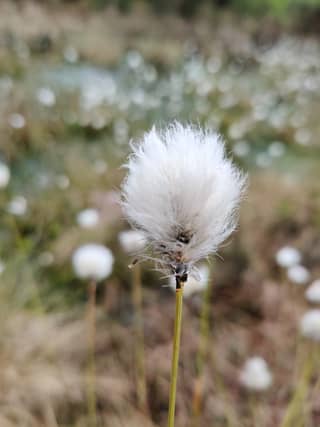
One of Ireland most iconic peatland species, single-headed bog cotton (ceannbhán as Gaeilge), is in bloom. This is a native wildflower which is easily identified and brings a carpet of white fluffy seed heads to our local peatland landscapes.
It flowers each year from April to June, so now is the perfect time to observe for yourself this loved Irish peatland wildflower. We actually have two different types of cotton grass in Ireland, the second being many-headed bog cotton. They can be distinguished from each other because, as its name suggests, single-headed bog cotton has one white fluffy seed head while many-headed bog cotton has between four and five seed heads.
Although a peatland consists of 90% water and 10% dead plants, the surface of the bog is made of hummocks and hollows.
Hummocks are the drier areas of the bog while the hollows often form bog pools. Single-headed bog cotton grows on the drier surface of the bog.
Many plants of single-headed bog cotton grow tightly packed together to form a clump or tussock on the bog surface. In this way, the plants create a drier environment for themselves.
But the disadvantage of this growth form is that the plants have to ensure that they do not die from summer drought on the bog.
The leaves are specially adapted to conserve water. They are long and rolled into needles.
As you will know cotton is used every day in our clothes, and indeed Ireland did try to start a cotton industry. However, there was a lot of competition from the UK. When Roberts Brook’s cotton business collapsed in Prosperous in 1786, losing lots of public money, there was little enthusiasm to fund such projects.
Although other private individuals did attempt to get into the cotton business, most were closed by the early 19th century.
Locally families used to pick cotton for stuffing pillows and mattresses, especially if family members had allergies and could not sleep on a pillow of feathers.
If you are out and about and observe an animal or wild plant that you would like help identifying, I am happy to help. Submit your sighting to [email protected].