
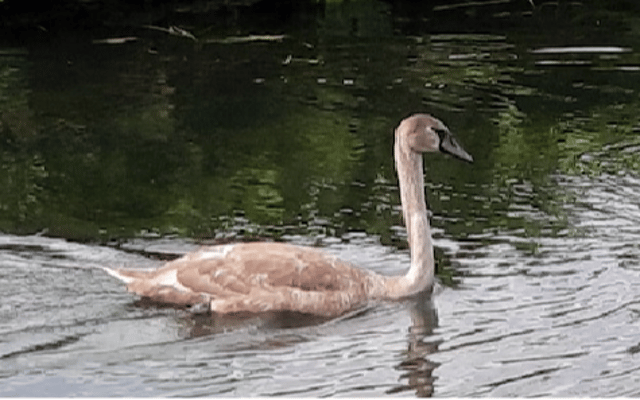
Little hoglet and cygnet finding their feet

It was certainly a week of wildlife baby observations for me! Over the summer at the Bog of Allen Nature Centre we have been watching house martins (Gabhlán Binne as Gaeilge) spend their time feeding chicks within their mud nests constructed under the eaves of the centre.
House martins can have two to three broods each year, however as they have a long journey back to Africa, we were surprised there was another brood in August.
Late last week I was fortunate to observe the house martin chicks fledge from their nest and watched them swoop and dive across the courtyard of the centre.
The next day I was leaving the centre heading towards Naas when I observed a young hoglet making its way across the courtyard.
Hoglets are the young of hedgehogs (Gráinneog as Gaeilge). Female hedgehogs give birth to between three and six young. They are cared for exclusively by the female. After four weeks the female will lead the young from the nest teaching them to forage.
At six weeks old the young hoglets disperse and lead solitary lives. You can see from the image that as soon as I stopped the car the hoglet quickly got into its protective mode, but you can also see the small size of the hoglet when you compare it to the size of the clover leaves that it sheltered in.
After taking the picture I left the hoglet, and will have to wait and see if I observe it over the coming weeks before it begins its winter hibernation.
Arriving at my destination of Naas I parked close to the Grand Canal and observed two cygnets both brown with their white feathers yet to emerge from below and both with their tails in the air and their long necks under water busy feeding.
I could not see the adults swans (Eala Bhalbh as Gaeilge) however I am sure they were not far away as cygnets stay with their parents for between four and five months.
I wonder what young wildlife you will observe in your community this week?