
Laois IFA Presidential candidate, Francie Gorman outlines key priorities
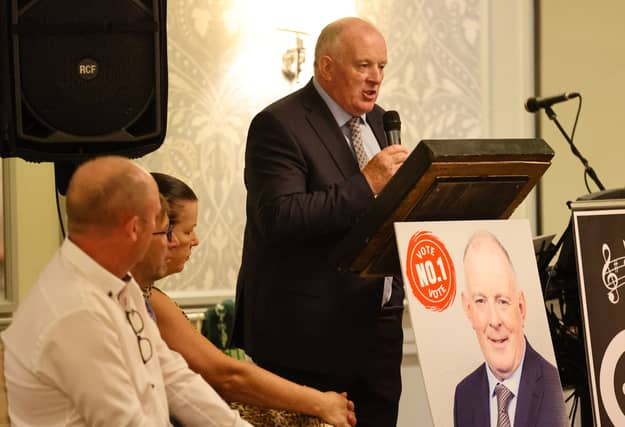

Food production, communication, environmental challenges and commodity prices were among the themes of Francie Gorman’s official launch for the IFA Presidency last Friday night in the Manor Hotel Abbeyleix.
Speaking to an attendance of over 300 people the Ballinakill beef, suckler and sheep farmer set out his stall for the Presidency of Ireland’s largest farming organisation.
He criticised environmentalists for their “incessant and unfair vilification” of farmers and for ignoring the role they play in food production and protecting the environment.
He said his priority is to ensure Ireland does not transfer its food production business to countries that produce food in “a less sustainable fashion than we do just to keep people who are anti-farming in this country happy.”
“Aside from the constant need to improve commodity prices and ongoing issues around engagement with the Department on the various schemes, the potential diminution of our food production output remains the single biggest issue facing farmers.
“Ireland produces its milk, beef and grain as sustainably as anywhere else in the world and if it’s not produced here it's going to be produced by countries with a bigger environmental footprint. Neither Irish farmers nor the environment benefit from such a scenario,” he explained.
He said Ireland should be immensely proud of the growth of its agriculture sector in the half-century since it entered the European Union (EU) in 1973.
“Ireland remains a rural, agriculture-based country that produces enough food to feed 40 million people and because of that, and due to not having huge industrial regions like Germany’s Ruhr Valley, agricultural emissions will always bear the highest emissions totals.
“Our sector has faced persistent and unfair criticism from environmentalists in the media with no acknowledgement of the important role we play. This criticism does not mean farmers get a free pass on the environment, but it also doesn’t mean that the work of farmers to improve water quality and the sustainability of their produce should be ignored either.
“Irish farming has a very positive story to tell, but it’s not getting through in the media,” he added. The IFA must take some responsibility for this as over the years it has relinquished its once proudly held status as a powerful, leading voice for farmers.
“Strong leadership and unity amongst members are key to strengthening our negotiating position, as well as our ability to develop and drive policy focusing on increasing farm income and securing a future for the next generation of farmers.”
Mr Gorman said the issue of how the IFA engages with the EU and the Government on policy matters is a key focus of his Presidential bid.
“Farmers are being driven to breaking point regarding the various agri schemes in terms of the difficulties being experienced by applicants, delayed payments and approvals for schemes like TAMS, and the prohibitive costs associated with engaging directly with the Department whereby individual farmers must employ a private consultant or Teagasc advisor to do their work.
“You throw in a year like we have had with incessantly poor weather and huge input costs, and it's easy to understand why farmers are frustrated.”
“The Environment and climate change is a huge challenge, but farmers producing top quality food in a sustainable way is not the problem,” he said. It’s a cop out to suggest that we should cut back our grass-based production and import food from other parts of the world with a higher carbon footprint.
“Farmers must be supported to meet the environmental challenge we face which is why I am proposing a new Environmental scheme, with a payment of €15,000 to be opened to all farmers, including organic.”
“We need to communicate the positive work carried out by farmers an awful lot better, particularly in relation to the environment, in a way that we will be able to impact on the policies that ensure our businesses remain economically efficient and that younger generations are encouraged to enter our sector,” concluded Mr. Gorman.
Among the other policy issues being highlighted by Mr. Gorman in his presidential campaign is the need for increased access to renewables and benefits for farmers, the elimination of bureaucracy and restrictions around forestry, the protection of agricultural reliefs, securing fixed prize contracts for tillage farmers, bringing about an end to further designations of Hill Areas and Land, an increased role for women and young farmers, and maximising milk, beef and lamb prices
On the role of women in IFA he said he would seek enhanced childcare supports.
Francie Gorman thanked Ella Walshe and the family of the late Padraig Walshe for their attendance and support.