
Laois property prices rise by €10,000 in one year


Housing supply rises by over a quarter in Laois claims new report
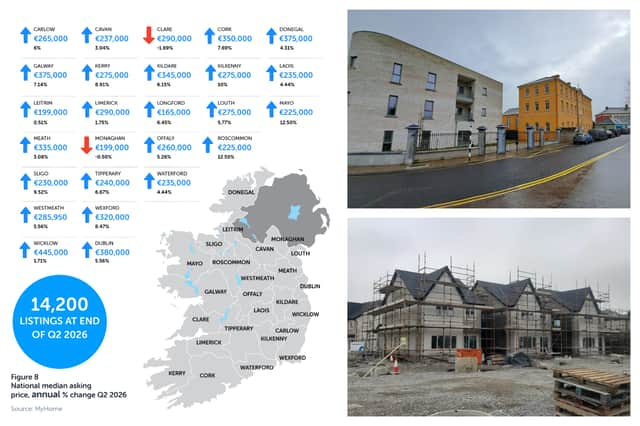
Property prices in Laois have risen by €10,000 in the last year, according to the latest MyHome Property Price Report.
The report for Quarter 2 2026, in association with Bank of Ireland, also shows that the median asking price for a property in the county is now €235,000. That means prices have remained unchanged over the quarter.
The authors also say the asking prices for a 3-bed semi-detached house in the county rose by €10,000 in the last year to €225,000. This means prices remained unchanged over the quarter.
Meanwhile, the report finds that the asking price for a 4-bed semi-detached house in Laois rose €31,000 in the last year to €295,000. This price rose by €16,000 over the quarter.
There were 155 properties for sale in Laois at the end of June 2026 – an increase of 26% over the quarter. It is also claimed that the average time for a property to go on sale in the county after being placed up for sale now stands at just over three months.
The author of the report, Conall MacCoille, Chief Economist at Bank of Ireland, said that the key question now was whether buyers in Laois and other counties will they be able to meet the elevated asking prices.
“Our data, while surprising, does not suggest vendors are being unrealistic. Through May and June transactions were being settled 7-8% above the original asking price – if anything signalling more intense competition amongst homebuyers,” he said.
Mr MacCoille said that while stretched affordability was becoming more apparent in the mortgage market, wages were still rising in line with house prices. MORE BELOW GRAPHIC.
“A key piece of context here is the latest data showing average earnings (AWE) were €56,000 annualised in Q1 2026, up 4.4% on the year. So, the bigger picture is still one in which house prices are rising broadly in line with wages – so that affordability is broadly steady.
“On the activity side, residential transactions in the first four months of 2026 were up 2.9% on the year, but this was entirely driven by homebuilding. A somewhat worrying feature of the market was that liquidity among the existing stock of homes is at its weakest rate since 2014, at just 2% of 2.2 million homes. This implies the average home is sold just once every 50 years.
“The underlying message here is that existing homeowners clearly feel unwilling to consider moving home – for fear of failing to secure another. The elevated cost of retrofitting an existing home may also be another impediment,” he said.
He added that a wild card in the market was the sharp rise in ‘notices-for-termination’ of rental tenancies.
“This figure is up 50% in Q1 2026 to 7,062. Given the pick-up in terminations since mid-2025, and that 60% of landlords intended to sell, this could in time add 5% to market liquidity. Clearly, here a temporary improvement in housing availability for homebuyers, would come at the expense of those seeking to rent,” he said.
He concluded by saying that previous predictions regarding asking price inflation for 2026 may have been pessimistic.
Joanne Geary is Managing Director of MyHome highlighted the supply-side rise.
“The rise in asking prices is tough news for prospective homebuyers, however we are seeing very positive signs on supply. The number of properties for sale on MyHome has jumped by 20% in the last quarter to just over 14,000 properties which should ease the fierce competition in the market.
“Overall, the first-time buyers’ market is still driving activity in the market, with the median mortgage and property value among this cohort rising by a third in the last five years. Demand remains very strong, but the recent increase in interest rates along with rising inflation will mean affordability may become more stretched,” she said.