
Laois school children encouraged to learn EU anthem Ode to Joy



No such incentive to learn Amhran na bhFiann exists and it's not obligatory
Children in Laois and elsewhere are being encouraged to learn the EU anthem under a special initiative.
While Ireland's national anthem Amhrán na bhFiann is no on the school curriculum, under the Ár nAmhrán or Our Anthem project children have been having lessons of the EU anthem Ode to Joy.
In 1972, the Council of Europe adopted Beethoven's "Ode to Joy" theme as its anthem. In 1985, it was adopted by EU leaders as the official anthem of the European Union.
As part of the EU50 programme celebrating Ireland’s membership of the European Union over the last 50 years, a partnership between the Department of Foreign Affairs, the Department of Education and the Royal Irish Academy of Music invites schools at all levels, and all children and young people engaging in music performance education, to learn, rehearse and perform our EU Anthem, Beethoven’s Ode to Joy.
The Ár nAmhrán/Our AnthemEU50 culminate in live performances of the Anthem in schools on the eve of and on Europe Day, 8-9 May 2023.
Laois Offaly TD Sean Fleming is Minister of State at the Department of Foreign Affairs. He visited local primary schools in Laois to celebrate Europe Day.
"I would like to acknowledge the significant milestone that Ireland has reached after 50 years of being a Member of the European Union (EU).
"This week, I celebrated Europe Day with local schools in Laois. Many schools in Laois took part in the Blue Star Programme, which taught students about European cultures and the EU through creative projects and activities.
"I visited Holy Family Senior School in Portlaoise and Scoil Fionntáin Naofa in Shanahoe to mark Europe Day on Tuesday 9th May," he said.
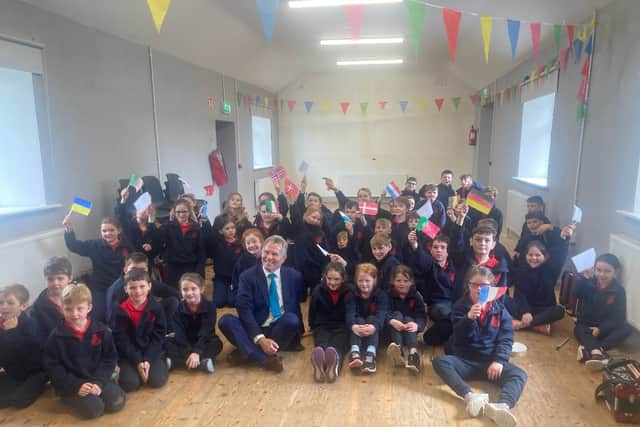
"Students made fantastic projects, painted European Union member states’ flags and with their parents made a variety of foods from other European countries. The schools also took part in Ár nAmhrán, Our Anthem, which is a special new initiative that encourages schools to learn the EU anthem – Ode to Joy. I also was delighted to present an EU flag to both schools.
"Ireland joined the European Union (then known as the European Economic Community) on the January 1 1973. Since then, Ireland has been transformed for the better, from being one of the poorest countries in Northern Europe, to now being one of the strongest economies in the world," he said.
A project pack of sheet music, recordings and other supporting materials were made available from the dedicated Ár nAmhrán/Our Anthem page on Royal Irish Academy website, where schools could register their interest in participating. A flag was also distributed to each participating school and schools are encouraged to raise or display the EU flag when the anthem is performed.
While schools in Laois have been incentivised to learn the national anthem, there is no such scheme for Ireland's own anthem.
Taoiseach Leo Varadkar said previously that Amhrán na bhFiann should be taught in schools and that pupils should learn the words of the national anthem.
Speaking at the launch of the Ode to Joy project in March the Tánaiste, Minister for Foreign Affairs and Minister for Defence, Micheál Martin TD said he hopes schools are inspired to take part in marking the 50th milestone and students "take active ownership of ‘Ode to Joy’ as their European anthem”
Minister for Education Norma Foley TD said the project gives students the opportunity to bring their language skills, creativity, musicianship and active citizenship together, as they interpret the music and words of Ode to Joy and consider the opportunities that the EU has brought to Irish society, including to education.
She looked forward to hearing the inspiring strains of this anthem brought to life in schools and communities, in English, French, German and Ukrainian, and through a wide range of styles and musical performances.
Versions for singing in Irish, English and Ukrainian as well as the original German are also available.