
Report into microlight crash near Emo published

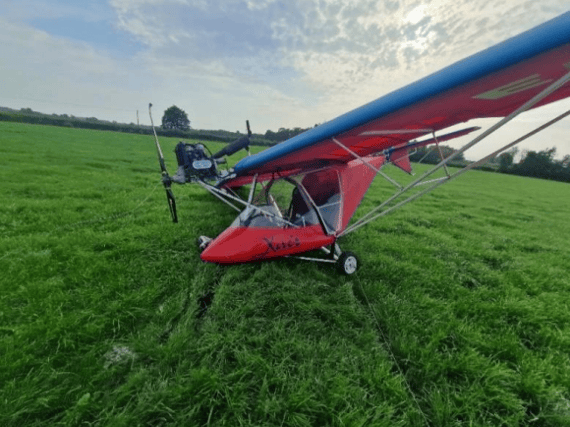

The Air Accident Investigation Unit(AAIU) found a progressive engine warm up wasn't carried out
It wasn’t possible to carry out a progressive engine warm up before a microlight aircraft crashed in a field near Emo last year, a report has found.
The passenger of ‘Raj Hamsa X Air’ aircraft was taken to hospital with back pain following the collision at the Limetree Airfield near Emo on September 7, 2023. The aircraft's paperwork was correct and it was operating on an IAA Flight Permit.
“The Investigation was informed that the pilot was uninjured. The investigation was also informed that the passenger felt lower back pain and was taken to hospital by ambulance from where he was discharged later on the night of the accident; the investigation was informed that the back pain was due to soft tissue injury,” the report stated.
An Air Accident Investigation Unit(AAIU) report into the crash noted that the aircraft’s owner informed the investigators that “brakes had been fully upgraded IAW manufacturer specifications with new shoes and drums.”
The 36 year-old pilot however had said the “brakes were not good” before the flight and the aircraft would start to pull away when the rpms got above 2,500. The aircraft engine was run at around 2,200 revs for five minutes before takeoff, the report noted.
“When the Raj Hamsa X Air aircraft was at 50 to 60 ft above the terrain of a hill on the take-off path, the engine ‘coughed’ several times and the aircraft lost height. An emergency landing was carried out into an agricultural field which resulted in substantial damage to the aircraft. The passenger was injured. There was no fire. The engine power interruption was subsequently determined to be due to a cold seizure in the engine’s front cylinder and a loss of clearance in the rear cylinder,” the report stated.
“The prevention of cold seizure requires that an engine be progressively warmed up at higher than idle speeds over a period of time before fully opening the throttle to commence a take-off run. Running the engine at such higher speeds is only possible when the aircraft brakes can hold the aircraft stationary at these higher engine speeds,” the report stated.
An engine expert told investigators that the aircraft should have been held by its brakes while its engine speed was brought up to at least 4,000 rpms for more than a minute before take off.