
'The forgotten heroes' - Descendants call for national recognition of Laois 1916 volunteers

Owen Kirby and Patrick Fleming are the grandsons of volunteers involved in 1916 Rising operations in Laois. Here, they detail those operations and advocate for the rectification of a historical injustice
Most Laois natives know the history. Or should. That on Good Friday, April 21, 1916, Paddy Fleming of The Swan delivered a handwritten note to his brother Eamon, the commander of the Portlaoise Company of the Irish Volunteers. On it was the message "Q, 1916 Ballyfin, 23rd inst, 7pm. Acknowledge by bearer on arrival.” Written by Patrick Pearse and still in existence today, it was the order, in code, that the Easter Rising was on and that the Portlaoise Company were to implement previously arranged plans. For the Volunteers, this meant the dismantling of local rail and telegraph lines to prevent British reinforcements from Rosslare reaching Dublin, where the main event of the Rising was to occur.
What the group did not receive, or else ignored, was a countermanding order that ultimately delayed the Rising in Dublin until Easter Monday, April 24. Thus, following Pearse’s directive, on Sunday night, April 23, the Portlaoise Volunteers met at the then-Maryborough Town Hall before splitting into two groups; one under the command of Eamon Fleming, which deployed to Maganey, and one under the command of Paddy Ramsbottom, which headed out to Colt Wood.
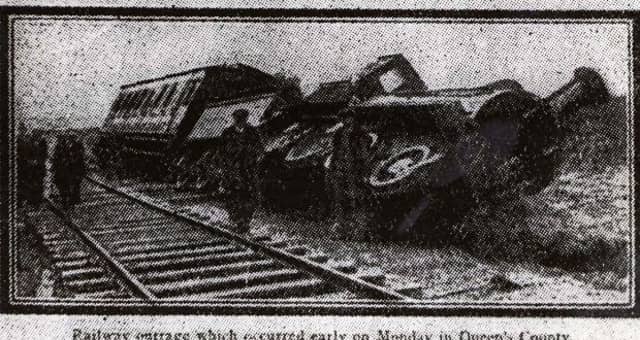
At each location, with the minimal equipment and weapons on hand, they went about their task during the course of which Paddy Ramsbottom fired what has been recorded as the “First Shot of the Rising.” When an employee of the Great Southern and Western Railway company arrived at Colt Wood to investigate the source of the railways’ communication system disruption, Ramsbottom fired over his head. The man escaped to alert his bosses, but they returned too late to prevent the derailing of a train carrying members of the Royal Irish Constabulary. Mission accomplished.
Memorials to the events in Laois in 1916 have been erected, in stone and bronze, and can be seen today at Colt Wood, Maganey and outside the County Council offices in Portlaoise. On them, the names are recorded for posterity of the men and, yes, women, who at great risk to themselves and their families took up the torch of Irish freedom in this county. On paper, their history lives on in Cormac Moore’s “Laois: The Irish Revolution, 1912-23” and Michael Rafter’s "The Quiet County” both of which rely heavily on the records of the Military Archives at Cathal Brugha Barracks in Dublin. There are also written and oral family accounts that have been passed down through the generations.
After a few weeks in hiding, and following the collapse of the Rising in Dublin and executions of the national leadership, including Pearse, the Portlaoise Volunteers went on the run. The core group later reconstituted and saw active service in the War of Independence. In the Civil War that followed, the original, tight knit group that rose up in 1916, sadly, experienced the same divisions that saw brother pitted against brother, friend against friend, throughout the country. But whatever animosities may have been engendered as a result, they did not diminish the risks taken and the contributions made in 1916 by all.
We, the authors, count ourselves blessed that among the ranks of the Portlaoise Company of Irish Volunteers were our own grandfathers, Michael Gray and Paddy Fleming, whose service and sacrifice in 1916 are a cherished inheritance. When the time came for the State to recognize their 1916 service, however, they were not among those honored from Laois; though, their roles were well-known in the County and are attested to in the Military Archives. Of the 15 men and 4 women who comprised the Portlaoise Volunteers, only six eventually received official recognition; the remainder were denied for reasons, stated and unstated - bureaucracy, Civil War legacies, expiration for applying, conflation of recognition with pensions etc. Of note, not one of the Laois women without whom the Volunteers would likely have been unfed, unhoused and exposed would ever receive formal appreciation for their efforts.
In 2018, the Military Archives acknowledged, in a post devoted to the Portlaoise Volunteers on their site, that “[t]here are a number of apparent discrepancies and anomalies regarding the awarding of 1916 service outside Dublin in the Military Service Pensions Collection (MSPC)…the situation regarding the awarding of pensions in respect of 1916 service among the Portlaoise Company is one of them.”
110 years on, we believe it is time to rectify the “discrepancies” and to complete the history of Laois 1916 by entering the names of the forgotten heroes, men and women, on the official rolls:
Lorcan O'Brádaig – Lalors Mills
Thomas F. Brady – Lalors Mills
Michael Gray – Portlaoise
John Muldowney – Portlaoise
Michael Walsh – Portlaoise
Terence Byrne – Knocklaide
James Ramsbottom – Fossey
Patrick J. Fleming – The Swan
John Frawley – Wolfhill
Noreen, Breda, Kathleen and May Brady – Lalors Mills.
Laois has duly recognized and honored all its 1916 Volunteers. It is our duty now that their service is finally shared with the nation. We respectively ask the State to do its part and request that the Portlaoise County Council take up this cause.