
Longford and Westmeath farmers told interventions needed to turn tide on water quality


“The Farming for Water EIP model has huge potential to get farmer buy-in and improve water quality throughout the country.”
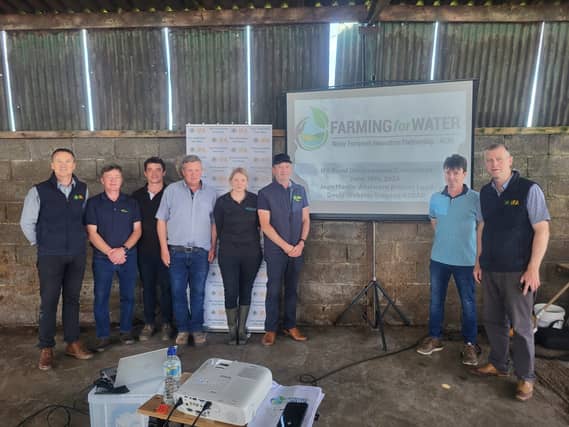
Organised by IFA, a strong representation of farmers and industry stakeholders attended the farm of David and Roisin Fay on the banks of Lough Ennell, Co Westmeath to learn more about the Farming for Water EIP, a new European Innovative Partnership Programme (AGRI) project, funded by the Department of Agriculture Food and the Marine and the Department of Housing, Planning and Local Government, which focuses on-farm interventions or measures designed to protect, preserve, and improve water quality.
Speakers included Joan Martin, Assistant Project Manager and David Webster, Teagasc Agricultural Sustainability Support and Advisory Programme (ASSAP) advisor, and David Fay, farmer.
Joan Martin outlined how participation in the EIP isn’t an open call at the present time, and that a tiered hierarchy within the priority areas for action identified in the second cycle of the river basin management plan are being prioritised for entry, but will progress to the third cycle areas for action once finalised in the forthcoming months. The locations of these can be found on the Environmental Protection Agency’s website (www.catchments.ie) or check with your local ASSAP advisor.
Although in its infancy, the EIP is garnering strong interest among farmers, and any farmer within a catchment area interested in getting involved is asked to contact their local ASSAP for further information. More farmers will be coming on board in the coming months.
With no limit to farmer payment; no mandatory measure (other than Rainwater Management Plan); and funding towards the costs of up to 41 measures (within certain parameters) and willingness to fund additional site-specific bespoke measures, the level of interest among farmers is unsurprising. The ASSAP advisor will recommend what measures are applicable to the farm based on the EPA’s pollution impaction potential maps.
Demonstrating some of these measures on-farm, David Webster re-iterated that this EIP is not about supplementary income - it is about water quality; doing the right thing; and getting the right measure in the right place. The more measures implemented, the more the farmer gets paid, but the Rainwater Management Plan is key. It shows how water flows on the farm, on the land, and where individual measures will be most effective, targeting the reduction of nutrient loadings to water courses.
Attendees were introduced to the opportunity of collective and targeted action involving a local project which almost eradicated completely the incidence of E. Coli in bathing waters which had been an issue in the years previous and threatened the closure of the bathing water. Interventions involving E. Coli and Phosphate can be more immediate – perhaps within a year - however for Nitrates it can take a little longer to see the benefit of actions taken.
John Curran IFA National Rural Development Chair said, “The Farming for Water EIP model has huge potential to get farmer buy-in and improve water quality throughout the country.”
“The need for targeted action is obvious, and the day of finger-pointing is done. It’s about the collective, and the sum of individual targeted actions that will turn the dial at the end of the day. We all have to buy into this.”
“We have seen on the Fay farm that small tweaks to management practices and/or investments can make a big difference. It’s about awareness, know-how and having the right measure in the right place at the right time, unique to the individual site, coupled with tangible support and direction.”
“What farmer would not close off water drinking points for example, when the cost of fencing and an alternative water source is provided. It’s a win-win. But, as seen with this EIP, being properly resourced in terms of finance and know-how, is key too. Let’s have more of that please, for more and more farmers around the country,” he added.