
Longford man gets a fresh lease of life in new care setting

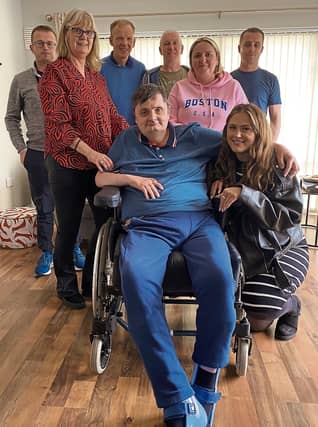

Niall McGrath settles into his new life in Esker Gardens
“He was a happy, healthy 21-year-old. He went to London to work and then this happened to him and his life just completely changed,” Nadine Roper describes the impact of the tragic accident that re-shaped her uncle's life.
Niall McGrath acquired a traumatic brain injury in 1989 and lived the 35 intervening years in a nursing home.
At the tail end of the 1980s packing an otherwise healthy young man off to a care setting for older people was the only way of dealing with the patient's complex needs, but it was not an appropriate long term solution.
Three decades later an investigation by the Ombudsman looked at the suitability of placing people under 65 in nursing homes.
That report noted that in June 2020 there were 1,320 people under 65 years of age supported by the Nursing Homes Support Scheme.
Niall was one of those statistics. A particularly pertinent one as he was the second longest “patient” in nursing home care.
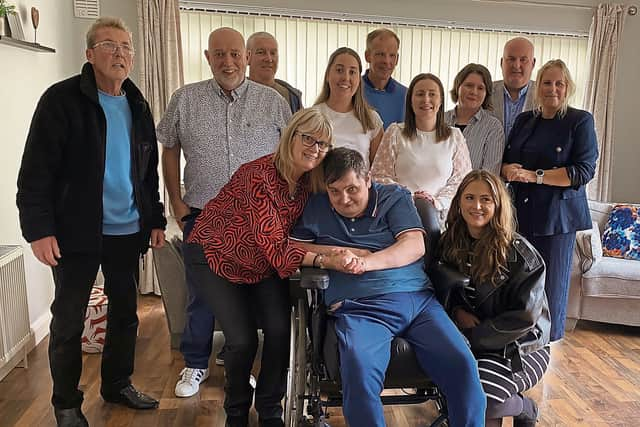
Here for the party: Pat Harley, Gerry Haslam (Orchard Care), John Gorman (CIL), Emma Briody (Orchard Care) Declan Mimnagh (Friend), Aoife Mullaly (Orchard Care), Sinead Keane (HSE), Joe Flaherty TD, Eve Hayes (HSE), Sandy Roper (Sister) Niall McGrath, Nadine Roper (Niece)
It's not unusual for reports to be published only to gather dust, but this particular study has had a transformative impact on the lives of people overlooked for decades.
One tangible outcome of the report is the establishment of specific facilities. Esker Gardens is designed for up to four residents and provides care for clients with physical, neurological and sensory impairments.
It's run by Orchard Care, a private company that renders support to children and adults with significant and complex needs.
On Wednesday July 17 there's a buzz in Esker Gardens. Niall watches Father Ted on the TV in the sitting room. Beyond the double doors a colourful garden stretches peters off toward the fields, and ultimately the horizon.
It's a different world from the nursing home setting of St Joseph's Care Centre, on the Dublin Road in Longford town. There was nothing bad about Niall's care in St Joseph's, but it was inappropriate for his condition.
With preparations underway for the party the man of the moment is gregarious. His brain injury may have trapped him in his body, but there's a mischievousness and a joy that bubbles from him.
Niall's sister, Sandy Roper, explained the reason for the gathering: “Niall has settled very well into a house in Esker Gardens with three other people with brain injury. He's doing great. As a way to celebrate his big move and progress so far, we are having a small get together.”
The move to Esker Gardens is the end product of the Wasted Lives report published three years ago that highlighted the plight of people between 20 and 65 inappropriately placed in nursing homes.
At 56 years of age Niall has finally been given the opportunity of a fresh lease of life with his move to the Orchard Care community residential home, where he will live with people his own age.
“We cannot describe the difference this has made for Niall’s quality of life,” Sandy said of her brother's transition, “His mood and demeanour has drastically changed. He is so incredibly content and happy since his big move.”
Aoife Mullally, the Orchard Community Care Manager for Esker Gardens, presides over the facility that specialises in catering for people with acquired brain injury.
“We have four residents here, three gentlemen and one lady,” Aoife told the Leader, “They're all part of the Wasted Lives Project which was set up by the HSE to support people that were misplaced in nursing homes. There are now around 1,500 people in the country misplaced in nursing homes at the moment.”Orchard Care provides care facilities like Esker House across the country to meet the shortfall in care identified in the Wasted Lives report.
“The HSE established the Wasted Lives Project. They fund the transition from the nursing homes into a facility that is more like a home. As you can see this house is beautiful, it's perfect for people with physical and sensory needs,” Aoife explained.
Located near Ballinalee, the care setting opened in October '22. Two residents moved in then, one more in January '23 and Niall is the fourth having moved in at the start of June.
“On any given day, we have a team of about 12 or 13 staff members. We have three to four staff members on shift,” Aoife says, “There hasn't been a whole pile of challenges here, we've been very, very lucky.” At present Esker House is the only Orchard Community Care facility in the area. Plans are in train to open another in Kenagh, and another house has been purchased near Ballinalee that is slated to open in 2025.
The care model is popular with service users: “They love it, the feedback from them has been amazing. They're all so happy here, they're living lives here, making new lives. They go to pottery, they do art and woodwork, they go to concerts and festivals.
“One resident has been to London for two nights, she's been to Edinburgh for another two nights as well, it's about giving them their lives back.”Another guest at the Esker House party is Gerry Haslam, the Regional Director of Operations of Orchard Community Care: “Today is a celebration, Niall has come over to us here in Esker Gardens and it's a great success story,” he says.
Niall's move from institutional care in a congregated setting to the small community-based house is a radical shift: “He's part of a small intimate community setting with peers. He'll have more opportunities in a less crowded scenario. We're able to meet his needs and he's not reliant on the availability of others,” Gerry outlines.
There is a seismic difference between nursing home care and that provided by Esker House: “Our model of care is to work in a person-centred way. When you work in a small setting like this you have more opportunities to meet people's needs and wishes. You're not reliant on staff availability.
“The resources are here to support the people to do the things they want. Any time I come here people are doing different things. The things Niall likes to do, he'll get the opportunity to do those. He'll get to do it with a consistent staff team that knows him well.”
The changes to Niall's life has brought him obvious joy, but his wider family have experienced the blossoming positivity. Niall's niece, Nadine Roper, says the changes are immeasurable: “There's a clear difference in his mood and his demeanour, it's lovely to see.
“It's bittersweet because he was so young when he initially went into the nursing home. That was before my birth. He was deprived of the life he should have been living for so long. It's great that he has a second chance, we're really positive about it and delighted he's here.”
Even before the Wasted Lives report Niall's family highlighted his situation: “My mum (Sandy) was a huge advocate for Niall for years and years. She works in the HSE.
“Prior to that my grandmother (Niall's mother), who passed away in October, pushed for him too. There was a lot of advocacy work, highlighting and nagging to get to this point,” Nadine said.
The publication of the 2021 report identified the plight of a large number of people: “I thought it was crazy there were so many people like Niall. It was eye-opening. Niall has always been in a nursing home since before I was born.
“It's just mad to think there are so many other people like him. I work with the intellectually disabled, but for acquired brain injury there just weren't that many places for them to go, which is mad.”
The accident in 1989 was an enormous blow to the McGrath family: “It was shocking. He was a happy, healthy 21-year-old. He went to London to work and then this happened to him and his life just completely changed.
”Niall's journey since then has been step by step: “He came home. They were told to not expect much from him. The doctor said “he's going to be a vegetable, don't expect much”. When I was younger he just kind of laid there.
“He went to the NRH twice for rehabilitation, and the difference in him was mad. From mobilising and moving his legs to talking. All that came through advocacy and pushing for services that he wasn't initially getting. In the last 10 to 15 years things started happening. It's amazing a little bit of stimulation has transformed him in terms of his personality and the way he expresses himself.
”Nadine is at pains to point out that her uncle's care in St Joseph's was not a problem: “There was no fault of the nursing home, because the reality is they're extremely understaffed. He just didn't have much human interaction.
”Esker House provides a totally different care environment: “He has choice in his day now. He kind of dictates his own life, it's not constrained by staffing. He never had choices. It's lovely, you can see the difference. He's just thriving.
“He's getting out and about in the community. He's getting to see faces he hasn't seen in years and they're getting to recognise him and catch up. He's delighted to see people he's not seen for so long.”
Nadine says the family are overwhelmed by the progress of the last month: “Niall is finally getting to live the life he should have had all these years. I wish it could have happened sooner, however the future is bright and Niall is thrilled to embrace his second chance.”
In her role as Regional Director of Nursing overseeing intellectual disability residential services for the HSE, Eva Hayes is well versed in the changes brought about by Wasted Lives: “I have just gotten to know Niall within the last few years,” she tells the Leader.
The sequence that brought about the change in Niall's circumstances was plotted out: “I work very closely with Sinead Keane (the HSE coordinator of adult disability services), who works with the under 65s, and we managed to secure some funding through that stream from a national level.
“Niall was known to the service while he was in St Joseph's. Through Sinead and our national colleagues we secure funding to explore the options for Niall to come out of the nursing home environment to a more person-centred individualised community setting,” Eva said.
Up and running a couple of years the Wasted Lives programme is enhancing and improving the lives of those in inappropriate settings: “Today is a total example of that. The person-centred approach Niall has been exposed to has afforded him an opportunity to live within the community. In the right environment people flourish. That's the essence of the programme, it's to ensure everybody has an opportunity for a quality of life.”