
Longford’s Community Policing Sergeant Darran Conlon has ‘best job in the job’
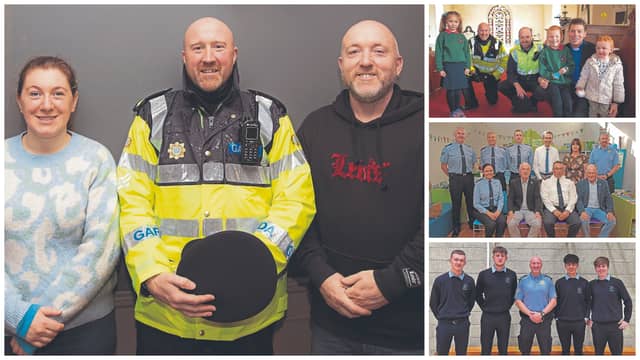

Life as a Garda: A career with An Garda Síochána isn’t easy, but it is very rewarding
A career with An Garda Síochána isn’t easy, but it is certainly very rewarding. That’s according to Longford’s Community Policing Sergeant, Darran Conlon, who is calling on anyone considering a career as a Garda to get their application in before 3pm on February 8.
Sgt Conlon has been with An Garda Síochána for 23 years and currently has what he refers to as “the best job in the job” on the local Community Policing Unit, where he manages a team of uniformed Gardaí with the goal of increasing community engagement and looking out for the people.
“I only ever wanted to be a guard when I was growing up. It’s all I ever thought about, so every decision I made in my life was towards getting into the guards,” Sgt Conlon told the Longford Leader.
“I think I have the best job right now, being Community Policing Sergeant in Longford because of the variety I get. I can just go about my business and meet people every day and I feel we are making a big difference there.
“A lot of people have respect for the guards. But there are also communities where that is not the case and now we’re doing a lot more to reach out into those communities, introducing ourselves and breaking down barriers. That’s a lot of my work.”
Anyone applying to be a Garda now, however, won’t be doing Community Policing from day one. They’ll be on the beat, they’ll be responding to calls for service and dealing with the day-to-day duties of a Garda. By doing this, personnel get the opportunity to develop skills and work towards opportunities for promotion or a place on one of the various Garda units available.
“There’s a job for everyone, within the Guards. The Dog Unit, Mounted Unit, Water Unit, Detective Unit, Scenes of Crime, Financial Crime, Computer Crime, Armed Support Unit, etc, are all possibilities to people,” said Sgt Conlon.
“There’s also a big difference between city policing and rural policing. Then rural policing can be different depending on what part of the country you’re in. We are in the Mayo Roscommon Longford Policing Division. The people living in Belmullet have different issues to the people living in Granard and the local Gardaí respond accordingly.
“No matter where you are appointed to, it’ll start off on day one with putting on that uniform for the first time and realising that, from now on, people will look at you a lot differently. People will come up to you expecting you to have all the answers for many things. So you’re expected to be the source of all knowledge and to be able to solve all problems.
“New recruits will be in the station taking calls that come in over the phone. Nobody ever phones to wish you a happy birthday. They are calling because they need and expect a service. And that call can be anything from ‘my dog is missing’ to ‘there’s a man banging at my front door trying to get in’ to ‘I’m just after finding a dead body’.
“No matter what your plan for the day was, it will go according to the calls that come in. That could mean you are left preserving a crime scene after your rostered finish time, or you have to come back in early the next morning to interview prisoners from a burglary. No two days will be the exact same as they will throw up something different. That is both challenging and exciting.”
A Garda fresh out of Templemore will probably start off as an observer in a patrol car, going from call to call and building up their experience, he added.
“I must say, no matter where you are stationed, it will be busy, because the workload is so much - shoplifting, drink driving, assaults, theft offences. There has to be an investigation on every one of them and an outcome. And the progress on the investigation is marked all the way along.
“On top of this the probationer guard will have classwork and assignments as part of the continuous professional development until they are fully qualified. They have to keep the college assignments up as well as their workload.
“So this can be overwhelming for people, but the support system is in place. They’ll be given a tutor guard. There is great camaraderie still existing within the guards and there will be support and guidance.
“That is very evident in Longford where everyone helps everyone else and advice is always at hand. So you’re thrown in at the deep end, but you’re given a life jacket and a buoy, with lifeguards and a lifeboat all around you. Anyone that wants to get through, will,” he assured.
The camaraderie and teamwork really comes out when things get busy or when there’s a more difficult call, such as a fatality or a tragedy.
“Everyone rallies around and you don’t have to tell people what to do at the scene. Everyone gets the job done, to make sure that the investigation is conducted properly,” said Sgt Conlon. A Human Rights based approach is taken with the victim or grieving family to the fore of every investigation.
“So as a newly qualified guard going out to that first traumatic call, they will be guided and they will be given a role or a job that they’re able for and brought through it. So there is camaraderie there, there is support and there are people, senior people, always looking out for the junior people and helping them along. There is peer support and counselling available too, which is great.
“I am where I am today because good guards guided me and gave me their experience and I could learn from it. And I’m still learning today and every day and the new recruitment campaign aims to attract people from a wide variety of backgrounds so we, as an organisation, can broaden and be more representative of the community we serve. These candidates will bring with them valuable personal attributes and capabilities we hope to benefit from.”
This Garda recruitment drive is welcoming people from all backgrounds to apply, as well as people between the ages of 35 and under 50, after a Government decision to increase the age limit for applicants.
“People from different backgrounds bring their own personal experiences with them and how that can help us is, if we go to a call and if we have a Garda that can speak Irish or Russian, straight away there’s a barrier broken, and a big help to resolving the matter,” said Sgt Conlon.
The increase in the age limit will also see a change in the way new Gardaí handle the job, with older applicants having the benefit of more life experience.
“I think who it really suits is the person in the last recruitment campaign who was 36-38 and missed out by a couple of months or a year or two, that they’re back in the loop now and they could have a lot to offer,” said Sgt Conlon.
“Life experience is so important. It provides credibility and a more holistic approach when dealing with a situation. I think it’s important that people have real world experience from something as simple as living away from home and paying your own rent and car insurance, right up to seeing how people have gotten into trouble with drinking or drugs.
“That’s normal life, and seeing how you navigate through life’s challenges, and what life lessons you’ve learned is really important, and you can bring that to the job,” said Sgt Conlon.
But there are skills younger people can bring to the table too. If you’re a good person who does the right thing for the right reasons, with an interest in helping people and making a difference, that’s a great start. Then there’s the opportunity to tap into more specific skills.
“A young person coming in with a computer degree now is a huge asset. Lots of the issues coming to our attention are elaborate computer frauds, text scams and online harassment. The younger personnel could bring that social media understanding and, combined with enthusiasm and experience, they could do a great job in solving an online bullying case, for example,” Sgt Conlon explained.
“But start off by being a decent person who genuinely wants to make a difference. Because it is tough. You do work nights. You do work weekends and, if you’re a younger person, you will see your friends going off on holidays and you might not be able to get leave.
“But we get paid for it and if you had the opportunity over that weekend to make a life-changing difference to someone that is more rewarding. And I can look back on my career so far and say that I’ve been involved in things that have made a genuine difference to people.
“So if you come with that viewpoint, you’re going to make a good guard and you’re going to get the skillset and the toolbox and the experience as you go along. For that reason I would recommend a career in An Garda Síochána.”
Anyone considering a career with An Garda Síochána can submit their application through publicjobs.ie before 3pm on February 8, 2024.
More information can be sought from the Community Policing team in Longford Garda Station on 043 33 50570 or by emailing Sgt Conlon on [email protected].