
Offaly artist unveils stunning new painting


TULLAMORE-based artist Vincent Devine is putting the finishing touches to a new painting which will bring crucial messages about cancer research to a wide audience.
Vincent, well known for his portrait of the late Vicky Phelan, has collaborated with the Conway Institute, a leading research laboratory in UCD, to create the Vitruvian, an artwork inspired by Leonardo da Vinci but reimagined to reflect the work of 21st century scientists.
Da Vinci's Vitruvian Man dates from about 1490 and was apparently drawn to illustrate human anatomy. It depicts an eight-limbed naked adult male standing in a circle and a square.
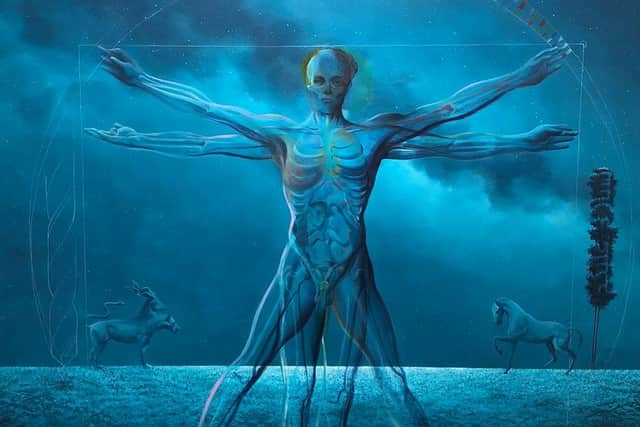
“It's called the Vitruvian, not the Vitruvian Man,” he explains.
Along with that, his painting draws on thematic images used previously by the Clara-born painter, including animals, the inside of the human body and ancient mythology.
Different scientific approaches to tackling cancer are represented by a chimera, which incorporates the head of a lion, the head of a goat and the tail of a snake.
In the Vitruvian, the chimera can be interpreted as a form which is about to do battle with the other animal in the picture, the horse of death, an image which featured in Devine's portrait of the cancer campaigner Vicky Phelan.
The artist became involved with the Conway Institute when he brought the Vicky Phelan portrait to UCD and met Professor Liam Gallagher, an expert in cancer biology.
Professor Gallagher mentioned that funding was available for an artwork which would attempt to illustrate the work of the research team at the Conway Institute.
Vincent was then commissioned to create the painting and he set about intensive research, conducting interviews with 15 scientists at the institute.
“Liam is a visual thinker as well and the two of us were bouncing ideas around,” he said.
The painter had full access to the institute lab and was excited to discover that imaging was a key component of the work being done there.
“I could see all these different things and I said to myself that would be really cool as a painting, as a symbol here. I was lighting up.”
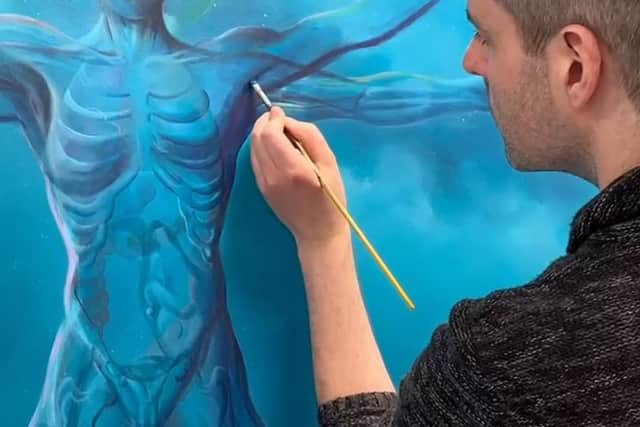
“Liam said he wanted the painting to show something on how cancer affects the whole body, at tissue level, cellular level and molecular level. I want to show all the different levels,” says Vincent. “That's no small task.”
He sees the painting as a way of breaking down the barriers which prevent people from engaging in both science and art.
He selected the image of the Vitruvian Man as the inspirational centrepiece because it is a well known drawing by arguably the most famous artist in history.
Much of the work in cancer research is focussed on tracking how cancer spreads throughout the body and one aim of the painting is to reflect that scientific reality.
“Cancer's thing is it disrespects boundaries and it deregulates the whole body,” adds Vincent.
“This is what we're trying to highlight. It's all about what [cancer] does in the body and how we're trying to get ahead of it.”
The Conway Institute researchers have reviewed the painting and Vincent was relieved to learn they were happy with it.
“There's a huge avenue to create a kind of a visual language in the science field. It's like a diagram. Any of the researchers can stand in front of that painting and show how the cancer moves through the body if it's not detected and not treated.”
The Vitruvian is owned by UCD and will be permanently displayed there but the painter hopes it will go on tour and be exhibited in Esker Arts Tullamore, along with his own gallery.
“The idea is to bring this around and raise awareness [among] people who feel they don't know enough about cancer research. Because obviously a lot of money goes in and is fundraised for cancer research and people are always asking where is the money going? This tries to show them the work that is happening in Conway.”