
Offaly farmland is unusable after very wet July

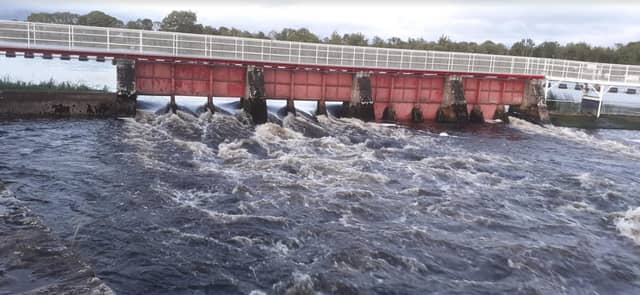

A LOCAL group says that large areas of farmland in Offaly are now unusable following a very wet July.
Save Our Shannon Organisation (SOSO) told the Midland Tribune that after one of the wettest Julys ever a lot of farmers are unable to cut their land for hay and silage. SOSO believes that this situation could have been averted if the Shannon was being properly managed by the government.
“Once again there's severe flooding during the summer,” commented Liam Broderick PRO of SOSO. “Once again flood waters are spread over the Shannon Callows from Athlone down to Meelick. It seems they are at a higher level above Banagher Bridge towards Shannonbridge (particularly in the Clonfert area) and above the bridge in Shannonbridge (particularly in the Clonmacnoise and Clonown Callows).”
Liam pointed out that it has been raining incessantly for four weeks with the result that no meadow has been cut in any part of the Shannon Callows. He said farmers now consider that this crop of hay is lost and it's unlikely that any of it can be salvaged.
“The Save Our Shannon Organisation,” he continued, “have been calling for years now, ever since the major flooding periods of November 2009, January 2015, and February 2020 for three actions by those in charge of the Shannon.”
The first of these actions includes the establishment of a single governing authority over the Shannon. Nothing has happened. There are several governing authorities with responsibility for the river including the ESB, the NPWS, the OPW, Waterways Ireland, Inland Fisheries, and the County Councils. The most important of these are the ESB, the OPW and Waterways Ireland. The ESB operates Ardnacrusha Generating Station, and Waterways Ireland is responsible for maintaining the river levels at a certain depth to enable vessel navigation.
The second action includes the removal of a number of pinchpoints in order to improve the conveyancing of water in the Callows region. A few years ago the Minister of State with responsibility for the OPW, Kevin Boxer Moran, announced that his plan was to remove ten of the pinchpoints along the river. One substantial pinchpoint was removed in the Lusmagh area and a small bit of another pinchpoint was also removed, but the other eight pinchpoints were never tackled.
SOSO has also been advocating for years for the lowering of the three major lakes on the Shannon during the summer so that there would be some storage area for flood waters as they rise. They have also been calling for the opening of the gates/sluices in Athlone and Meelick in time, prior to a serious fall of rain. Once again, they say, this hasn't happened.
“On Friday July 14th,” continued Liam, “we visited Meelick and saw that five of the 12 sluice gates were still shut, in spite of the heavy rainfall. The next day our secretary Emily Young contacted all the TDs in the region and told them about the problem. Some didn't reply. One of them however did contact Waterways Ireland and got all 12 sluice gates in Meelick open. This was happening at a time when Met Eireann had been issuing warnings, almost every day the previous week, concerning constant rain and the dangers of spot flooding.
“On the 15th of July, as the flood waters in the Shannon had been rising for over a week, the water levels in Lough Allen were 0.60metres above the summer level and below Athlone weir heading towards Shannonbridge the water level was 0.72metres above the summer level. We believe that Loughs Derg, Ree and Allen should be lowered by a metre during the months of April and May so that there is sufficient storage during wet summers. This would also benefit the biodiversity of the region. The corncrake no longer exists in the Callows because its nests were destroyed by summer flooding; and the curlew is also struggling due to the higher than usual water levels.”
The PRO pointed out that while flood walls have been constructed in Athlone and a Bund in Banagher, since November 2009 nothing has been done to help the rural areas of the Shannon Callows. He wondered if the government considers “the flooding of good farmland and farm buildings to be an integral part of rewetting our bogs?”
In August 2021 Minister Patrick O'Donovan visited the region and said €7 million would be made available “to implement a programme of strategic maintenance upstream of Ardnacrusha to assist with mitigating flooding and the removal of a number of ‘pinch points’ through the Shannon Callows that can help to delay flooding in the area.” SOSO says that since then nothing has happened.
SOSO's PRO said that if farmers can't harvest their hay and silage then there will be a fodder crisis. "The last time we had a fodder crisis was in February 2020," he said, "and it's a bad state of affairs."