
OPINION (AN COLÚN): A Crinkill mural, Shinrone graveyard and Cloughjordan castle


THE Offaly Heritage Seminar was held in Birr over the weekend and on Saturday two busloads visited the Birr Barracks Mural in Crinkill, Kilcomin medieval church near Shinrone and Emmel Castle near Cloughjordan. Amanda Pedlow, Heritage Officer, and Rachel McKenna, County Architect, efficiently and good humouredly, oversaw things and the events ran along smoothly.
Brendan Cooke, on a bitterly cold morning, at 10 o'clock, met us at the Birr Barracks Mural. It was Brendan's idea to create the mural. "I raised it regularly for three years until it eventually got done this year," he told us. It's a magnificent mural which has added immeasureably to that part of Crinkill. The work was painted by Nik Purdy from Blowdesigns in Sligo and it depicts the Barracks during the time of the British Empire and the final Leinster Regiment soldiers marching down the street having left the Barracks for the very last time. Brendan said the mural serves an educational purpose. "There are some people who don't realise the connection with the old walls surrounding Grant's and the Leinster Regiment Barracks which existed here until 1922." Brendan said it was very important to point out that a lot of the soldiers in the Regiment were from the midlands region. "They didn't join the British Army because of a love of the Empire," he commented. "For a lot of Irish men it was about finding employment during hard times; it was about putting bread on the table." Brendan said it was perfectly ok and reasonable for people to be upset by the history but it wasn't ok to simply whitewash it. He said he was really glad to report that he hasn't received any negative comments about the mural (negative in a political sense) and nor has any member of Crinkill Tidy Villages.
After this our bus took us to Kilcomin Graveyard a couple of miles outside Shinrone. Here we could see the fantastic restoration of the medieval church which is taking place and the clean-up of the site by the local committee. Stephen Callaghan, who did a very thorough study of Offaly's graveyards for Offaly County Council a couple of years ago, told us he was very impressed with the renovation work. "A few years ago you wouldn't have known there was the remains of a church at all because it was covered by a massive amount of foliage." He said a monastery was founded here by St Cuimín in the 7th Century. He pointed out a coffin rest on the wall, informing us that it was considered bad luck to rest the coffin on the ground. He said an ancient ecclesiastical bell was found near here in the 19th Century, and it now resides in the British Museum. The headstones in Kilcomin go back to the 1640s; one of them is of a Cromwellian planter (Joshua Smith, who owned a large house in the townland of Glasshouse. Water from a depression in the slab that covers Smith's grave is said to cure warts.) One of the headstones was magnificently decorated with an angel and sunburst representing unbreakable optimism and life after death. There's a Lonely Man's Corner in the graveyard. When vagrants or vagabonds who wandered the countryside looking for work died in the parish, they were interred in this lonely place.
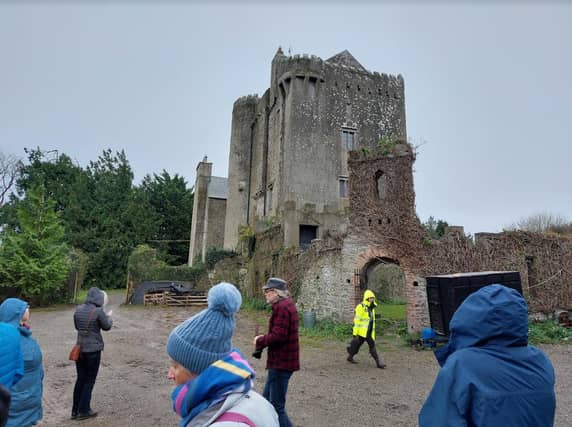
After this we drove to Emmel Castle near Cloughjordan where we were warmly welcomed by the famous Hollywood actor Patrick Bergin and his partner Helen. Local man Seamus Costello was on hand to tell us the history and point out the features of this elegant, impressive building, which is one of Offaly's heritage gems. Rachel McKenna told us that a lot of vital restoration work has been carried out on the castle since 2020. Seamus told us a terrible battle was fought near here called The Battle of the Bloody Togher. He said Templeharry Church, where the link with Obama was identified, is nearby. Emmel was an O'Carroll castle and there were many skirmishes between the O'Carrolls and the neighbouring O'Kennedy clan. The original Castle remains in excellent condition. It's attached to an attractive late 17th Century house. The Stoney family moved in in the early 18th Century. Seamus said the Stoney family "went broke feeding people during the Famine."
Inside, you can see where the entrance to the old tower house once stood, guarded by a couple of holes through which you could fire missiles at people. Unusually, the narrow winding stair ascending up the tower house is not stone, but oak. This perhaps dates from the 1600s and it's believed that it's the only one of its kind in Ireland.
Patrick told us that an eccentric master of the local foxhunt lived here in the 1960s and '70s, called Dalgety. The hounds were kept in the outhouses. Dalgety said that when he died he wanted his body to be cremated and fed to the hounds. At the time cremation was not allowed in Ireland. Therefore he was cremated in England, the ashes were brought back, mixed with the hound food and fed to the pack. Patrick pointed at a bugle hanging on the wall and said it was one of Dalgety's hunting horns. He said a hunting horn can be heard blowing in the area every halloween and it's a mystery who is blowing it. He added that the ghost of one of the O'Carrolls still walks the upstairs rooms from time to time.