
OPINION (AN COLÚN): Following a trail of tears to the Shannon


ON SUNDAY MORNING I joined about thirty other history enthusiasts to follow in the footsteps of the O'Sullivan Beara clan as they marched northwards during the dreadful winter of 1603, when we walked a few miles to the banks of the Shannon.
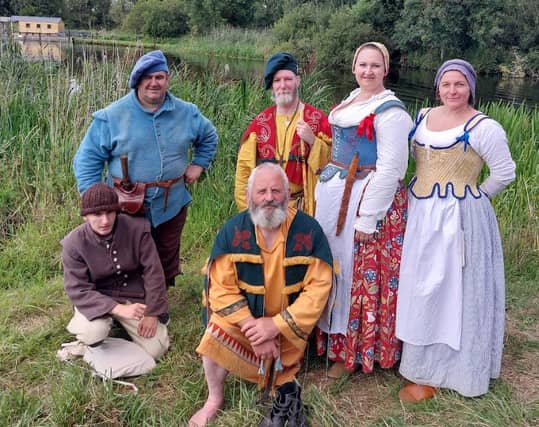
The event was hosted by James Heenan and the Lorrha & Dorrha Historical Society. Six members of the O Sullivan Beare Living History Group were in attendance, attired in authentic costumes from the early 1600s. Conchobhar Ó Súilleabháin (Con O'Sullivan) and his group expertly brought the story of O'Sullivan Beare and his epic journey to life.
On arriving at the Shannon, one of the re-enactors, Sonia Dowds, had in her hands a bouquet of flowers tied with a harvest knot and a stone from Dunboy Castle (which used to be the O'Sullivan Beare Stronghold). Sonia handed the bouquet to local man Reuben Ecyon who entered the water and swam out into the middle of the river. He then let the offering drift away on the current, a tribute to O'Sullivan Beare and those who died on the epic march over four hundred years ago.
Con O'Sullivan spoke about the march and showed himself to be an expert on the period. He discussed the clothes he was wearing, which imitated the clothes the Irish wore in the early 1600s. This included a saffron Léine (a long, baggy-sleeved shirt), wound round with a Crios (a belt, which was worn in Ireland up to the 1980s), a red Seaicéad over the Léine. The Seaicéad barely reached the waist and had a number of woven symbols on it including oak leaves and hounds. On his legs were Triús. Some went in bare feet, not because they were poor but because it offered greater traction and stability when fighting.
Con told us a little bit about Donal Cam, the Chieftain of the O'Sullivan Beara clan in 1603. By inclination he wasn't a soldier. Rather, he inclined towards things of the heart and mind such as poetry and music. However, forced by dire circumstances into being a soldier he proved himself to be an extremely capable one. In fact, there was the touch of a military genius about him (as shown by the fact he won a number of battles despite being severely outnumbered).
Con compared the march northwards by a thousand members of the clan, during a two week period in January 1603, to other epic events of suffering, resilience and endurance during human history, such as the Battle of Thermopylae; the March of ten thousand Greeks in Persia; and the Trail of Tears undertaken by the Cherokee nation. The O'Sullivan Beara march, Con believed, was Ireland's equivalent to the Cherokee Trail of Tears.
James Heenan said the nature of the Shannon would have been different in 1603. It was before the Ardnacrusha Dam and the water would have been shallower and about half a kilometre wide. “This spot is called White's Ford, Ballymacegan,” he said, “and is the most probable spot for the crossing.” All the boats had been withdrawn at the order of Donogh MacEgan, and the ferrymen were warned “under the severest penalties” not to carry O'Sullivan over. White's Ford was not far from Redwood Castle and was probably the most attractive spot for a crossing. The bank of the river was a sprawling marsh. Behind the marsh it was heavily wooded. The clan went to ground in a clearing on January 7th, digging a defensive trench and building a barrier of felled trees. Boat building started. Horses were killed and skinned. The skins were stretched over willow frames. Ten O'Malleys, who were taking part in the march, got into a coracle (something like a rather unstable egg basket) and drowned in the middle of the river. The others crossed safely in a currach. Landing on the Galway side they were attacked by hostile locals (the O'Madden clan) and beat them back with musket fire. They were also attacked by the MacEgan clan on the Tipperary bank. Donogh MacEgan and his men killed horseboys and drove “the terror-stricken women into the river”. Forty O'Sullivan Beare soldiers lying in hiding now attacked the MacEgans and killed fifteen of them, including Donogh, who was beheaded.
After successfully crossing the Shannon the west Cork men shortly afterwards plundered a local village, where they feasted on raw beans and grain, washed down with ale. It was only a brief respite. Some very testing days during their odyssey of endurance still lay ahead (including a battle at Aughrim, during which they defeated the English despite being outnumbered four to one).
Con O'Sullivan said the group will walk the whole route, in period costume, from west Cork to Leitrim next year. He said a major and very important feature of the route is the local communities. “We have found the local communities along the route to be wonderful, including of course the community in this part of North Tipperary.” Con said he is very interested in gathering the stories and folklore of the local areas along the route.