
AI in connected cars can ease rush hour congestion, study shows
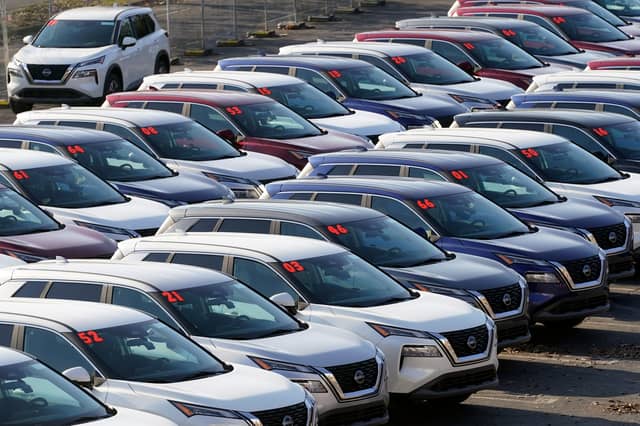

US researchers said they have successfully used artificial intelligence (AI) in a group of wirelessly connected cars to help ease rush hour traffic on a major road.
During an experiment in Nashville, Tennessee, 100 test cars sent traffic information back and forth on the Interstate 24 route (I-24).
Their adaptive cruise control was modified to react to the overall flow of traffic using AI, in a bid to reduce so-called “phantom” traffic jams with no obvious cause.
Researchers are still examining the data, but say the experiment was a success. In addition to easing driver frustration, less stop-and-go driving means fuel savings and less pollution.
Japanese researchers put about 20 human drivers on a circular track and asked them to drive at a constant speed.
Before long, traffic went from a smooth flow to a series of stops and starts.
Prof Work said: “Phantom traffic jams are created by drivers like you and me.”
He explained that if one person taps the brakes, for whatever reason, then the person behind them takes a second to respond and has to brake even harder. Then, the next person has to brake even harder. The wave of braking continues until many cars are at a standstill.
“We know that one car braking suddenly can have a huge impact,” Prof Work said.
The experiment showed that a few cars driving slowly and steadily could have an impact as well – for the better.
The experiment utilised 100 cars that travelled in loops on a 15-mile section of I-24 from about 6am to 9.45am each morning.
Working on the premise that if 5% of the cars on the road were acting together, they could lessen the prevalence of phantom traffic jams, the researchers equipped those 100 cars to communicate wirelessly, sending traffic information back and forth.
They also took advantage of the adaptive cruise control that is already an option on many new vehicles.
In the experiment, the adaptive cruise control was modified to react to the overall traffic flow – including what was happening far ahead – using AI.
The cars’ decision-making occurred on two levels, Prof Work said. At the cloud level, information about traffic conditions was used to create an overall speed plan. That plan was then broadcast to the cars, which used AI algorithms to determine the best action to take.
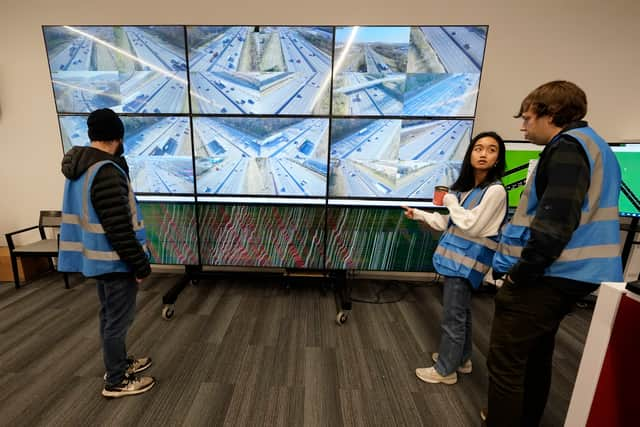
The researchers were able to evaluate the effect the connected cars had on morning traffic flow using a special four-mile stretch of I-24 outfitted with 300 pole-mounted sensors.
The experiment is a project of the Circles consortium, a group that includes several car makers and the US Energy and Transportation departments. Other lead researchers are based at the University of California, Berkeley; Temple University; and Rutgers University-Camden.
Liam Pedersen is deputy general manager for research at Nissan, a Circles consortium partner who was in Nashville last week for the experiment. He said one of the exciting things about it is that it builds on technology that is already in many new cars.
“This is not autonomous driving,” he said. “This is something we could realise very soon.”